Stock Analysis · Buckle Inc (BKE)
Overview
Buckle Inc. is a U.S. specialty apparel retailer focused on casual clothing, footwear, and accessories. The company sells a mix of its own private-label products and well-known third-party brands, with an emphasis on denim and related lifestyle apparel. Buckle primarily operates through its physical store base and also sells directly to customers online through its e-commerce channel.
In simple terms, Buckle makes money by buying (or producing) apparel and accessories, then selling them at retail prices. Like most retailers, its results depend heavily on customer demand, product selection, inventory management (having the right items at the right time), and the ability to maintain healthy pricing without relying too much on discounting.
Buckle reports revenue as net sales and does not typically break out public revenue percentages by product category in the same way some larger retailers do. Its main sources of revenue are therefore best understood by channel:
- Retail store sales (in-person purchases at Buckle stores)
- E-commerce sales (online purchases shipped to customers)
Buckle’s recent financial pattern shows a business that has remained profitable, with sales and earnings moving up and down with consumer spending cycles. Over the last several fiscal years, total revenue has fluctuated around the low single-digit billions, while profitability has stayed relatively strong for an apparel retailer.
From the income-flow view (FY2022 to FY2026), total revenue moved from about $1.29B (FY2022) to about $1.30B (FY2026). Over the same period, net income declined from roughly $255M to about $210M, reflecting pressure on operating profit even as revenue recovered in the most recent year shown.
Key Figures
| Metric | Value | Industry ⓘ |
|---|---|---|
| Date | Mar 17, 2026 | |
| Context | ||
| Sector | Consumer Cyclical | |
| Industry | Apparel Retail | |
| Market Cap ⓘ | $2.52B | |
| Beta ⓘ | 1.09 | |
| Fundamental | ||
| P/E Ratio ⓘ | 12.06 | 14.92 |
| Profit Margin ⓘ | 16.16% | 8.32% |
| Revenue Growth ⓘ | 5.30% | 8.15% |
| Debt to Equity ⓘ | 90.39% | 96.42% |
| PEG ⓘ | 3.32 | |
| Free Cash Flow ⓘ | $215.31M | |
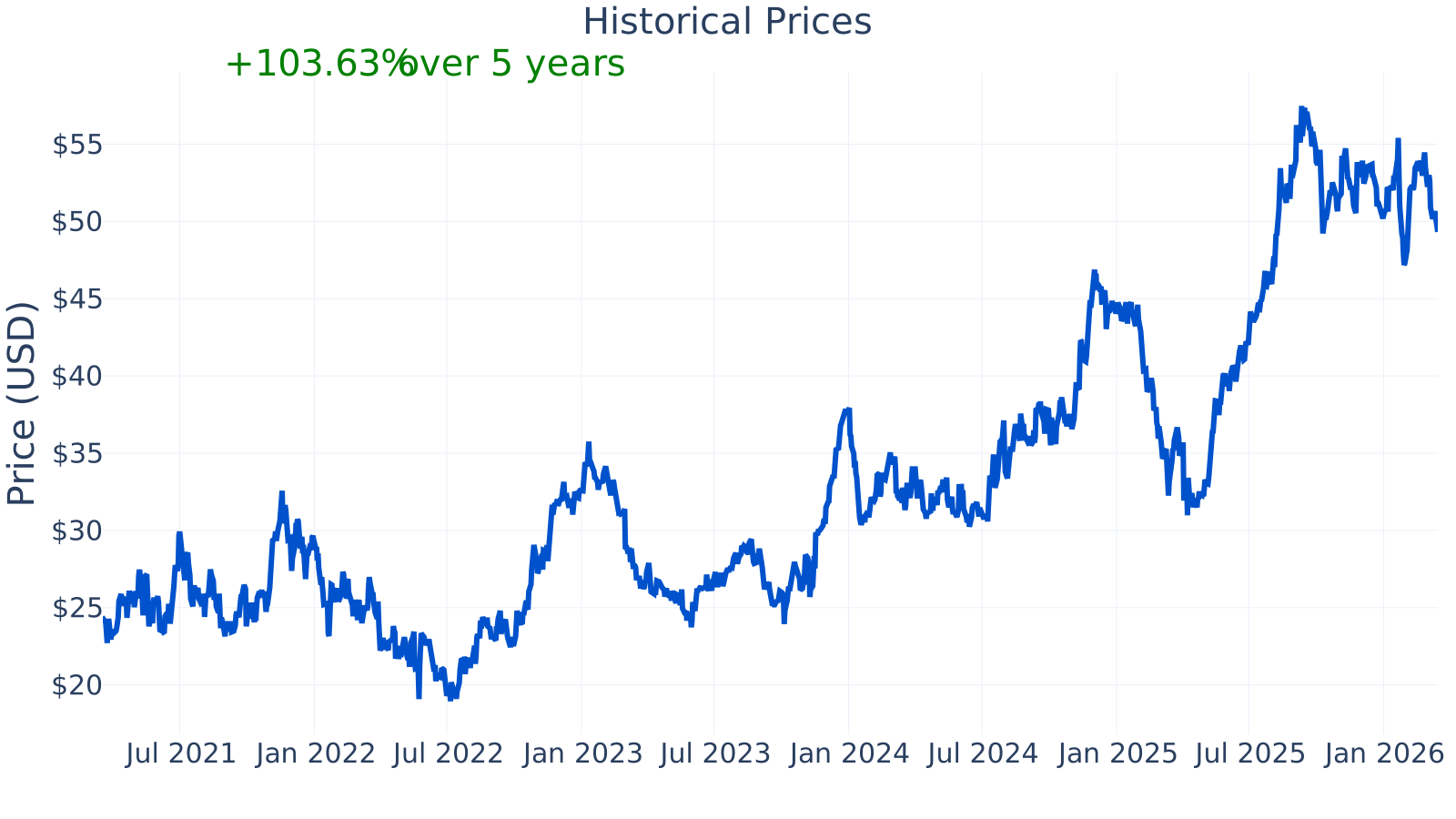
Buckle’s market capitalization is about $2.52B, placing it in the small-to-mid-size public company range. The stock’s beta of ~1.09 suggests price moves that have been roughly in line with the broader market historically.
Profitability stands out: the latest profit margin is ~16.2%, compared with an industry median of about 8.3%. Growth is more moderate: the latest year-over-year revenue growth is ~5.3%, below the industry median of about 8.2%. Buckle also shows meaningful cash generation, with about $215M in free cash flow over the last twelve months (TTM).
Growth (Low to Medium)
Apparel retail is generally a mature, highly competitive industry. Long-term growth tends to come less from overall market expansion and more from gaining market share, improving merchandising, strengthening brand loyalty, and building better digital capabilities. Consumer demand is also cyclical: sales often rise and fall with confidence, employment conditions, and discretionary income.
For Buckle specifically, the near-term growth picture has been uneven. Year-over-year revenue growth was very strong earlier in the period shown (which can happen when comparing against unusually weak prior-year results), then turned negative for multiple quarters, and more recently returned to positive territory.
In the most recent point shown, revenue growth is about 5.3% year over year. That is positive, but it also indicates that Buckle’s growth rate may not consistently outpace peers in an industry where consumer tastes and promotional activity can shift quickly.
Cash flow can be an important support for long-term resilience in retail, especially during weaker demand periods. Buckle has continued to produce substantial free cash flow over time, although it has trended down from the earlier peak shown.
Free cash flow was about $293M (FY2022) and about $215M (TTM). This suggests the business still generates cash at a meaningful level, even if the amount has become lower than a few years ago.
Potential catalysts typically come from company-driven execution rather than a rapidly expanding end market. Examples include better product assortments, improved inventory positioning, higher conversion online, and maintaining strong merchandise margins despite industry-wide discounting. Because apparel demand can change quickly, sustained growth usually requires consistent merchandising success across multiple seasons.
Risks (Medium to High)
The biggest risk for Buckle is that apparel retail is structurally competitive and promotion-heavy. Many retailers sell similar categories (especially denim and casualwear), and consumers can switch brands easily. This can pressure pricing, force markdowns, and lead to volatile quarterly results.
Another important risk is fashion and merchandising execution. If product selections miss trends or inventory arrives at the wrong time, retailers often resort to discounting, which can compress margins even if sales volumes hold up. Buckle’s profitability has remained relatively strong versus peers, but its margin has gradually declined from earlier highs in the period shown.
Buckle’s profit margin is currently about 16.2%. While that is roughly double the industry median (about 8.3%), the longer view shows a drift down from around 19–20% earlier in the period. That kind of margin compression can matter because small changes in retail margins can have an outsized impact on earnings.
Balance-sheet risk is another consideration. Retailers often use lease obligations for store locations, and some also use debt. A simple way to gauge leverage is debt-to-equity.
Buckle’s latest debt-to-equity is about 90%, slightly below the industry median near 96%. Historically, it has often been below the industry median, though it has moved around over time. This points to leverage that is not obviously extreme versus peers, but still meaningful enough that operating performance and cash flow discipline remain important.
On competitive advantages, Buckle is not the clear category leader in U.S. apparel retail by scale; it competes with many larger chains and online-first platforms. Its advantages are more practical than structural: established store presence, customer familiarity in its target segments, and historically strong profitability compared with many apparel retailers. The main competitive challenge is that larger rivals can often invest more heavily in marketing, technology, and supply chain, while fast-fashion and online-focused competitors can react quickly to trends.
Main competitor groups include:
- Specialty apparel retailers focused on similar demographics and casualwear/denim
- Department stores and big-box retailers that sell overlapping categories
- Online-first apparel sellers competing on convenience and assortment
Because the market is crowded and consumer preferences shift quickly, Buckle’s results can vary significantly based on execution and the broader consumer spending environment.
Valuation
One common valuation yardstick is the price-to-earnings ratio (P/E), which compares the stock price to the company’s earnings. Buckle’s latest P/E is about 12.1, below the industry median near 14.9. Over the period shown, Buckle’s P/E has often been below the industry median, although it has risen at times (reaching the mid-teens at one point) as the stock price changed and earnings moved through cycles.
Interpreting valuation in context matters. A lower P/E can reflect the market expecting slower growth, more volatile earnings, or higher business risk. In Buckle’s case, the valuation level sits alongside (1) strong profitability versus many peers, (2) moderate and somewhat inconsistent revenue growth, and (3) the normal cyclicality and competitive intensity of apparel retail. The company’s PEG ratio (~3.32) also signals that, relative to typical growth expectations, the P/E may not look low once growth is considered.
Conclusion
Buckle is a specialty apparel retailer with a long-standing store-based model supported by e-commerce. The company has shown an ability to remain profitable through varying retail conditions, with profit margins that are meaningfully higher than the industry median and ongoing free cash flow generation.
At the same time, the business operates in a mature, intensely competitive industry where sales and margins can shift quickly due to consumer demand, promotions, and fashion cycles. Recent results show revenue returning to modest growth, while profitability—though still strong—has trended below earlier highs.
On valuation, Buckle trades at a P/E below the industry median in the figures shown, which aligns with a business profile that combines solid current profitability with moderate and uneven growth characteristics and typical apparel retail risks.
Sources:
- U.S. SEC EDGAR — Buckle, Inc. filings (Form 10-K, Form 10-Q)
- Buckle, Inc. Investor Relations — Company reports and shareholder materials (as publicly posted by the company)
- Wikipedia — “Buckle (company)” (basic company background)
This article is for informational purposes only and does not constitute financial advice. Some content is AI-generated. See Disclaimer


