Stock Analysis · Brunswick Corporation (BC)
Overview
Brunswick Corporation is a manufacturer focused on the recreational boating market. It designs and sells boats and boat engines, and it also participates in parts, accessories, and services that support boat ownership. In simple terms, the company aims to earn money not only when a customer buys a boat or an engine, but also through products and services used over the lifetime of boating.
In its SEC filings, Brunswick describes its business through operating segments that typically map to: (1) propulsion (marine engines), (2) boat manufacturing, and (3) parts/accessories/services (aftermarket and distribution). These categories matter because they behave differently across the economic cycle: boat sales are usually more sensitive to consumer confidence and interest rates, while recurring parts and service demand can be steadier.
Main revenue streams are generally organized around these activities (largest-to-smallest mix can shift by year with the cycle):
- Propulsion (marine engines and related systems)
- Boat (recreational boats sold through dealer networks)
- Parts & Accessories / Services (replacement parts, accessories, distribution, and other boating-related offerings)
From a profitability lens, the company’s results in recent years show how quickly the boating cycle can change. Total revenue rose from about $5.85B (2021) to $6.81B (2022), then eased to $6.40B (2023), declined to $5.24B (2024), and recovered to $5.36B (2025). Net income moved from profits in 2021–2024 to a loss in 2025, highlighting how margins can compress when demand slows or costs rise.
Across 2021–2025, revenue and operating profit declined from the 2022 peak, and 2025 shows a meaningful deterioration in operating income (turning negative) and net income (a loss). Interest expense stayed material (roughly $66M in 2021 vs. about $112M in 2023 and about $112M in 2025), which can matter more when operating profit is under pressure.
Key Figures
| Metric | Value | Industry ⓘ |
|---|---|---|
| Date | May 04, 2026 | |
| Context | ||
| Sector | Consumer Cyclical | |
| Industry | Recreational Vehicles | |
| Market Cap ⓘ | $5.17B | |
| Beta ⓘ | 1.38 | |
| Fundamental | ||
| P/E Ratio ⓘ | N/A | 16.13 |
| Profit Margin ⓘ | -2.47% | 3.22% |
| Revenue Growth ⓘ | 12.80% | 8.35% |
| Debt to Equity ⓘ | 8.90% | 64.75% |
| PEG ⓘ | 0.65 | |
| Free Cash Flow ⓘ | $340.50M | |
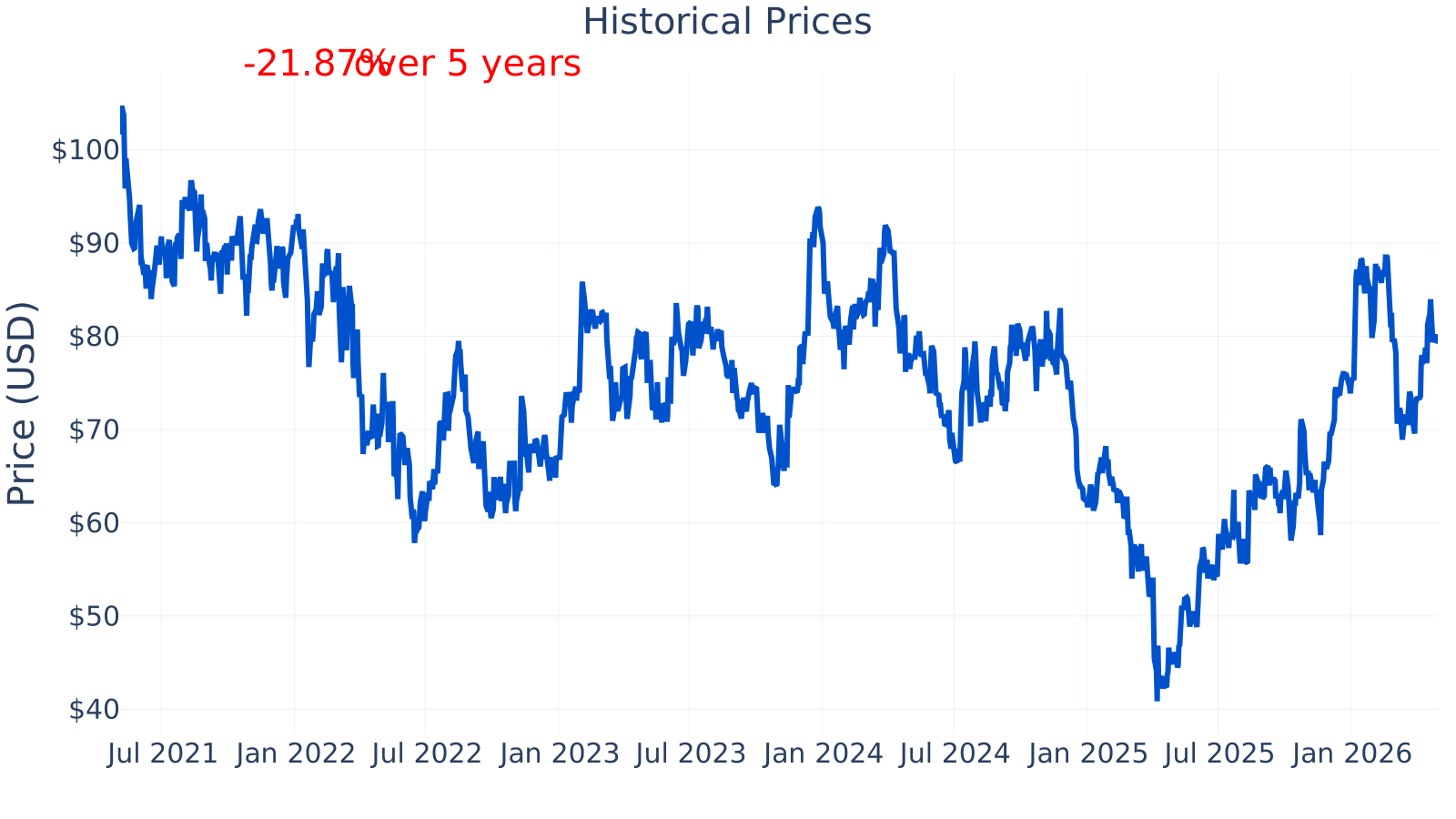
Brunswick’s market capitalization is about $5.17B. The stock’s beta of ~1.38 indicates it has tended to move more than the overall market, consistent with a consumer-cyclical business. The latest profit margin is about -2.47%, below the industry median of about 3.22%, reflecting a period of weak profitability. At the same time, the latest revenue growth (YoY) is about 12.8%, above the industry median (~8.35%), suggesting a near-term rebound in sales. Leverage appears modest on this snapshot, with debt-to-equity around 8.9% versus an industry median around 64.8%. Trailing twelve-month free cash flow is about $340.5M, which is important because it represents cash potentially available for debt reduction, reinvestment, or shareholder returns (depending on company decisions and conditions).
Growth (Medium)
Brunswick operates in recreational boating, a market that tends to be cyclical: demand can rise strongly when consumers feel confident and financing is easy, and slow when interest rates rise or discretionary spending tightens. For long-term growth, the key question is less about boating being a “fast-growing” necessity category and more about how the company positions itself across the cycle—particularly by balancing new boat/engine sales with recurring, service-like revenue from parts and accessories.
A strategy that can support longer-term durability is expanding the “lifetime” relationship with boaters (engines, parts, upgrades, maintenance-related categories, and distribution). This does not remove cyclicality, but it can help reduce reliance on new unit sales alone. Another structural support is innovation in propulsion and onboard systems, because technology upgrades can drive replacement and premiumization over time (even when total boat unit demand is uneven).
The year-over-year revenue growth pattern shows the cyclicality clearly: very strong growth in 2021, moderating in 2022, then a multi-quarter contraction through much of 2023–2024, followed by a return to positive growth in late 2025 and early 2026 (about +12.8% most recently). This suggests stabilization and rebound in the top line, though it does not by itself confirm a full recovery in profitability.
Free cash flow has been positive and fairly substantial over the last several years shown, rising from about $98.7M (2022-03-31) to the $331–$406M range (2023–2025), and about $340.5M most recently. Consistent free cash flow can provide flexibility during downcycles, but it is still important to compare it with profitability trends and working-capital swings typical in manufacturing businesses.
Risks (High)
The main risk is that Brunswick is exposed to discretionary consumer spending and financing conditions. Boats and related equipment are high-ticket items for many households, so demand often weakens when interest rates are higher, credit is tighter, or consumer confidence falls. Dealer inventory levels also matter: if dealers are overstocked, new orders can slow abruptly even if end-consumer interest is stable.
Another key risk is margin volatility. Input costs, promotions/discounting needed to clear inventory, and production utilization can change quickly. That matters because a relatively small drop in pricing power or volume can have an outsized effect on profit, as fixed manufacturing costs become harder to absorb.
Profit margin has fallen steadily from roughly 10%+ in 2021 toward low single digits in 2024, and it turned negative in late 2025 and remained negative most recently (about -2.47%). Over the same period, the industry median stayed positive. This gap suggests company-specific and/or mix/cycle pressures that have recently been more severe than typical peers.
Financial risk often shows up through leverage and interest costs. Even when debt levels are manageable, interest expense becomes more burdensome when operating income is weak.
On the latest point shown, debt-to-equity is about 8.9%, lower than the industry median (~38.7% on the latest point and ~64.8% in the latest table). However, the series also shows meaningful fluctuations over time, with periods where the ratio was far higher than today. This indicates capital structure and equity levels can shift, and leverage should be interpreted alongside cash flow, profitability, and balance sheet details in the most recent filings.
Competitive pressure is also relevant. Brunswick competes with other marine manufacturers across boats, engines, and aftermarket products. Competition can play out through pricing, dealer relationships, brand strength, product innovation, and reliability/service networks. In propulsion and boats, Brunswick is often discussed as one of the larger diversified participants, but it still competes with specialized engine makers and boat brands, and market share can shift with product cycles. A practical competitive advantage for a diversified player can be breadth (boats + engines + parts) and distribution reach, though those advantages are most valuable when the company maintains strong product quality and brand demand.
Valuation
The P/E ratio history highlights an important limitation of simple valuation tools for cyclical companies: when earnings fall sharply (or turn negative), the P/E can spike or become not meaningful. Earlier in the period shown, Brunswick often traded in the roughly 7x–19x range, sometimes close to the industry median. In 2025, the P/E rose sharply (including very high values) and then becomes not meaningful in the most recent points displayed as 0 on the chart, consistent with earnings pressure and losses.
Given the latest negative profit margin, valuation based on earnings alone can be hard to interpret. In such situations, investors often look more at balance sheet strength, cash generation, and whether margins appear to be recovering. Brunswick’s positive free cash flow provides useful context, but the gap between cash flow and profitability can vary due to working capital movements and other timing effects, so the details in the latest SEC filings typically matter for a full interpretation.
Conclusion
Brunswick is a well-established participant in recreational boating with multiple revenue pillars spanning boats, propulsion, and parts/accessories/services. The business is inherently cyclical, and recent results show that clearly: revenue has started to re-accelerate after a downturn, but profitability has deteriorated to a loss-level margin in the most recent period shown.
From a long-term perspective, the most decision-relevant facts to track are whether margins normalize as demand stabilizes, how resilient cash generation remains through the cycle, and whether the company’s breadth across engines, boats, and aftermarket categories translates into steadier earnings over time. The current valuation picture is less straightforward using P/E due to depressed earnings, so interpretation depends heavily on whether profitability recovers and on what the latest filings indicate about demand, dealer inventories, and cost structure.
Sources:
- SEC EDGAR — Brunswick Corporation Forms 10-K and 10-Q (Annual and Quarterly Reports)
- Brunswick Corporation Investor Relations — SEC Filings and Investor Materials
- Wikipedia — “Brunswick Corporation” (general background only)
This article is for informational purposes only and does not constitute financial advice. Some content is AI-generated. See Disclaimer


