Stock Analysis · Boyd Gaming Corporation (BYD)
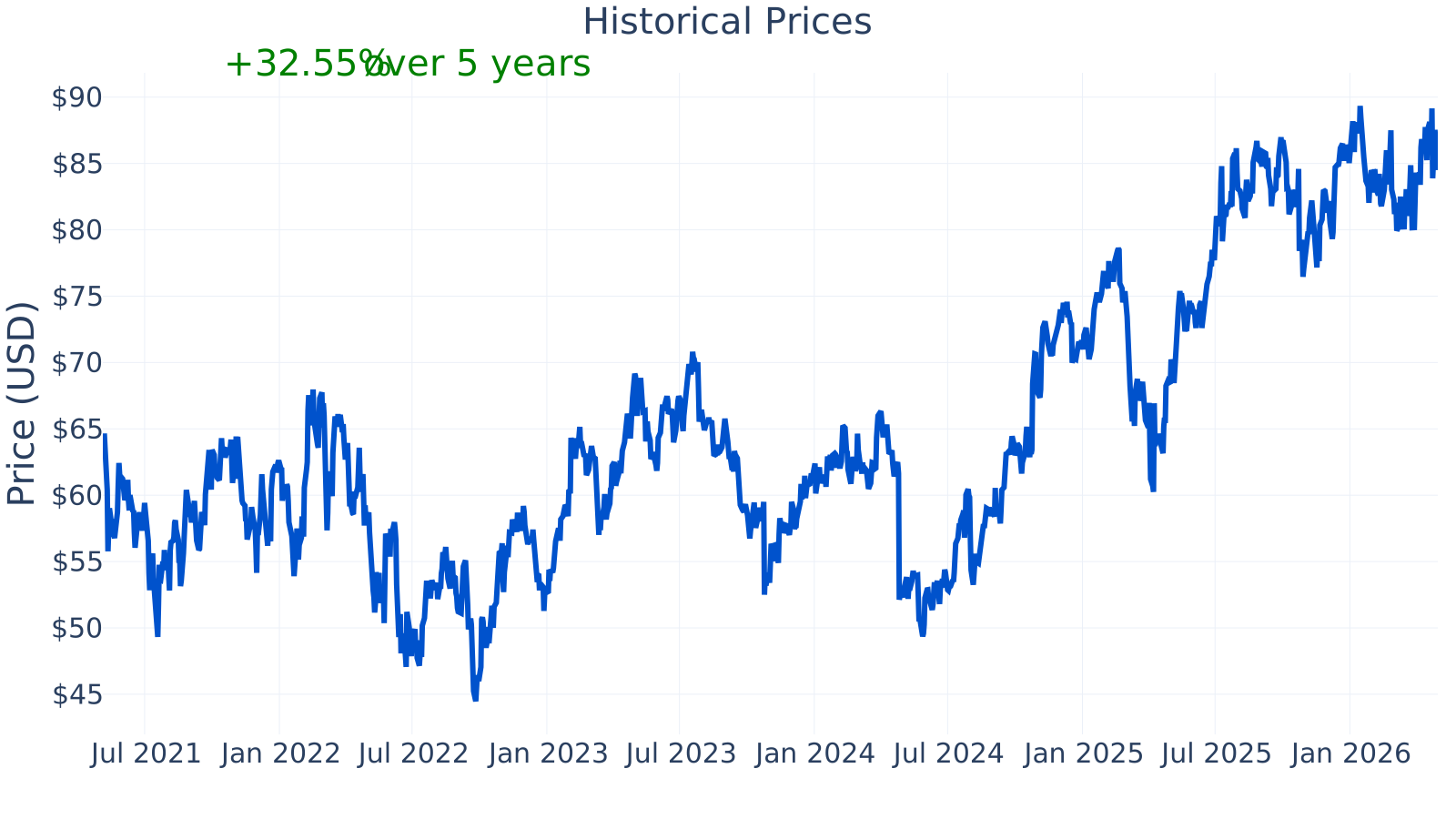
Overview
Boyd Gaming Corporation is a U.S. gaming and entertainment company. It owns and operates casino properties that combine slot machines and table games with hotel rooms, food and beverage, and other on-site entertainment. The business is primarily focused on “locals” casinos in Las Vegas and on regional drive-to markets across multiple states, with an additional online component through its interactive gaming activities.
In simple terms, Boyd generally earns money when guests:
- Gamble (slot machines and table games)
- Stay and spend on-property (hotel, restaurants, bars, entertainment, and other amenities)
- Use online offerings where available and legal (interactive gaming)
Public filings typically break results into operating segments (Las Vegas Locals, Downtown Las Vegas, Midwest & South, and Online). The exact percentage mix by revenue varies over time and is best read directly from the latest annual report segment footnote; the overall pattern is that gaming operations are the largest driver, with non-gaming spend (rooms and food & beverage) as an important supporting contributor.
Across the 2021–2025 period shown, total revenue increased from about $3.37B (2021) to about $4.09B (2025). Operating income is shown as materially higher in 2025 than prior years, which suggests that results in that year included items that are not purely “run-rate” operating performance (for example, one-time gains, accounting impacts, or other non-recurring factors). For long-term readers, this is a reminder to separate recurring cash generation from one-off items when interpreting profitability.
Key Figures
| Metric | Value | Industry ⓘ |
|---|---|---|
| Date | May 04, 2026 | |
| Context | ||
| Sector | Consumer Cyclical | |
| Industry | Resorts & Casinos | |
| Market Cap ⓘ | $6.36B | |
| Beta ⓘ | 1.19 | |
| Fundamental | ||
| P/E Ratio ⓘ | 3.74 | 19.89 |
| Profit Margin ⓘ | 44.84% | 4.08% |
| Revenue Growth ⓘ | 0.60% | 3.45% |
| Debt to Equity ⓘ | 21.18% | 370.23% |
| PEG ⓘ | 3.03 | |
| Free Cash Flow ⓘ | $281.12M | |
Boyd Gaming is shown with a market capitalization of about $6.36B and a beta of ~1.19, which indicates the stock has historically tended to move somewhat more than the overall market. The company’s P/E ratio (~3.7) is far below the industry median shown (~19.9), while its profit margin (~44.8%) appears far above the industry median (~4.1%). At the same time, the most recent year-over-year revenue growth (~0.6%) is below the industry median shown (~3.5%). Debt-to-equity is listed at about 21%, which is below the industry median shown (much higher). Free cash flow (TTM) is shown at about $281M. Taken together, these metrics point to a company that (based on these snapshots) looks unusually profitable and conservatively levered versus peers, but with modest recent top-line growth—while also signaling that some profitability measures may be affected by non-recurring items and accounting effects rather than only underlying operations.
Growth (Medium)
The casino and regional gaming industry tends to be mature rather than “hyper-growth.” Demand is closely tied to consumer spending, employment trends, and travel patterns. For companies like Boyd, growth often comes from a mix of (1) steady operational improvements, (2) property reinvestment and expansions where returns justify it, and (3) capturing share through loyalty programs and database marketing, rather than from explosive market expansion.
The revenue growth pattern shown is consistent with a business that had a sharp rebound period (earlier high growth rates) and then settled into low-to-mid single digit changes, with the latest point around 0.6% year-over-year. That profile is generally more characteristic of a mature operator than a rapidly scaling business.
The trailing twelve-month free cash flow trend shown declines from roughly $817M (2022) to about $281M (2026). For a capital-intensive business (casinos require ongoing maintenance and periodic upgrades), sustained free cash flow matters because it is the flexible resource used for reinvestment, debt reduction, and shareholder returns. A downward trend can reflect higher capital spending, working-capital swings, normalization after unusually strong periods, or other business factors; it is typically something readers would want to reconcile with the company’s recent filings (for example, comparing operating cash flow versus capital expenditures and understanding any major changes in the period).
Potential catalysts in this industry are usually regulatory (new market access, expanded gaming rules), property-level investments that increase capacity or improve the customer mix, and growth or cross-selling in online channels where legal. These catalysts tend to be incremental and jurisdiction-dependent rather than guaranteed.
Risks (Medium)
Boyd’s core risks are closely tied to discretionary consumer spending. During economic slowdowns, customers may reduce gaming budgets, travel, dining, and entertainment spend. In addition, casino operations face ongoing regulatory oversight at the state level, and changes in tax rates, licensing rules, or compliance requirements can affect profitability.
Debt is an important consideration in the casino industry because properties are expensive and the sector often uses leverage. The debt-to-equity trend shown moves from much higher levels earlier in the period to about 21% most recently, which is also well below the industry median shown. Lower leverage can reduce financial risk (for example, sensitivity to interest rates and refinancing conditions), although readers should still look at debt maturity schedules, interest rate exposure, and lease obligations in the annual report to understand the full fixed-payment burden.
Profit margin rises dramatically in the most recent points shown (to roughly 45%), far above the industry median line. Casino operators can have healthy margins, but a jump of this magnitude often signals that the period includes non-recurring items or accounting impacts (for example, gains, tax-related effects, or unusual expense timing). For risk assessment, it is useful to compare these margins to longer-term averages and to also track operating metrics such as property-level performance, visitation trends, and normalized operating income described in filings.
Competition is substantial and mostly local by market. Boyd is a meaningful operator, but it is not the dominant leader across the entire U.S. casino industry. Competitive positioning typically depends on each property’s location, the strength of its loyalty program, the quality of reinvestment, and how effectively it attracts repeat customers.
Main publicly traded competitors in the broader Resorts & Casinos space include large integrated and regional operators such as:
- Caesars Entertainment
- MGM Resorts International
- Wynn Resorts
- Las Vegas Sands (more international exposure)
- Penn Entertainment
- Churchill Downs (different mix, but competes in some gaming categories)
Compared with the largest Las Vegas Strip-focused brands, Boyd’s mix is more weighted to locals and regional customers, which can be a differentiator: locals-focused play can be more repeat-driven and less reliant on convention and international travel flows, but still remains sensitive to regional economic conditions and competitive supply in each market.
Valuation
The P/E ratio shown for Boyd declines over time and is very low at the most recent point (around 3.7) compared with the industry median shown (around 20.7 at the same time). A low P/E can mean the market expects earnings to fall, believes current earnings are not sustainable, or assigns a discount due to business risks. It can also happen when reported earnings are temporarily elevated by one-time gains or accounting items—making “E” (earnings) unusually high and the P/E mechanically low.
Because the profit margin chart also shows unusually high recent margins, the valuation picture should be interpreted with that context: if earnings are inflated by non-recurring factors, then simple multiples like P/E may not reflect normalized profitability. In this industry, readers often complement P/E with cash-flow-based views (for example, free cash flow trends and leverage) and with management’s explanations in filings about unusual items.
Conclusion
Boyd Gaming is a well-established casino operator with a business model centered on repeat local and regional customers, supplemented by on-property amenities and online activity where permitted. Over the multi-year view shown, revenue has grown from the low-$3B range to just above $4B, while recent year-over-year revenue growth appears modest. The company’s leverage, as shown by debt-to-equity, appears lower than the industry median, which can reduce balance-sheet pressure in a cyclical sector.
At the same time, the most recent profitability metrics appear unusually high and the P/E unusually low relative to peers, which suggests the reported results may include non-recurring items. For a long-term perspective, the key factual follow-ups in the filings are whether cash generation supports reinvestment needs, how sustainable recent earnings are on a normalized basis, and how competitive conditions look in Boyd’s core local and regional markets.
Sources:
- U.S. Securities and Exchange Commission (SEC) EDGAR — Boyd Gaming Corporation filings (Form 10-K, 10-Q, 8-K)
- Boyd Gaming Corporation — Investor Relations materials (annual reports and press releases)
- Wikipedia — “Boyd Gaming” (basic company background)
This article is for informational purposes only and does not constitute financial advice. Some content is AI-generated. See Disclaimer


