Stock Analysis · Boyd Gaming Corporation (BYD)
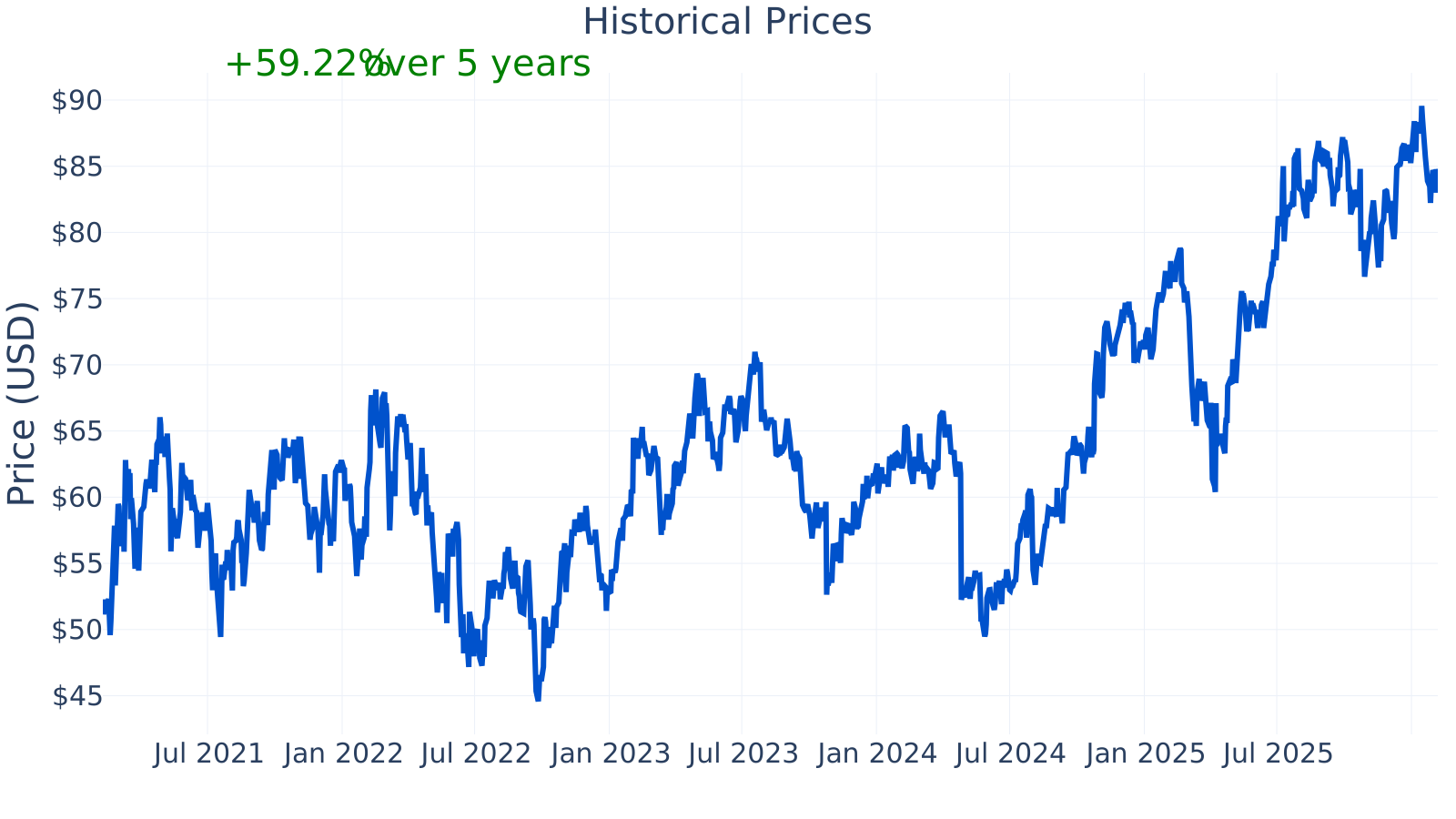
Overview
Boyd Gaming Corporation is a U.S. gaming and hospitality company. It operates casinos and related amenities (such as hotel rooms, food and beverage outlets, entertainment, and event space). The company’s properties are primarily located in Nevada (including the Las Vegas area) and in several other U.S. states. In addition to operating its own properties, Boyd also participates in online gaming through equity interests/partnership arrangements described in its public filings.
In simple terms, Boyd’s business model is to attract guests to its properties and earn money from a mix of casino play and non-gaming spending. Like most casino operators, results tend to be influenced by consumer discretionary spending, travel patterns, and the regulatory environment in each jurisdiction.
Main revenue streams generally include the following (often reported as “Gaming” and “Non-gaming” categories in filings; exact percentages can vary by year and by property mix):
- Gaming revenue (slot machines, table games, and other casino play)
- Food & beverage (restaurants, bars, banquets)
- Hotel (room revenue and related fees)
- Other (entertainment, retail, and other on-property services)
The company’s segment reporting and any material revenue concentrations are detailed in its annual report (Form 10-K), which is the most authoritative place to confirm how revenue is broken out and how it changes over time.
From 2021 through 2024, total revenue rises steadily (about $3.37B to $3.93B), while net income remains solid (roughly $464M to $578M). The 2025 line shows unusually large jumps in operating income and net income alongside sharp changes in expense lines, which can happen due to one-time items, accounting impacts, asset sales, tax effects, or other non-recurring factors that are typically explained in the annual report footnotes. For long-term analysis, it can be helpful to separate recurring operating performance from unusual items disclosed in the filing.
Key Figures
| Metric | Value | Industry ⓘ |
|---|---|---|
| Date | Feb 07, 2026 | |
| Context | ||
| Sector | Consumer Cyclical | |
| Industry | Resorts & Casinos | |
| Market Cap ⓘ | $6.67B | |
| Beta ⓘ | 1.21 | |
| Fundamental | ||
| P/E Ratio ⓘ | 3.70 | 22.13 |
| Profit Margin ⓘ | 46.02% | 6.12% |
| Revenue Growth ⓘ | 4.50% | 4.30% |
| Debt to Equity ⓘ | 96.30% | 525.78% |
| PEG ⓘ | 0.85 | |
| Free Cash Flow ⓘ | $412.38M | |
Boyd Gaming’s market capitalization is about $6.7B, placing it in the mid-cap range. The stock’s beta (~1.21) suggests it has tended to move somewhat more than the broader market. The table also shows a P/E ratio of ~3.7 versus an industry median ~22.1, which is a large gap; when a P/E is unusually low, it can reflect market expectations of lower future earnings, higher perceived risk, or earnings that include non-recurring benefits. Profit margin is shown at ~46.0% versus an industry median of ~6.1%, another unusually wide difference that may signal the presence of non-recurring items affecting net income in the most recent period. Revenue growth year-over-year is shown at ~4.5% (close to the industry median of ~4.3%). Debt-to-equity is ~96%, below the industry median shown (which is elevated), indicating less balance-sheet leverage than the median company in this peer set. Trailing twelve-month free cash flow is approximately $412M.
Growth (Medium)
The resorts and casinos industry is generally tied to consumer spending, tourism, and local economic conditions. Over long periods it can grow, but it is typically not a “straight line” industry: demand can hold up well in strong economic environments and soften during recessions. For companies like Boyd, growth often comes from a combination of (1) steady operating improvements at existing properties, (2) portfolio changes (acquisitions, expansions, renovations), and (3) digital/online exposure where permitted by regulation.
Boyd’s strategy, as described in its filings, has historically focused on operating efficiency, serving repeat customers (including loyalty programs), and maintaining a portfolio of properties that can generate cash flow across different regions. If management continues to reinvest in properties with strong local demand and maintains disciplined costs, the model can support incremental growth even when the broader environment is not booming.
Year-over-year revenue growth appears to normalize after the large post-2020 rebound period. Recent quarters show low-to-mid single digit growth (for example, around 2%–9% in the most recent points shown), including a brief dip near flat/slightly negative growth in early 2024. This pattern is consistent with a mature, cyclical business where growth is often driven by pricing, visitation, and property-specific initiatives rather than rapid market expansion.
Free cash flow over the trailing twelve months remains positive, with recent values shown around $412M. The trend indicates that cash generation has been meaningful since 2021, even though it has come down from earlier highs (for example, roughly $817M in 2022). In a capital-intensive industry, sustained free cash flow matters because it can support debt reduction, reinvestment in properties, and shareholder return programs (all subject to management decisions and covenant constraints described in filings).
Risks (High)
This article is for informational purposes only and does not constitute financial advice. Some content is AI-generated. See Disclaimer


