Stock Analysis · Box Inc (BOX)
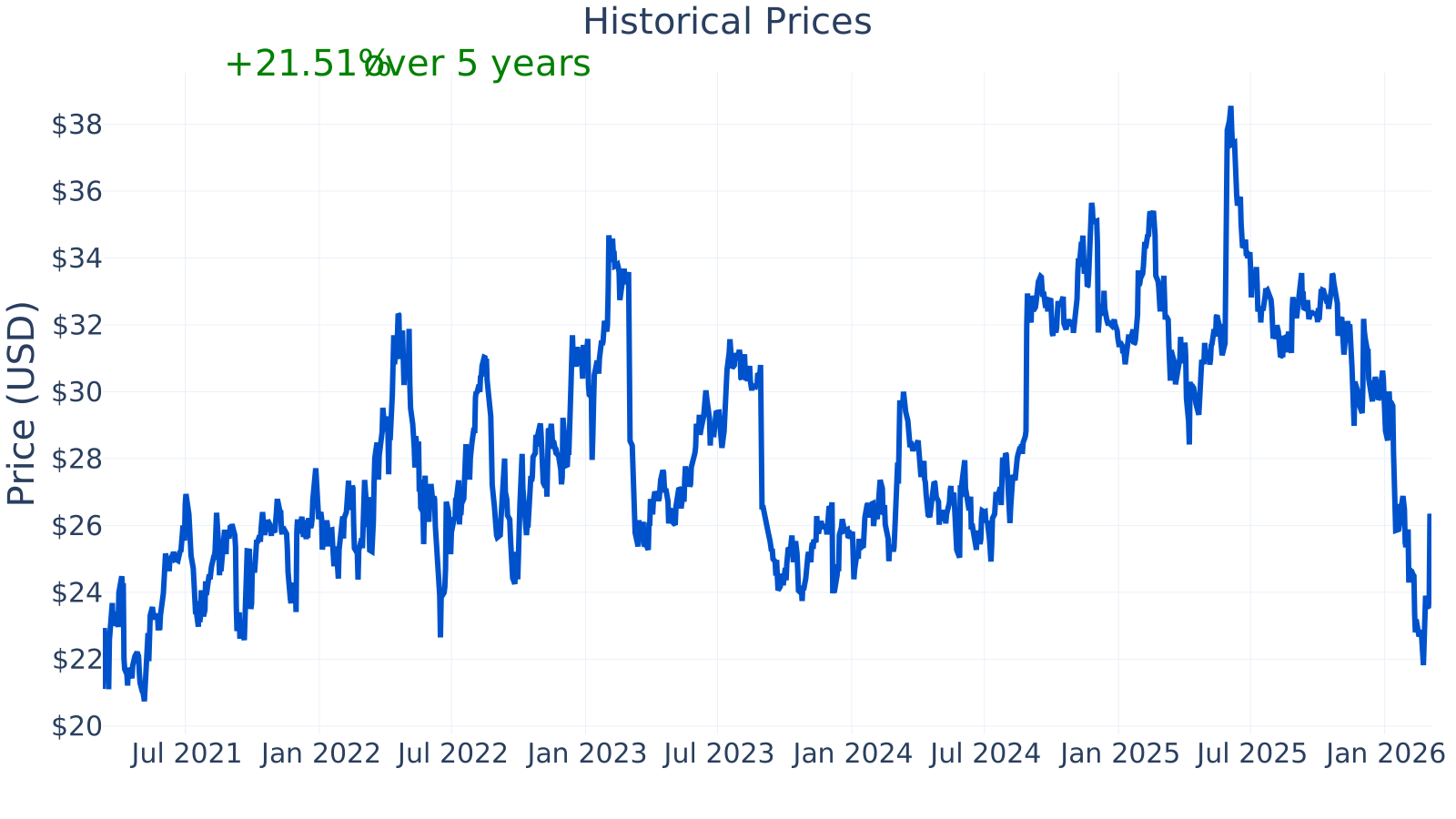
Overview
Box, Inc. is a software company focused on cloud content management. In simple terms, it helps organizations store, organize, share, and secure files and documents, while also supporting collaboration and workflow features around that content. Its products are typically used by businesses and institutions that need centralized control over access, retention, and compliance, rather than consumer-style file storage.
Box primarily earns revenue by selling subscriptions to its platform (software delivered over the internet). The company generally describes its revenue as coming mainly from cloud content management subscriptions and related services, with customers paying recurring fees (often under multi-year contracts) based on seats/users and/or usage tiers.
Main revenue sources (from largest to smallest, based on how the company describes its business in filings):
- Subscriptions (recurring platform access fees; the core of the business)
- Professional services and other (implementation, support, and related services; typically a smaller portion)
At a high level, Box’s model is designed around recurring revenue (customers renewing subscriptions) rather than one-time license sales.
Over the last several fiscal years shown, total revenue increased from about $874M (FY2022) to about $1.18B (FY2026). Over the same period, gross profit rose as well (about $625M to about $933M). Operating income moved from negative in FY2022 to positive in subsequent years, indicating improved operating efficiency, although net income varied year to year.
Key Figures
| Metric | Value | Industry ⓘ |
|---|---|---|
| Date | Mar 09, 2026 | |
| Context | ||
| Sector | Technology | |
| Industry | Software - Infrastructure | |
| Market Cap ⓘ | $3.67B | |
| Beta ⓘ | 0.74 | |
| Fundamental | ||
| P/E Ratio ⓘ | 20.52 | 27.58 |
| Profit Margin ⓘ | 9.80% | 6.83% |
| Revenue Growth ⓘ | 9.40% | 16.30% |
| Debt to Equity ⓘ | -342.28% | 24.92% |
| PEG ⓘ | 0.62 | |
| Free Cash Flow ⓘ | $350.38M | |
Box’s market capitalization is about $3.67B and its beta of 0.74 suggests the stock has historically moved less than the broader market on average. The company’s P/E ratio is 20.52 versus an industry median of about 27.58, while its profit margin is about 9.8% versus an industry median near 6.8%. Year-over-year revenue growth is about 9.4%, below the industry median shown (about 16.3%). Free cash flow over the trailing twelve months is about $350M. The debt-to-equity ratio is negative, which often happens when accounting equity is low or negative; it can make simple leverage comparisons less intuitive than for companies with consistently positive equity.
Growth (medium)
Box operates in the broader cloud software market, where organizations continue shifting content storage and business processes to cloud platforms. Demand is shaped by long-term trends such as remote and hybrid work, rising data volumes, and stricter security and compliance needs. In that context, a vendor that combines storage, collaboration, governance, and security can remain relevant, especially in regulated industries.
A key question for long-term growth is whether Box can expand within existing customers (more seats, more departments, larger workflows) while also attracting new enterprise customers in a competitive market. The company’s filings emphasize enterprise use cases such as security controls, compliance features, and integrations with other business software, which are areas that can support customer retention and expansion if executed well.
The year-over-year revenue growth trend has generally moderated from higher rates earlier in the period (mid-to-high teens) to mid-single digits at times, and more recently around 9.4%. That pattern can indicate a business maturing in its core category, making execution on customer expansion, product differentiation, and pricing discipline more important for sustaining growth.
Free cash flow has increased over time from about $228M (FY2022 trailing period shown) to about $350M (latest trailing period shown). For a subscription software business, rising free cash flow can be an important signal of operating scale and spending discipline, though it should be interpreted alongside reinvestment needs and competitive pressures.
Risks (medium-high)
Box’s main risks include intense competition, customer retention and pricing pressure, and the need to keep pace with security requirements. Cloud content management overlaps with capabilities offered by large platform providers, and customers may prefer “bundled” solutions that come packaged with broader productivity suites or cloud infrastructure. If competitors include similar features at lower incremental cost, it can pressure growth and margins.
Another risk is that enterprise software purchasing can be cyclical: customers may slow new deployments, reduce seat counts, or delay expansions during tighter budget environments. Because Box depends heavily on subscription renewals and expansions, changes in customer usage and renewal behavior can affect results.
On competitive advantages, Box’s positioning is typically described around enterprise-grade security, governance, compliance features, and integrations across common business applications. These can support stickiness (switching costs) in organizations with complex requirements. However, leadership is not absolute because several large and well-funded companies offer adjacent or overlapping solutions.
Commonly cited competitors in company filings and public descriptions of the category include major cloud and productivity vendors as well as enterprise software providers offering document management and collaboration capabilities. Examples often include Microsoft (OneDrive/SharePoint within Microsoft 365), Google (Google Drive/Workspace), Dropbox (business offerings), and broader enterprise content/document management vendors (for certain use cases). Box’s relative standing tends to be strongest where customers prioritize independent cloud content management with strong governance across many third-party applications rather than a single-vendor suite.
The debt-to-equity ratio shown swings widely and is negative most recently. This metric can become hard to interpret when equity is small or negative, because the denominator drives extreme values. In practice, this makes it important to rely more on liquidity, cash generation, debt maturities, and contractual obligations in filings rather than using debt-to-equity alone as a leverage indicator.
Profit margin improved significantly from negative levels earlier in the period to positive levels later on, with the most recent value around 8.6% (and earlier peaks higher). The industry median shown is around 6.7% at the most recent point. Margin improvements can reflect cost control and operating leverage, but margins can also fluctuate due to items like stock-based compensation, restructuring costs, and tax effects.
Valuation
One straightforward valuation reference is the price-to-earnings (P/E) ratio, which relates the stock price to earnings. Box’s latest P/E is about 20.52, below the industry median shown (about 27.58). This indicates the market is valuing Box at a lower earnings multiple than the median company in its software infrastructure peer set, at least by this measure.
Historically, the displayed P/E ratio has moved down materially from much higher levels in 2023 to lower levels more recently (around the high teens to low 20s in 2025–2026 points shown). A declining P/E can happen due to higher earnings, a lower share price, or both. Interpreting whether the current multiple is “high” or “low” depends on how durable earnings are, the pace of revenue growth (currently under the industry median shown), and competitive risks.
Another angle is the relationship between profitability and growth: Box shows positive profit margins and meaningful free cash flow, while revenue growth is more moderate compared with the industry median shown. In many software businesses, that combination can lead markets to focus more on cash generation and retention quality than on high growth alone.
Conclusion
Box is a cloud software company built around recurring subscription revenue for managing and securing business content. Over the years shown, revenue and gross profit increased, operating profitability improved from losses to positive operating income, and free cash flow rose to roughly $350M on a trailing basis.
The long-term picture depends on whether Box can sustain solid renewals and expand within enterprise accounts while competing against large platform vendors and other content/collaboration providers. Recent revenue growth is positive but below the industry median shown, while profitability metrics are comparatively strong versus the median shown.
From a valuation description standpoint, Box’s P/E ratio is below the industry median shown, and the multiple has trended down from elevated levels in 2023 to lower levels more recently. At the same time, competitive intensity and the company’s fluctuating leverage indicators (including a negative debt-to-equity figure) are key items to evaluate through primary filings and ongoing results.
Sources:
- SEC EDGAR — Box, Inc. annual filings (Form 10-K)
- SEC EDGAR — Box, Inc. quarterly filings (Form 10-Q)
- Box Investor Relations — shareholder letters, earnings materials, and press releases
- Wikipedia — “Box (company)” (basic company background)
This article is for informational purposes only and does not constitute financial advice. Some content is AI-generated. See Disclaimer


