Stock Analysis · Lucky Strike Entertainment Corporation (LUCK)
Overview
Lucky Strike Entertainment Corporation (LUCK) operates location-based entertainment venues. In plain terms, it runs places where people go out to bowl, eat and drink, play arcade-style games, and attend group events. These venues typically bundle several activities in one spot, which helps the business earn revenue from multiple customer needs during the same visit (games, food, beverages, and special events).
For long-term analysis, this kind of business is usually influenced by local consumer spending, traffic to retail and entertainment areas, and how well a venue keeps customers returning through attractive concepts, promotions, and group bookings.
Based on the company’s SEC filings, revenue is primarily generated from on-site guest spending across entertainment activities and food & beverage, plus event-related sales. Exact segment percentages can vary by period and venue mix, and are best confirmed in the latest annual report segment and revenue-footnote disclosures.
Typical revenue drivers include:
- Entertainment activities (bowling and other games/attractions, including arcade-style play)
- Food and beverage (restaurant and bar sales)
- Events and group business (corporate events, parties, and group packages)
Across recent fiscal years shown, total revenue increased from about $395.2M (2021) to about $1.201B (2025). Over the same span, interest expense rose (about $88.9M in 2021 to about $196.4M in 2025), which is important because higher financing costs can meaningfully affect net results even when operating income improves.
Key Figures
| Metric | Value | Industry ⓘ |
|---|---|---|
| Date | Feb 07, 2026 | |
| Context | ||
| Sector | Consumer Cyclical | |
| Industry | Leisure | |
| Market Cap ⓘ | $1.34B | |
| Beta ⓘ | 0.79 | |
| Fundamental | ||
| P/E Ratio ⓘ | N/A | 27.06 |
| Profit Margin ⓘ | 1.11% | 7.90% |
| Revenue Growth ⓘ | -1.80% | 6.00% |
| Debt to Equity ⓘ | -1640.67% | 33.08% |
| PEG ⓘ | N/A | |
| Free Cash Flow ⓘ | $42.87M | |
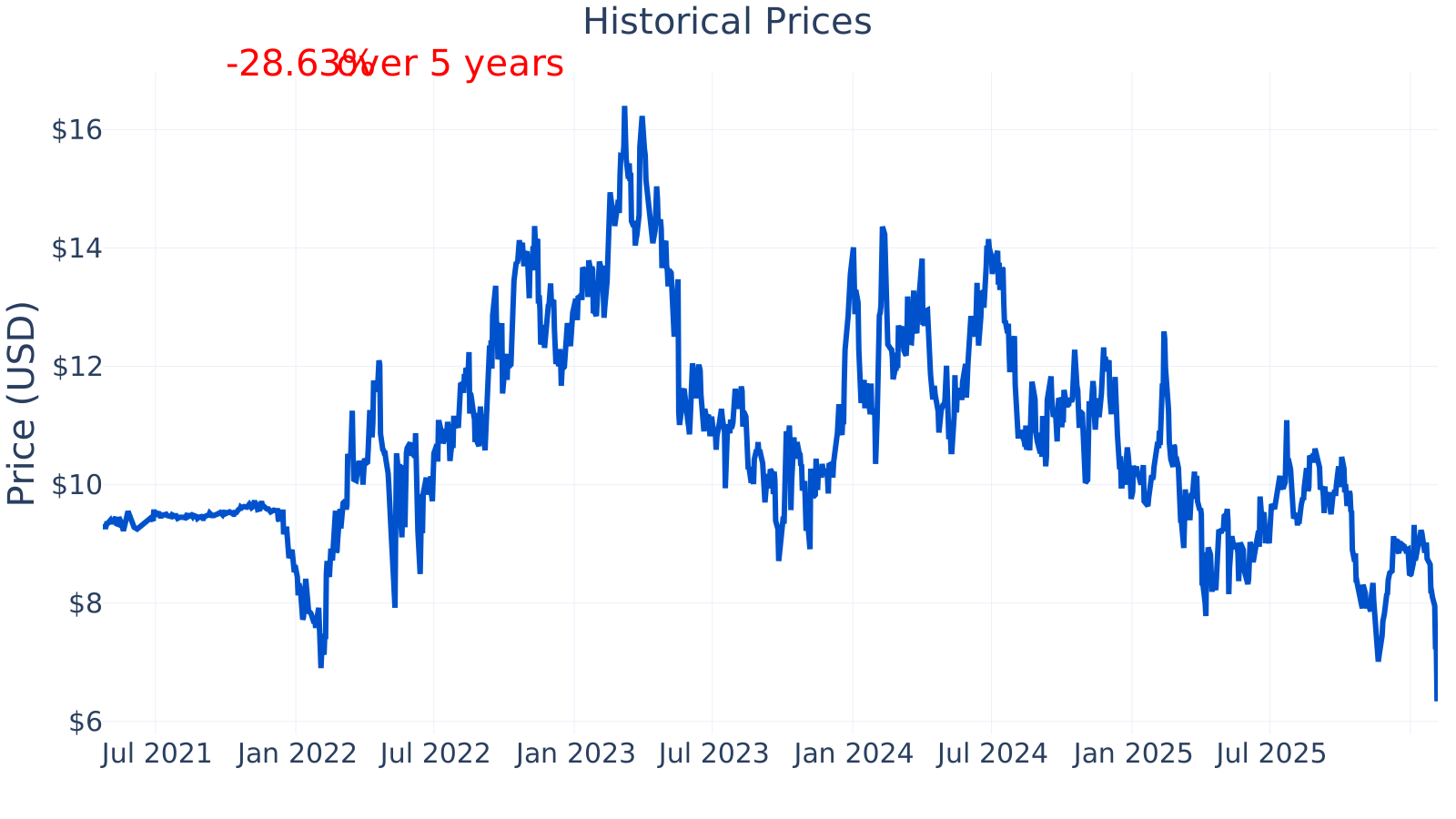
Lucky Strike’s market capitalization is about $1.34B, placing it in the small-to-mid cap range. The stock’s beta is about 0.79, which indicates it has historically moved somewhat less than the overall market on average (though individual periods can differ). The latest profit margin is about 1.11% versus an industry median near 7.9%, suggesting the company has recently converted a smaller share of revenue into bottom-line profit than the typical peer in its listed industry group. Year-over-year revenue growth is about -1.8% versus an industry median near 6%, indicating slower recent top-line momentum than peers. Trailing twelve-month free cash flow is about $42.9M, showing the business has produced cash after operating needs and capital spending in the most recent measurement window.
Growth (medium)
Lucky Strike participates in the broader out-of-home leisure market, which tends to grow when consumers prioritize experiences such as social entertainment, dining, and group outings. The industry is not purely “high-growth” like some technology categories, but it can expand through new venue openings, improvements in same-venue performance (more visits or higher spending per visit), and better monetization of food, beverage, and events.
A practical way to judge growth quality in this type of business is to separate two ideas: (1) whether revenue is rising, and (2) whether profits and cash generation rise with it. Location-based entertainment can grow revenue while still struggling to produce consistent profitability if costs (labor, rent, food inputs, promotions, or interest expense) rise too quickly.
The year-over-year revenue growth pattern has been uneven. Earlier periods show very strong growth (for example, triple-digit growth in 2022 quarters), followed by periods of modest growth and occasional declines. The latest point shown is positive (about 12.3%), but the most recent “headline” YoY value in the table is slightly negative (-1.8%), which highlights how results can shift depending on the exact quarter and comparison base.
Free cash flow has also been volatile over time: it moved from about -$9.4M (end of 2021) to strongly positive (over $100M in 2023), and then dipped negative again around 2024–2025 before returning to a positive $42.9M on a trailing basis in the latest table. For venue operators, free cash flow can swing because new builds, remodels, and maintenance capital expenditures can vary significantly from year to year.
Potential catalysts in this business model (discussed generally in company filings and typical for the category) include improving unit economics at existing venues, expanding event/group sales, rolling out new venues, and refinancing or reducing financing costs if debt levels and credit terms improve.
Risks (high)
Lucky Strike’s main risks are tied to consumer discretionary spending (people can cut back on entertainment during economic slowdowns), cost pressures (labor, food inputs, rent, utilities), and execution risk in operating many venues consistently. In addition, because the business involves physical locations, performance can be affected by local competition, site selection, and the ongoing need for reinvestment to keep venues current.
The debt-to-equity ratio shown is unusual and highly volatile, including very large positive values and later negative values. A negative debt-to-equity ratio typically occurs when book equity becomes negative (liabilities exceed assets on the balance sheet), which can make this metric harder to interpret in the usual “percentage” sense. Even so, the overall pattern suggests meaningful balance-sheet leverage or equity pressure relative to the industry median (which is around 33%). This raises the importance of monitoring balance sheet disclosures in SEC filings, including debt maturities, interest rates, covenant terms, and any planned refinancing.
Profitability has also been inconsistent. The company moved from negative profit margins in 2021–2022 to solidly positive periods in parts of 2023–early 2024, then returned to negative in mid-to-late 2024 and again in 2025. The most recent values are below the industry median in many periods, indicating the company has not consistently matched peer profitability. In a venue-based business, profitability can swing with traffic trends, pricing power, promotional intensity, and cost control.
Competitive positioning is another key risk area. Lucky Strike operates in a crowded leisure landscape that includes other bowling and entertainment chains, regional operators, and alternative “night out” options (restaurants, cinemas, live events, at-home entertainment). Competitive advantages in this space typically come from strong venue concepts, prime locations, efficient operations, brand recognition, and the ability to drive high-margin food and beverage attach rates and group events. Whether Lucky Strike is a clear category leader depends on the specific local markets and the peer set used for comparison; investors often look for consistent same-venue performance and stable margins as evidence of durable advantages.
Valuation
Price-to-earnings (P/E) is a common valuation metric, but it becomes less straightforward when earnings are volatile or near zero. The P/E series shown includes multiple periods where the company’s P/E is not displayed (set to 0 in the chart), which often happens when earnings are negative or extremely small. In the periods where it is shown, the company’s P/E ranges widely (for example, roughly 12.9 to 38.6, and later much higher values above 100), while the industry median tends to cluster around the low-to-mid 20s.
In practical terms, this means valuation discussions for LUCK often need more context than a single P/E number: the “E” (earnings) has shifted meaningfully across periods, and a small change in earnings can cause a big swing in P/E. For companies with fluctuating profitability, investors commonly look at a combination of operating performance, cash generation trends, and balance-sheet strength alongside earnings-based multiples.
Conclusion
Lucky Strike is an out-of-home entertainment operator whose results are influenced by consumer discretionary demand and the economics of running physical venues. Revenue has grown substantially over the multi-year period shown, but profitability and free cash flow have been uneven, and interest expense has been a meaningful factor in net results. Recent metrics show a thin profit margin (around 1.11%) and slightly negative year-over-year revenue growth in the latest summary measure, while trailing free cash flow is positive.
For a long-term view, the central questions are whether the company can produce more stable margins across economic cycles, sustain positive free cash flow after reinvestment needs, and manage balance-sheet risks implied by volatile leverage indicators. The valuation picture is also mixed because earnings variability makes P/E harder to rely on in isolation.
Sources:
- SEC EDGAR — Lucky Strike Entertainment Corporation — Form 10-K (Annual Report)
- SEC EDGAR — Lucky Strike Entertainment Corporation — Form 10-Q (Quarterly Reports)
- SEC EDGAR — Lucky Strike Entertainment Corporation — Form 8-K (Current Reports)
- Lucky Strike Entertainment Corporation — Investor Relations — Press Releases and SEC Filings
- Wikipedia — “Lucky Strike Entertainment” (basic company background)
This article is for informational purposes only and does not constitute financial advice. Some content is AI-generated. See Disclaimer