Stock Analysis · BorgWarner Inc (BWA)
Overview
BorgWarner Inc is an automotive supplier that designs and manufactures components used in vehicles. Historically, the company has been known for powertrain and drivetrain parts used in internal-combustion vehicles (for example, turbochargers and related systems), and it has also been expanding its portfolio of electrification products used in hybrid and battery-electric vehicles (such as e-motors and power electronics). Its customers are primarily global vehicle manufacturers, and the company’s results tend to follow overall vehicle production volumes and platform launches.
In simple terms, BorgWarner makes “behind-the-scenes” hardware that helps vehicles move efficiently—either by improving combustion efficiency or by enabling electric propulsion. That positioning puts it in the middle of a large industry transition: automakers are steadily increasing the share of electrified vehicles, while many conventional vehicle platforms are still produced at scale.
In its SEC filings, BorgWarner reports revenue through product/technology-focused groups rather than a consumer-facing product mix. A common high-level breakdown is:
- Air / combustion-related systems (including turbo and related technologies)
- Drivetrain & transmission-related systems
- Electrification (electric motors, inverters/power electronics, charging-related hardware, and related components)
Exact percentages can change year to year and are best taken from the most recent Form 10‑K segment and product disclosures.
Across 2021–2024, revenue fluctuated (about $12.6B to $14.8B), while profitability varied more meaningfully. For example, net income decreased from about $537M (2021) to about $338M (2024), showing that cost structure, pricing, and mix can matter as much as sales levels in this industry.
Key Figures
| Metric | Value | Industry ⓘ |
|---|---|---|
| Date | Feb 07, 2026 | |
| Context | ||
| Sector | Consumer Cyclical | |
| Industry | Auto Parts | |
| Market Cap ⓘ | $11.30B | |
| Beta ⓘ | 1.06 | |
| Fundamental | ||
| P/E Ratio ⓘ | 73.56 | 25.56 |
| Profit Margin ⓘ | 0.95% | 3.38% |
| Revenue Growth ⓘ | 4.10% | 4.95% |
| Debt to Equity ⓘ | 67.79% | 66.87% |
| PEG ⓘ | 1.21 | |
| Free Cash Flow ⓘ | $1.44B | |
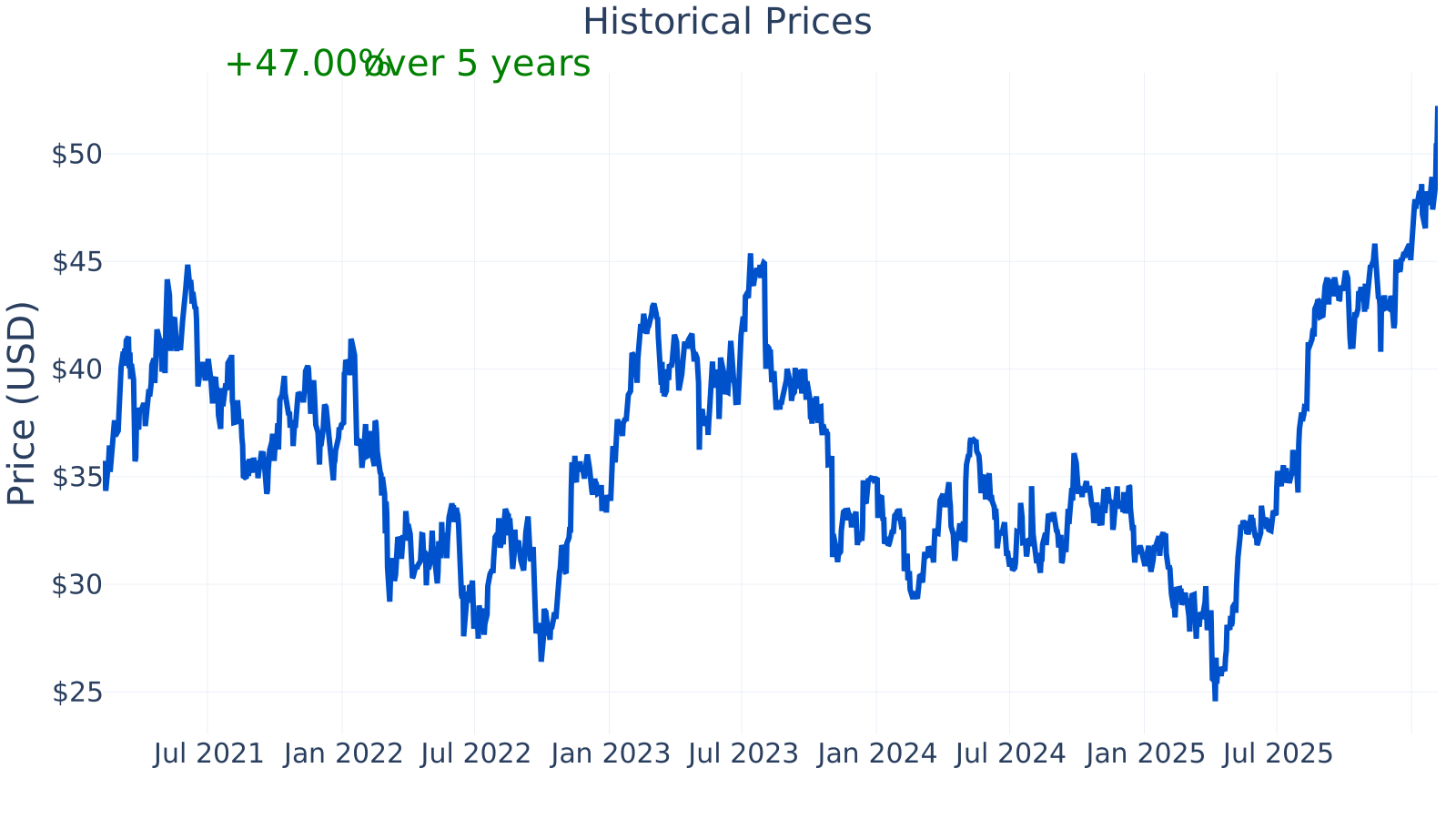
BorgWarner’s market capitalization is about $11.3B and its beta is about 1.06, which indicates price movements roughly in line with the broader market. The latest P/E ratio is about 73.6, well above the auto parts industry median of about 25.6; this can happen when earnings are temporarily depressed rather than the share price rising sharply. Profit margin is about 1.0% versus an industry median near 3.4%, and revenue growth year over year is about 4.1% versus an industry median near 5.0%. Debt-to-equity is about 67.8%, close to the industry median (~66.9%). Trailing twelve-month free cash flow is about $1.44B.
Growth (Medium)
The auto parts industry is closely tied to global vehicle production, which is cyclical. However, BorgWarner is also exposed to a structural shift: the long-term move toward electrified powertrains. That shift can create new demand for components like e-motors and power electronics, while some traditional combustion-focused products may face slower growth over time as electric vehicle penetration increases.
A central question for long-term business growth is whether the company can grow its electrification revenue fast enough to offset slower growth (or eventual decline) in some combustion-related categories. BorgWarner’s strategy—expanding its electrification portfolio while continuing to serve current high-volume combustion platforms—aims to operate on both timelines at once: near-term scale from legacy products and longer-term positioning in EV content per vehicle.
Recent year-over-year revenue growth has been uneven, with several quarters of contraction followed by modest positive growth most recently (about 4%). This pattern is consistent with a supplier exposed to changing production schedules, customer inventory adjustments, and platform timing.
Free cash flow shows a notable improvement from 2024 to 2025 (TTM), rising from roughly $449M (as of 2024-03-31) to about $962M (as of 2025-03-31), with the latest metric table indicating around $1.44B TTM. For long-term business resilience, sustained cash generation matters because it can help fund capital spending, product development, and balance-sheet flexibility during downturns.
Risks (High)
BorgWarner operates in a highly competitive, high-volume manufacturing environment where results can swing with changes in vehicle production, customer demand, and input costs. A key risk is the pace of the industry’s transition to electrification: if EV adoption accelerates faster than expected, some legacy combustion-related product lines may face faster pressure. If EV adoption slows, electrification investments may take longer to scale. In both cases, execution (winning programs, ramping plants, managing costs) is critical.
Debt-to-equity has generally stayed in a band around the mid‑60% to high‑70% range over the period shown, ending near 67.8%, roughly in line with the industry median. This suggests leverage is not an outlier versus peers, but it still creates sensitivity to interest rates and profit variability—especially in cyclical slowdowns.
Profit margin has fallen sharply over time, dropping to roughly 0.9% most recently, below the industry median (about 3.4%). This points to current profitability pressure. In practical terms, even small changes in pricing, warranty costs, utilization, or product mix can have an outsized effect on earnings in auto supply.
Competitive positioning in auto parts tends to be defined by long-standing customer relationships, the ability to meet quality and delivery standards at scale, and “design wins” that lock in multi-year production volumes. BorgWarner has established positions across multiple powertrain categories, but it competes with many large global suppliers that also invest heavily in electrification and efficiency technologies.
Main competitors typically include other major global automotive suppliers with overlapping portfolios (for example, suppliers active in propulsion, drivetrain, and electrification components). Relative placement depends on the exact product line: BorgWarner may be strong in certain propulsion technologies, while peers may be stronger in others. Because automakers often dual-source and pressure suppliers on cost, maintaining margins and winning new programs are ongoing challenges rather than one-time achievements.
Valuation
The P/E ratio increased substantially over the period shown, reaching about 72.9 by late 2025, while the industry median shown in the same chart remained far lower (high-teens in that period). Interpreting this requires caution: a high P/E can reflect a higher share price, but it can also occur when earnings are temporarily low. That second explanation is consistent with the recent compression in profit margin.
Because BorgWarner’s current profitability (net margin near 1%) is below the industry median, valuation ratios that use earnings can look elevated even if the underlying business has not meaningfully rerated. In this context, it can be useful to pair P/E with other reality checks—such as whether margins recover toward historical levels and whether free cash flow remains consistently positive through the cycle.
Conclusion
BorgWarner is a global auto supplier with a legacy foundation in combustion-related propulsion technologies and an expanding electrification footprint. The long-term industry backdrop includes a cyclical vehicle production base plus a structural shift toward electrified powertrains, creating both opportunity (new product content) and transition risk (mix and margin pressure during change).
The main points visible in the metrics are: (1) revenue growth has been modest and uneven recently, (2) free cash flow has improved meaningfully in the latest period shown, (3) leverage appears broadly in line with the industry median, and (4) profitability has weakened, which can mechanically drive a higher P/E ratio. Overall, the long-term investment debate tends to center on whether BorgWarner can convert electrification growth into durable, higher profitability while managing the decline curve and competitive pricing pressure in legacy categories.
Sources:
- SEC EDGAR — BorgWarner Inc Form 10‑K (Annual Report)
- SEC EDGAR — BorgWarner Inc Form 10‑Q (Quarterly Reports)
- BorgWarner Investor Relations — SEC Filings & Annual Reports (company-hosted)
- Wikipedia — “BorgWarner” (company overview and history)
This article is for informational purposes only and does not constitute financial advice. Some content is AI-generated. See Disclaimer


