Stock Analysis · Boot Barn Holdings Inc (BOOT)
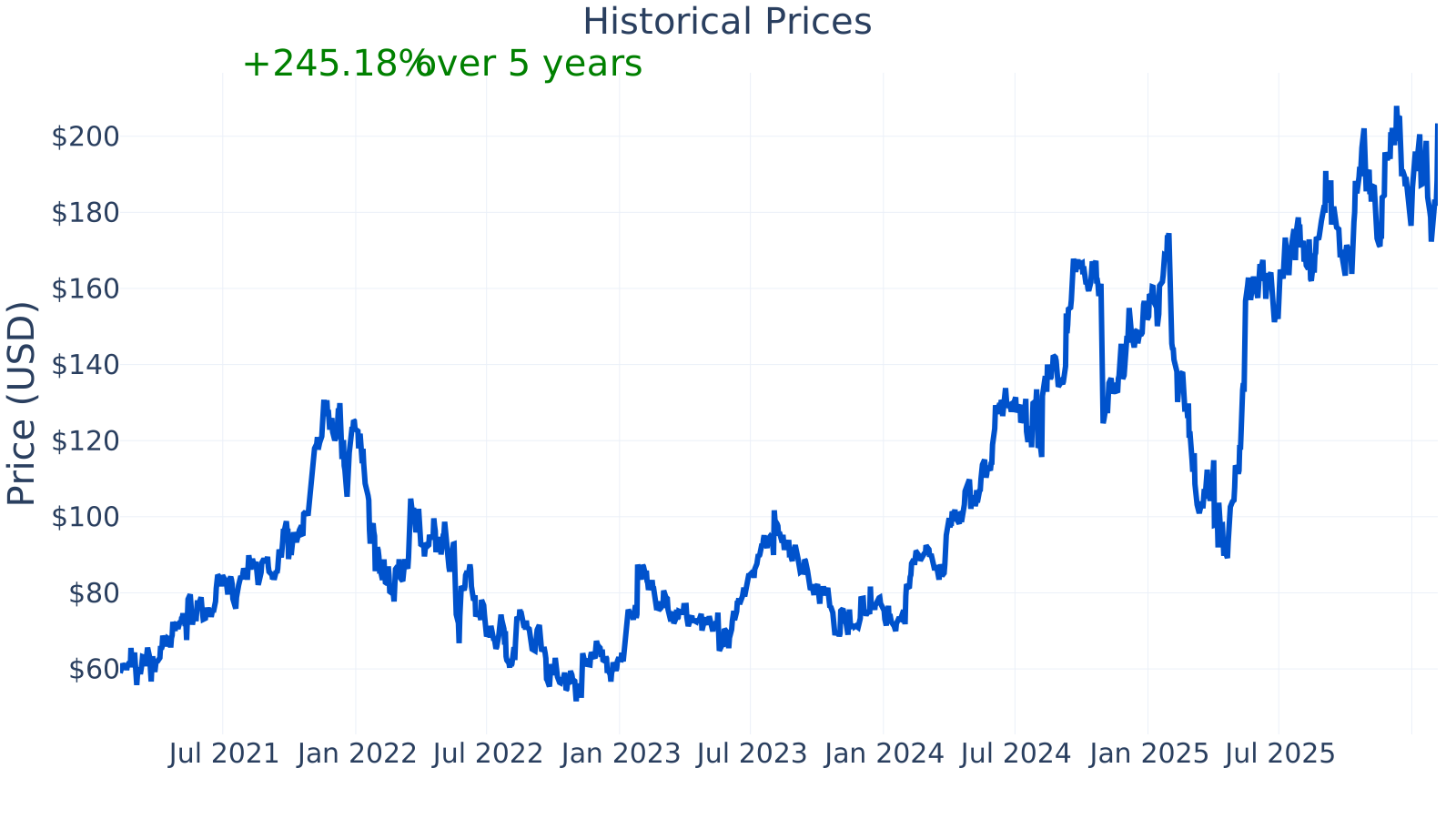
Overview
Boot Barn Holdings, Inc. is a U.S. specialty retailer focused on western and work-related footwear, apparel, and accessories. The company sells products through a nationwide store base and through its e-commerce sites. Its assortment typically includes cowboy boots and hats, work boots, jeans, shirts, outerwear, and related accessories, with a mix of well-known third-party brands and proprietary (in-house) brands.
From a business model perspective, Boot Barn’s revenue is primarily generated by selling merchandise to consumers (rather than services or subscriptions). In general terms, the mix is organized around major product categories such as footwear, apparel, and accessories, and it is sold through physical stores and online channels. Public filings are the appropriate place to find the company’s exact category and channel percentages (which can shift from year to year based on demand and store expansion).
The recent multi-year income statement pattern shows that revenue increased meaningfully from fiscal 2021 to fiscal 2025, while selling, general, and administrative costs also rose as the store base and operations expanded. Over the same period, interest expense declined to a relatively small amount, which can reduce financial pressure during weaker consumer cycles.
Key Figures
| Metric | Value | Industry ⓘ |
|---|---|---|
| Date | Feb 08, 2026 | |
| Context | ||
| Sector | Consumer Cyclical | |
| Industry | Apparel Retail | |
| Market Cap ⓘ | $6.20B | |
| Beta ⓘ | 1.67 | |
| Fundamental | ||
| P/E Ratio ⓘ | 28.48 | 17.99 |
| Profit Margin ⓘ | 10.10% | 8.42% |
| Revenue Growth ⓘ | 16.00% | 7.30% |
| Debt to Equity ⓘ | 54.87% | 104.73% |
| PEG ⓘ | 1.72 | |
| Free Cash Flow ⓘ | $89.48M | |
Boot Barn’s market capitalization is about $6.2B. The stock’s beta of ~1.67 suggests it has historically moved more than the broader market, which can translate into larger swings in both directions.
Profitability and growth metrics in the table show profit margin of ~10.1% versus an industry median of about 8.4%, and year-over-year revenue growth of ~16% versus an industry median of roughly 7.3%. Leverage appears lower than the peer median, with debt-to-equity around 54.9% compared with an industry median near 104.7%. Trailing twelve-month free cash flow is shown at about $89.5M, and the PEG ratio of ~1.72 indicates the valuation is not only about current earnings, but also what level of growth the market expects.
Growth (Medium)
Boot Barn operates in apparel retail, a large and competitive consumer category that typically grows with population, employment, and wage trends, but can be pressured during downturns when shoppers postpone discretionary purchases. Within that broad space, the company is concentrated in western and work wear—categories that can be influenced by regional lifestyle demand and by employment conditions in trades, construction, agriculture, and energy-related markets.
A key part of Boot Barn’s long-term growth strategy has historically been expanding its store footprint while also building out e-commerce. Store expansion can increase sales by reaching new geographies, but it also raises execution requirements (site selection, staffing, inventory management, and local marketing). Online sales can broaden reach beyond store markets, though it can bring higher fulfillment and return costs, depending on the product mix.
The revenue growth pattern over time shows very strong growth rates in 2021–2022 (in part reflecting unusual comparisons around that period), followed by a slowdown, including a brief negative period around early 2024, and then a re-acceleration into mid-to-late 2024 and 2025 with mid-to-high teens growth. That kind of path is consistent with a retailer navigating shifting demand and comparisons, rather than a straight-line trend.
Free cash flow has been uneven across the last several years, moving from positive levels to negative in some periods and back again. For retailers, this can happen when inventory investment rises, when new stores are opened (capital spending), or when working capital swings. For long-term durability, the key question is whether the business can generate cash consistently across a full cycle while still funding store growth.
Risks (Medium)
Boot Barn’s results are tied to consumer spending and to employment trends in customer groups that buy work and western products. A weaker macro environment can pressure traffic, increase promotions, and lead to slower inventory turns. Retailers also face fashion and assortment risk: if key styles, brands, or fits miss customer preferences, markdowns can rise.
Competition is another structural risk. Boot Barn competes with a mix of specialty western/work retailers, large workwear brands and their direct-to-consumer channels, mass merchants, and online marketplaces. Compared with many general apparel retailers, the company’s positioning is more focused (western and work), which can help build customer recognition. However, competitors with broader scale can sometimes compete aggressively on price, shipping, or marketing.
From a balance-sheet standpoint, leverage can affect how flexible a retailer is during weaker demand periods.
The debt-to-equity trend has generally remained around the 50% range in recent periods and sits below the industry median for apparel retail. Lower relative leverage can reduce interest burden and refinancing risk, though it does not remove risks tied to leases, inventory, or sudden demand slowdowns.
Profitability is another key risk area, since retailer margins can compress quickly when promotions increase or freight and product costs rise.
Boot Barn’s profit margin has been consistently above the industry median across the periods shown, though it declined from earlier peaks and later stabilized around the ~9%–10% range. This suggests the company has maintained stronger-than-median profitability for its peer group, but it still operates in a business where margins can be sensitive to discounting and cost inflation.
Valuation
Valuation is often discussed using the price-to-earnings (P/E) ratio, which reflects how much the market is paying for each dollar of earnings. Boot Barn’s latest P/E is about 28.5, which is above the industry median shown in the table (about 18.0). A higher-than-peer P/E typically implies the market expects stronger growth, more resilient earnings, or a business quality premium—while also leaving less room for disappointment if growth slows.
Over the periods shown, Boot Barn’s P/E ratio has varied widely, dipping to low double-digits in parts of 2022 and then rising into the mid-to-high 20s in 2024–2025. The industry median P/E in the same chart appears generally lower in the more recent periods. In plain terms, the stock has moved from being valued closer to peers at certain times to being valued at a more noticeable premium at others, which raises the importance of execution on growth and margin stability.
Conclusion
Boot Barn is a specialty retailer with a clear focus on western and work categories, operating through both stores and e-commerce. Financially, the company shows a combination of above-median profitability (relative to apparel retail peers), recently stronger revenue growth than the peer median, and lower leverage than the industry median, alongside variable free cash flow that is typical of store-growing retailers with working-capital swings.
The main long-term issues to monitor are whether demand remains durable across economic cycles, whether store expansion continues to produce good returns without pressuring margins, and whether competition (including large-scale retailers and direct-to-consumer brands) leads to heavier discounting. With the stock trading at a higher P/E than the industry median, the market appears to be assigning a premium that may depend on continued execution and steady profitability.
Sources:
- SEC EDGAR — Boot Barn Holdings, Inc. periodic filings (Form 10-K, Form 10-Q)
- Boot Barn Holdings, Inc. — Investor Relations materials and press releases (company website)
- Wikipedia — “Boot Barn” (basic company background)
This article is for informational purposes only and does not constitute financial advice. Some content is AI-generated. See Disclaimer


