Stock Analysis · Blackline Inc (BL)
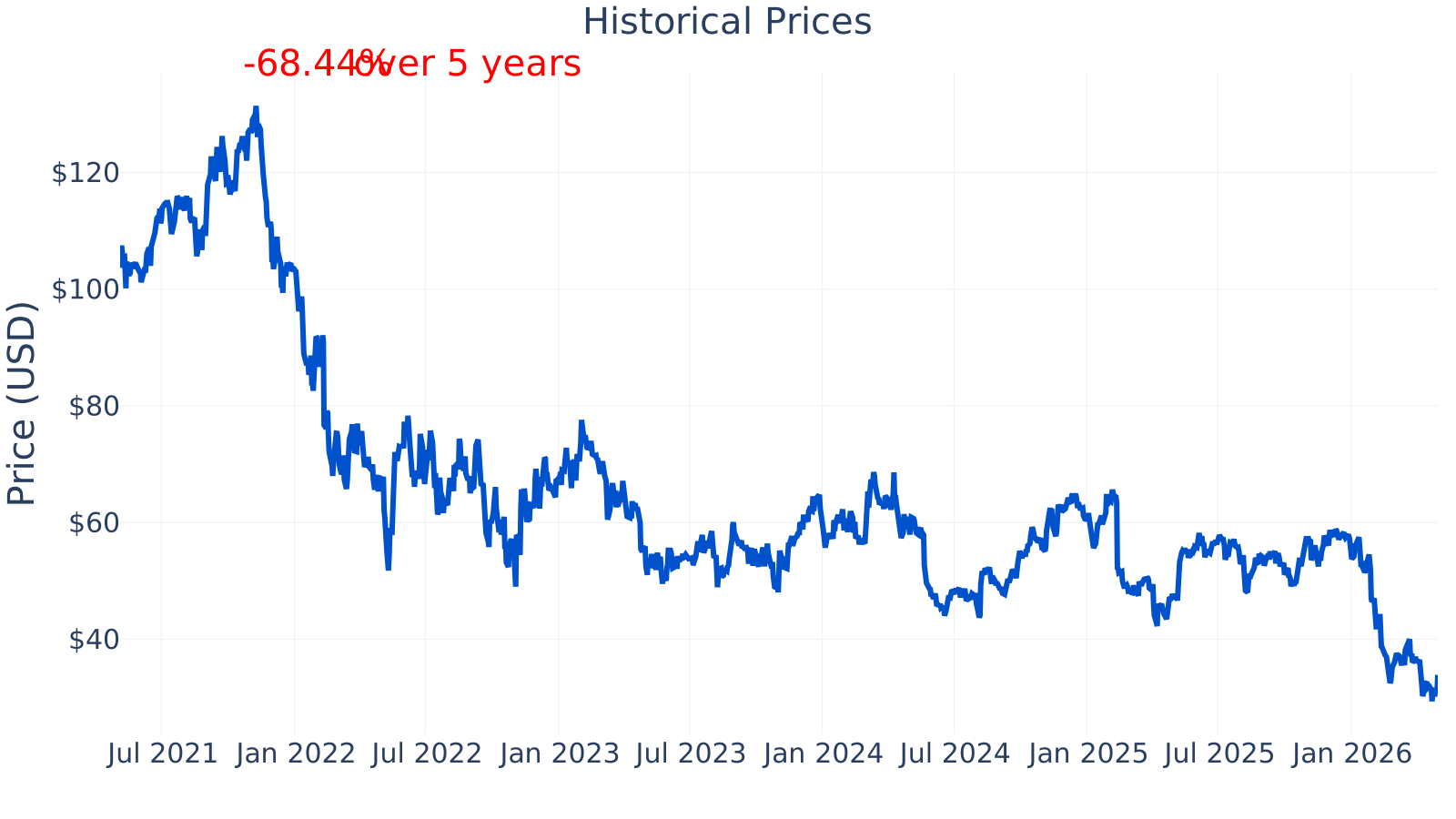
Overview
BlackLine, Inc. (BL) is a software company focused on automating parts of corporate accounting work, especially the “financial close” (the recurring process of reconciling accounts, validating balances, and producing financial reports at month-end, quarter-end, and year-end). Its platform is typically used by finance and accounting teams at mid-sized to large organizations to standardize workflows, reduce manual spreadsheet work, and improve visibility and controls.
The company primarily sells its software as a subscription service (commonly described as SaaS, or software delivered over the internet). In that model, customers generally pay recurring fees for access to the platform, and BlackLine may also provide services related to implementation and support.
In company reporting, revenue is commonly organized into broad categories such as subscriptions and professional services/other. Exact percentages can shift by year, but the recurring subscription component is designed to be the main driver of the business model.
Main sources of revenue (typical structure in company filings):
- Subscription revenue (recurring access to the platform; generally the largest component)
- Professional services and other revenue (implementation, training, and related services; usually smaller than subscriptions)
Over the period shown, total revenue rises steadily (from about $426M in 2021 to about $700M in 2025), while profitability is more uneven: operating income improves materially from losses (2021–2022) to profits (2023–2025). Net income turns positive in 2023 and remains positive afterward, though it drops sharply in 2025 versus 2024.
Key Figures
| Metric | Value | Industry ⓘ |
|---|---|---|
| Date | May 04, 2026 | |
| Context | ||
| Sector | Technology | |
| Industry | Software - Application | |
| Market Cap ⓘ | $2.02B | |
| Beta ⓘ | 0.69 | |
| Fundamental | ||
| P/E Ratio ⓘ | 86.95 | 26.40 |
| Profit Margin ⓘ | 3.50% | 7.95% |
| Revenue Growth ⓘ | 8.10% | 15.60% |
| Debt to Equity ⓘ | 282.93% | 27.14% |
| PEG ⓘ | 4.53 | |
| Free Cash Flow ⓘ | $153.33M | |
BlackLine’s market capitalization is about $2.0B, and the stock’s beta of 0.69 suggests it has historically moved less than the broader market on average (though beta does not prevent meaningful price swings). Profit margin is about 3.5%, below the industry median shown (7.95%), indicating thinner profitability than many peers at this point in time. Year-over-year revenue growth is about 8.1%, also below the industry median shown (15.6%). Debt-to-equity is about 283%, far above the industry median shown (~27%), which signals materially higher leverage than typical for the peer set. The P/E ratio is about 86.9 versus an industry median of 26.4, indicating a much higher earnings multiple than the median peer, and the PEG ratio of 4.53 is another indication that the valuation is high relative to growth expectations embedded in that metric. Trailing twelve-month free cash flow is about $153.3M, showing the business has been generating cash recently.
Growth (Medium)
BlackLine operates in enterprise financial software, an area supported by long-running trends: companies continuing to digitize back-office processes, increased attention to internal controls and audit readiness, and interest in standardizing finance operations across business units and geographies. These are not new themes, but they can create steady demand for tools that reduce manual work and make closing and reconciliation processes more consistent.
A key question for long-term growth is whether BlackLine can expand within existing customers (more modules, more users, broader deployment) while continuing to add new customers, without letting operating costs rise faster than revenue. The business model is designed around subscriptions, which can be favorable for planning and long-term customer relationships, but the pace of growth matters because software valuations often assume durable expansion.
The year-over-year revenue growth rate trends downward over time, moving from above 20% in 2021–2022 to high single digits by 2025 (about 8.1% at the most recent point shown). That pattern can indicate maturation in the company’s current product set, tougher comparisons, changes in customer buying cycles, or stronger competition—company filings typically discuss these drivers in more detail.
Free cash flow increases substantially across the period shown (from about $27.4M in early 2022 to about $171.2M by early 2025, with the latest shown around $153.3M). In plain terms, the business has recently been converting revenue into cash at a meaningfully higher level than a few years ago, which can provide flexibility for investment, debt servicing, or other corporate needs.
Risks (High)
A central risk is execution: sustaining product relevance and customer retention while operating in a competitive enterprise software environment. Accounting and finance teams are often cautious about switching core systems, but they can consolidate vendors over time, negotiate pricing pressure at renewal, or choose broader platforms that reduce the number of tools they maintain.
Another key risk visible in the financial profile is leverage. Compared with the industry median shown, BlackLine’s debt relative to equity is high, which can reduce flexibility during slower growth periods or when margins come under pressure.
Debt-to-equity is elevated across the full history shown and remains around 283% at the most recent point, versus an industry median near 27%. While the ratio has come down meaningfully from peak levels earlier in the timeline, it still indicates heavier reliance on debt than many peers.
Profitability also shows volatility. While margins improved notably from earlier losses, the most recent profit margin shown is much lower than the peak seen in 2024, which highlights that earnings can swing due to operating costs, interest expense, taxes, or other factors described in filings.
Profit margin improved from negative territory in 2021–2022 to strongly positive levels in 2024, then fell back to about 3.5% by the most recent point shown—below the industry median shown (7.9%). That “up then down” pattern suggests profitability is not yet consistently stable at a high level.
On competitive positioning, BlackLine is a recognized specialist in financial close and related accounting automation workflows. However, it faces competition from both specialized vendors and larger enterprise software providers that offer broad finance suites. Commonly referenced competitor categories include:
- Large enterprise finance platforms that can bundle multiple finance functions into a suite
- Close and consolidation specialists that focus on adjacent areas like consolidation, planning, reconciliation, and governance
In this landscape, competitive advantages tend to come from depth of functionality in close processes, integrations with major ERPs, customer switching costs, and the ability to demonstrate time savings and control improvements. Whether BlackLine is “the leader” depends on the exact workflow segment and customer profile; company filings are usually the best place to see how it describes its competitive environment and differentiators.
Valuation
The valuation signals are mixed, with several metrics pointing to a demanding earnings multiple relative to peers. The current P/E ratio shown is far above the industry median, which typically implies that the market is placing a higher value on each dollar of current earnings than it does for the median peer. This kind of valuation is easier to sustain when revenue growth and/or profit margins are expanding consistently.
The P/E ratio shown is about 86.9 versus an industry median near 26.4. The historical line also shows meaningful swings over time, including a sharp rise at the most recent point shown (around 118.9). Separately, the PEG ratio shown (4.53) is another indicator often interpreted as “high valuation relative to growth,” although PEG depends heavily on how growth is measured and forecasted.
Because revenue growth has recently been in the high single digits (about 8.1% year over year) and profit margin is currently modest (about 3.5%), a high P/E multiple places added emphasis on the company’s ability to improve margins, re-accelerate growth, or both. If either does not materialize, valuation can become more sensitive to changes in market expectations.
Conclusion
BlackLine provides subscription-based software that targets a real and recurring business need: automating and standardizing key accounting processes around the financial close. Over several years, revenue has increased steadily, free cash flow has improved substantially, and profitability moved from losses into positive territory—though net income and margins have also shown volatility.
From a long-term perspective, the main points to balance are: (1) an industry backdrop supported by continued finance digitization, (2) a recent slowdown to high single-digit revenue growth, (3) high leverage compared with typical software peers, and (4) a valuation that is high relative to the industry median on earnings-based multiples. Taken together, the publicly visible profile suggests the long-term outcome may depend heavily on sustained execution—particularly margin stability, balance sheet resilience, and the ability to expand growth beyond recent levels.
Sources:
- SEC EDGAR — BlackLine, Inc. Form 10-K (Annual Report)
- SEC EDGAR — BlackLine, Inc. Form 10-Q (Quarterly Reports)
- BlackLine Investor Relations — SEC Filings
- BlackLine Investor Relations — Press Releases
- Wikipedia — “BlackLine” (company overview and basic history)
This article is for informational purposes only and does not constitute financial advice. Some content is AI-generated. See Disclaimer


