Stock Analysis · Blackline Inc (BL)
Overview
BlackLine, Inc. is a software company focused on automating accounting and finance work for businesses. In simple terms, it provides cloud-based tools that help finance teams close the books faster, reconcile accounts, and improve control over financial processes. The company positions its platform around “financial close” and related accounting workflows, aiming to reduce manual spreadsheet work and make results more reliable and easier to audit.
BlackLine primarily earns revenue by selling subscriptions to its cloud software (typically contracted for a period of time and recognized over that service period). It also earns a smaller portion from professional services such as implementation, configuration, and customer support services tied to deployments.
Main revenue sources (highest to lowest) are typically:
- Subscription revenue (recurring cloud software access)
- Professional services and other revenue (implementation and related services)
Across recent years, total revenue has risen steadily (from about $426M in 2021 to about $700M in 2025), while operating income moved from losses to positive territory (notably positive in 2023–2025). Net income has been more uneven, influenced by items like taxes and interest, even as gross profit expanded with revenue growth.
Key Figures
| Metric | Value | Industry ⓘ |
|---|---|---|
| Date | Feb 23, 2026 | |
| Context | ||
| Sector | Technology | |
| Industry | Software - Application | |
| Market Cap ⓘ | $2.24B | |
| Beta ⓘ | 0.86 | |
| Fundamental | ||
| P/E Ratio ⓘ | 92.69 | 25.48 |
| Profit Margin ⓘ | 3.50% | 7.23% |
| Revenue Growth ⓘ | 8.10% | 15.70% |
| Debt to Equity ⓘ | 282.93% | 25.08% |
| PEG ⓘ | 5.49 | |
| Free Cash Flow ⓘ | $153.33M | |
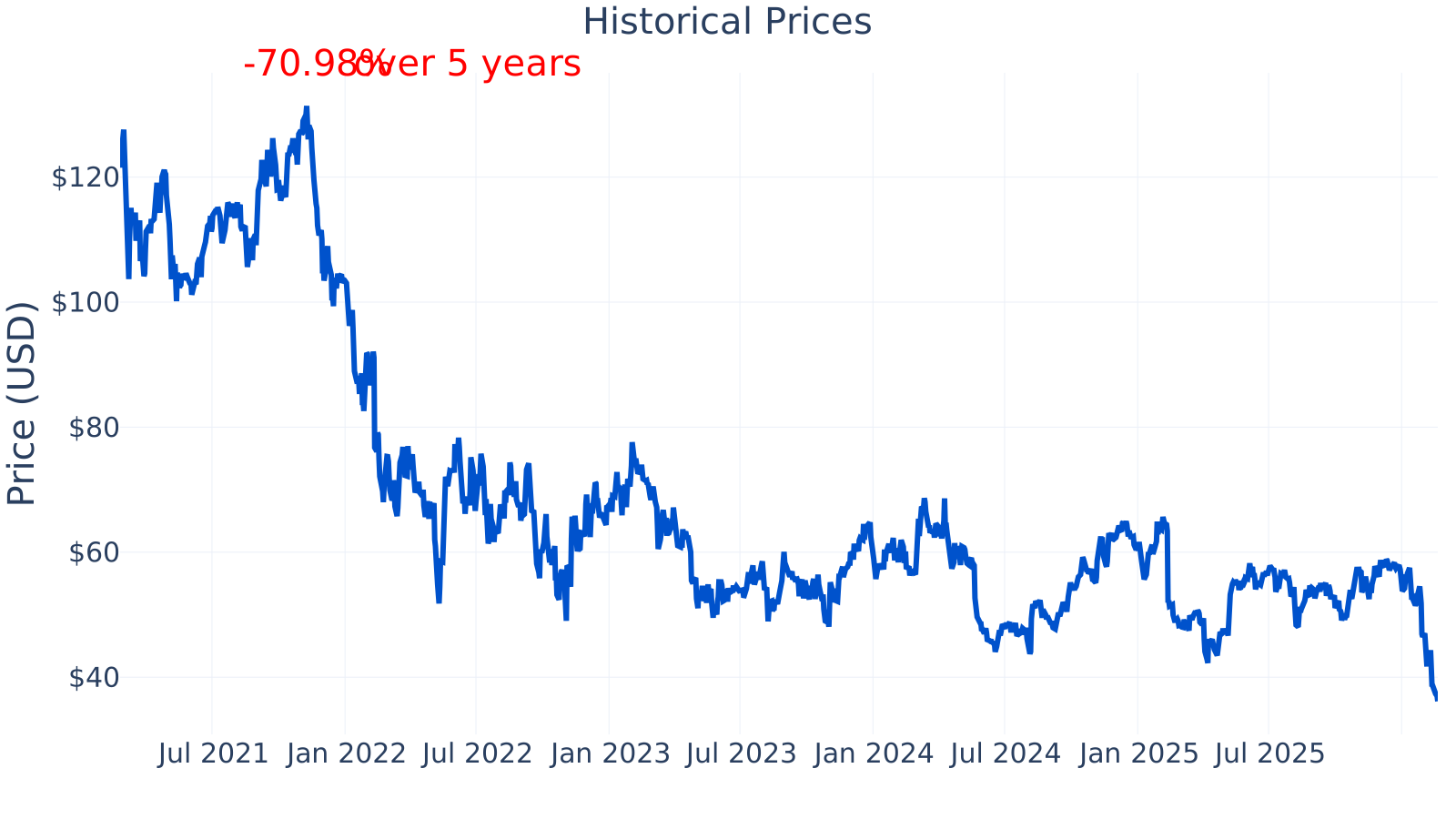
BlackLine’s market capitalization is about $2.24B. The stock’s beta is about 0.87, which is often interpreted as historically moving somewhat less than the overall market (though this can change over time). The company’s current P/E ratio is ~92.7 versus an industry median near 25.5, reflecting a much higher valuation relative to typical peers. Profitability is currently modest on a net basis with a ~3.5% profit margin versus an industry median near ~7.2%. Recent year-over-year revenue growth is ~8.1%, below the industry median shown here (~15.7%). BlackLine also shows a relatively high debt-to-equity ratio (~283%) compared with an industry median near ~25%. Free cash flow over the trailing twelve months is about $153M.
Growth (medium)
BlackLine operates in enterprise cloud software for finance teams, an area supported by long-term trends such as digitization of back-office operations, tighter internal controls, and a continued shift from on-premise tools to cloud subscriptions. These trends can support steady demand because finance departments repeatedly run these processes every month and quarter, and many organizations look for consistency, auditability, and automation.
A central growth question is whether BlackLine can keep expanding within existing customers (adding more workflows, modules, or users) while also winning new customers against large, well-funded software vendors. Its strategy typically centers on being a specialized platform for the finance organization rather than a general-purpose tool, which can help if it continues to deliver measurable time savings and control improvements.
Revenue growth has slowed compared with earlier periods: it ran around the low-to-mid 20% range in 2021–2022, moved into the low teens through 2023–2024, and recently sits around ~8%. Slower growth does not automatically mean the business is weak—many software companies mature this way—but it can change how the market values future results.
Free cash flow has improved meaningfully over time (from about $54M in 2021 to over $170M in 2025, with the latest trailing level around $153M). For long-term analysis, sustained free cash flow matters because it reflects the company’s ability to fund operations, product development, and potential debt reduction without needing external financing.
Risks (high)
This article is for informational purposes only and does not constitute financial advice. Some content is AI-generated. See Disclaimer


