Stock Analysis · Bill Com Holdings Inc (BILL)
Overview
Bill.com Holdings, Inc. (BILL) provides cloud software that helps small and midsize businesses (SMBs) manage core back-office financial workflows. In simple terms, the company’s tools are designed to reduce manual paperwork and make it easier for a business to pay bills, get paid, and keep financial records organized in one place. BILL primarily sells its services as subscriptions and also earns fees when customers use payment-related features.
Based on the company’s reporting in its SEC filings, revenue is generally generated through two main streams:
- Subscription revenue (software access, user seats, and platform features)
- Transaction revenue (fees tied to payment processing and other usage-based activity on the platform)
In addition to its core BILL platform, the company has expanded its product set over time to address adjacent needs for SMB finance teams, including spend and expense management capabilities and other tools intended to connect with accounting systems and bank/payment rails.
Business scale and profitability direction (high level): The company’s annual revenue has grown substantially over the last several years, while profitability has improved meaningfully from large losses toward near break-even and, at times, modest profitability. This pattern is common for software companies that invest heavily in growth (sales, marketing, and product development) before optimizing margins.
From FY2021 to FY2025 (fiscal years ending June 30), total revenue rose from about $238.3M to about $1.46B. Over the same span, operating results moved from a large operating loss (about -$111.2M in FY2021) to a positive operating income (about $49.0M in FY2025). This reflects both scale and cost discipline, including a notable reduction in selling/general/administrative costs as a share of revenue versus earlier years.
Key Figures
| Metric | Value | Industry ⓘ |
|---|---|---|
| Date | May 04, 2026 | |
| Context | ||
| Sector | Technology | |
| Industry | Software - Application | |
| Market Cap ⓘ | $3.87B | |
| Beta ⓘ | 1.32 | |
| Fundamental | ||
| P/E Ratio ⓘ | N/A | 26.40 |
| Profit Margin ⓘ | -1.56% | 7.95% |
| Revenue Growth ⓘ | 14.40% | 15.60% |
| Debt to Equity ⓘ | 50.98% | 27.14% |
| PEG ⓘ | 0.54 | |
| Free Cash Flow ⓘ | $347.96M | |
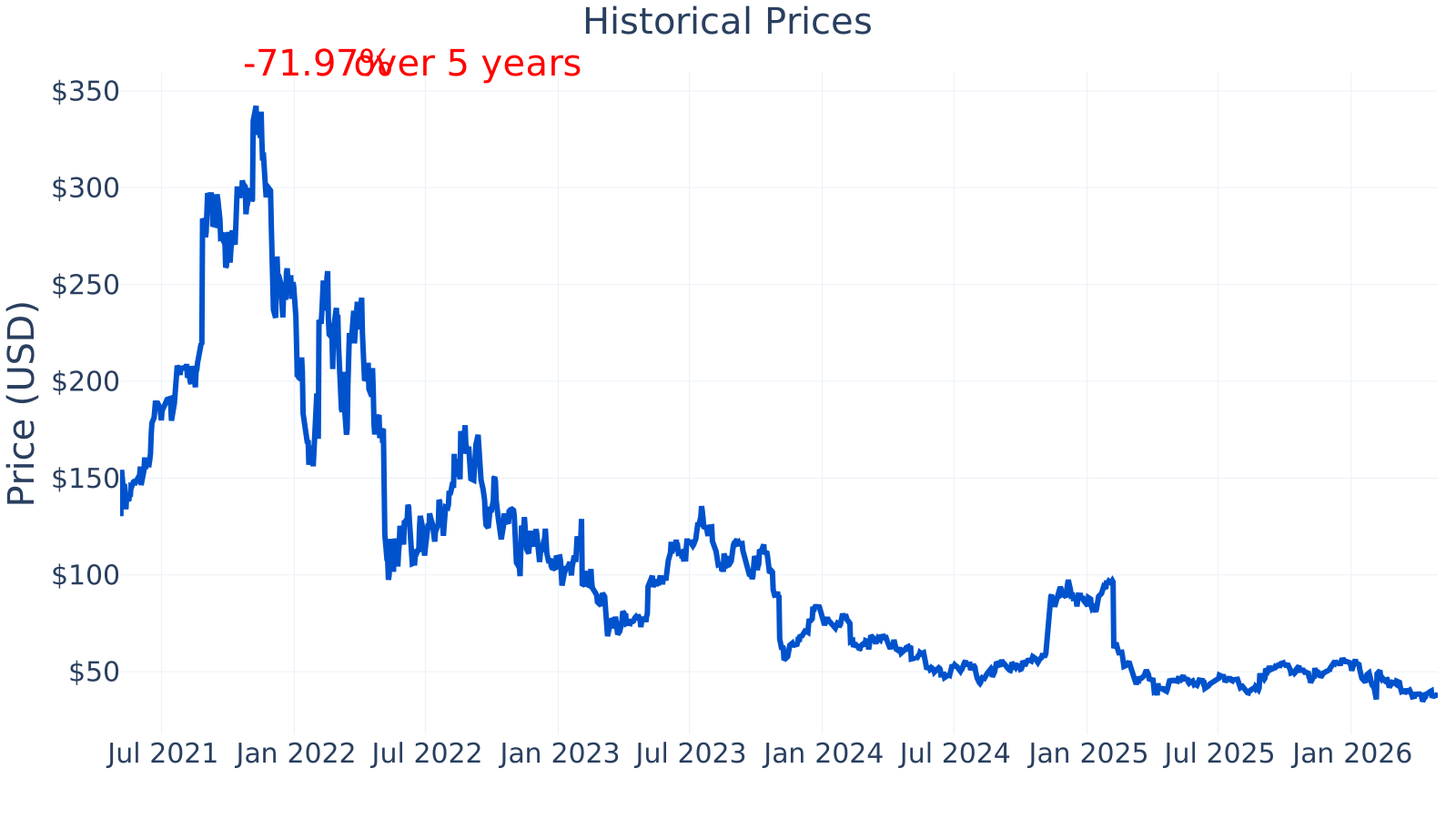
BILL’s market capitalization is about $3.87B, and its beta of about 1.33 indicates the stock has historically tended to move more than the broader market. Recent profitability is slightly negative (about -1.56% net profit margin versus an industry median near 7.95%), while revenue growth is still solid at about 14.4% year over year (roughly in line with an industry median near 15.6%). The company shows meaningful cash generation with trailing twelve-month free cash flow around $348M.
Growth (Medium)
BILL operates in a broad, multi-year shift toward digitizing financial operations for businesses. Many SMBs still rely on manual steps (emails, spreadsheets, paper invoices, check printing), and automating accounts payable and receivable can save time and reduce errors. This creates a long runway for software platforms that can become embedded in day-to-day workflows, especially when they integrate with common accounting systems.
The company’s strategy—pairing a recurring software subscription with payments and workflow automation—can support growth in two ways: (1) adding new customers, and (2) expanding revenue per customer as more payments and related activities run through the platform. A key long-term question is how much of BILL’s future growth comes from expanding into additional workflows (for example, spend controls and expense-related features) versus accelerating core platform adoption.
Year-over-year revenue growth has decelerated materially from extremely high levels earlier in the period (well above 100% in parts of 2021–2022) to the mid-teens more recently (about 14.4% in the latest point shown). Slowing growth is not unusual as a company becomes larger, but it increases the importance of customer retention, pricing power, and product expansion to sustain performance over time.
Free cash flow has improved significantly over the period shown, moving from slightly negative (about -$4.1M in 2022) to strongly positive (about $333.8M in 2025). For long-term fundamental analysis, this trend matters because positive and rising free cash flow can provide flexibility for continued product investment, acquisitions, or balance-sheet strengthening.
Risks (High)
BILL faces several risks that can matter over a multi-year holding period. First, demand is tied to SMB activity levels; if small businesses slow hiring, reduce spending, or experience higher failure rates, payment volumes and new customer adds can soften. Second, the company operates in areas (payments and financial workflows) that require strong reliability, security, and compliance; operational disruptions or security incidents can harm trust and increase costs.
Competition is another major factor. BILL participates in a crowded landscape that includes accounting platforms, payment networks, and other finance-software providers that can bundle overlapping features. Competitors can pressure pricing, raise customer acquisition costs, or reduce the uniqueness of BILL’s offering. In practice, BILL’s competitive position depends on product depth in payables/receivables automation, integration quality with accounting systems, and its ability to prove time/cost savings for customers. Leadership is difficult to define because “back-office automation” spans multiple categories, and customers may choose all-in-one suites or point solutions depending on their needs.
Profitability durability is also a risk. While the company has shown improving results, margins have recently fluctuated and can be influenced by spending choices, transaction mix, and macro conditions.
Net profit margin improved dramatically from deeply negative levels earlier in the period (around -40% to -55% in 2021–2022) to modestly positive territory in parts of 2024–2025, but the most recent value shown is slightly negative at about -1.56%. The industry median in the table is higher (about 7.95%), highlighting that BILL’s profitability profile still looks less mature than many software peers.
Balance-sheet leverage is another consideration, particularly because higher debt can reduce flexibility during slower growth periods.
Debt-to-equity has generally ranged from the mid-20% area to around 50% over the period shown, with the latest value at about 51.0%, above the industry median shown in the table (about 27.1%). This is not necessarily extreme, but it suggests BILL is more leveraged than the median peer in its software industry group.
Valuation
Valuing BILL using simple multiples can be challenging because earnings have been volatile and, at times, near break-even. When profitability is inconsistent, the P/E ratio can swing sharply or become not meaningful in some periods.
The P/E values shown are intermittent, with several periods where it is not displayed. When it does appear, it can be very high (for example, above 100 at multiple points shown), while the industry median in the same timeframe is far lower (generally in the 30–60 range on the chart). A high P/E commonly implies the market is embedding expectations for continued improvement in profitability and/or sustained growth; if either disappoints, valuation sensitivity can increase.
Given the combination of (1) mid-teens revenue growth, (2) improving but still uneven net margins, (3) strong recent free cash flow, and (4) higher leverage than the industry median, BILL’s valuation picture tends to depend heavily on execution: maintaining growth while turning operational improvements into consistently positive earnings.
Conclusion
BILL is a software company focused on automating SMB financial workflows, with revenue tied to subscriptions and usage-driven transaction activity. Over the last several fiscal years, the company has scaled revenue substantially and improved operating results, alongside a notable rise in free cash flow.
At the same time, growth has slowed from earlier hypergrowth levels to the mid-teens, profitability has recently slipped slightly negative after a period of improvement, and leverage (as measured by debt-to-equity) sits above the industry median. Competitive intensity in payments and finance automation remains a central long-term uncertainty, and valuation metrics like P/E can be difficult to interpret due to earnings variability.
From a long-term, fundamentals-oriented perspective, the key items to track over time are whether revenue growth stabilizes at a healthy rate, whether margins become consistently positive and closer to industry norms, and whether the company maintains strong cash generation while managing balance-sheet risk.
Sources:
- SEC EDGAR — Bill.com Holdings, Inc. Form 10-K (Annual Report)
- SEC EDGAR — Bill.com Holdings, Inc. Form 10-Q (Quarterly Reports)
- Bill.com Investor Relations — SEC Filings
- Wikipedia — Bill.com (company overview and history)
This article is for informational purposes only and does not constitute financial advice. Some content is AI-generated. See Disclaimer