Stock Analysis · Bill Com Holdings Inc (BILL)
Overview
Bill.com Holdings, Inc. (BILL) provides cloud software that helps small and mid-sized businesses (SMBs) manage back-office financial workflows. In simple terms, it aims to replace manual tasks like entering bills, routing approvals, paying suppliers, sending invoices, and tracking cash movement with a more automated system. The company sells mainly through subscription-style software and also earns fees when customers use its platform to move money (for example, paying a vendor).
Bill.com operates as a software platform that connects businesses with accounting systems and financial partners, with a focus on automating accounts payable (paying bills) and accounts receivable (getting paid). Its product positioning is built around saving time, reducing errors, and improving visibility into company finances—areas that tend to matter more as a business adds employees, vendors, and transaction volume.
In its SEC filings, BILL generally describes revenue as coming from two main categories: subscription revenue (recurring software access) and transaction revenue (fees tied to payments and other money movement on the platform). The exact split can shift over time based on customer activity levels and product mix.
Over the periods shown, revenue grows substantially, while the company also keeps spending meaningfully on operating expenses (notably product development and selling/administration). More recently, operating income turns positive, which indicates the business has been moving closer to (and reaching) operating profitability as it scales.
Key Figures
| Metric | Value | Industry ⓘ |
|---|---|---|
| Date | Feb 08, 2026 | |
| Context | ||
| Sector | Technology | |
| Industry | Software - Application | |
| Market Cap ⓘ | $4.90B | |
| Beta ⓘ | 1.26 | |
| Fundamental | ||
| P/E Ratio ⓘ | N/A | 27.79 |
| Profit Margin ⓘ | -1.56% | 6.02% |
| Revenue Growth ⓘ | 14.40% | 15.80% |
| Debt to Equity ⓘ | 40.90% | 25.15% |
| PEG ⓘ | 0.74 | |
| Free Cash Flow ⓘ | $347.96M | |
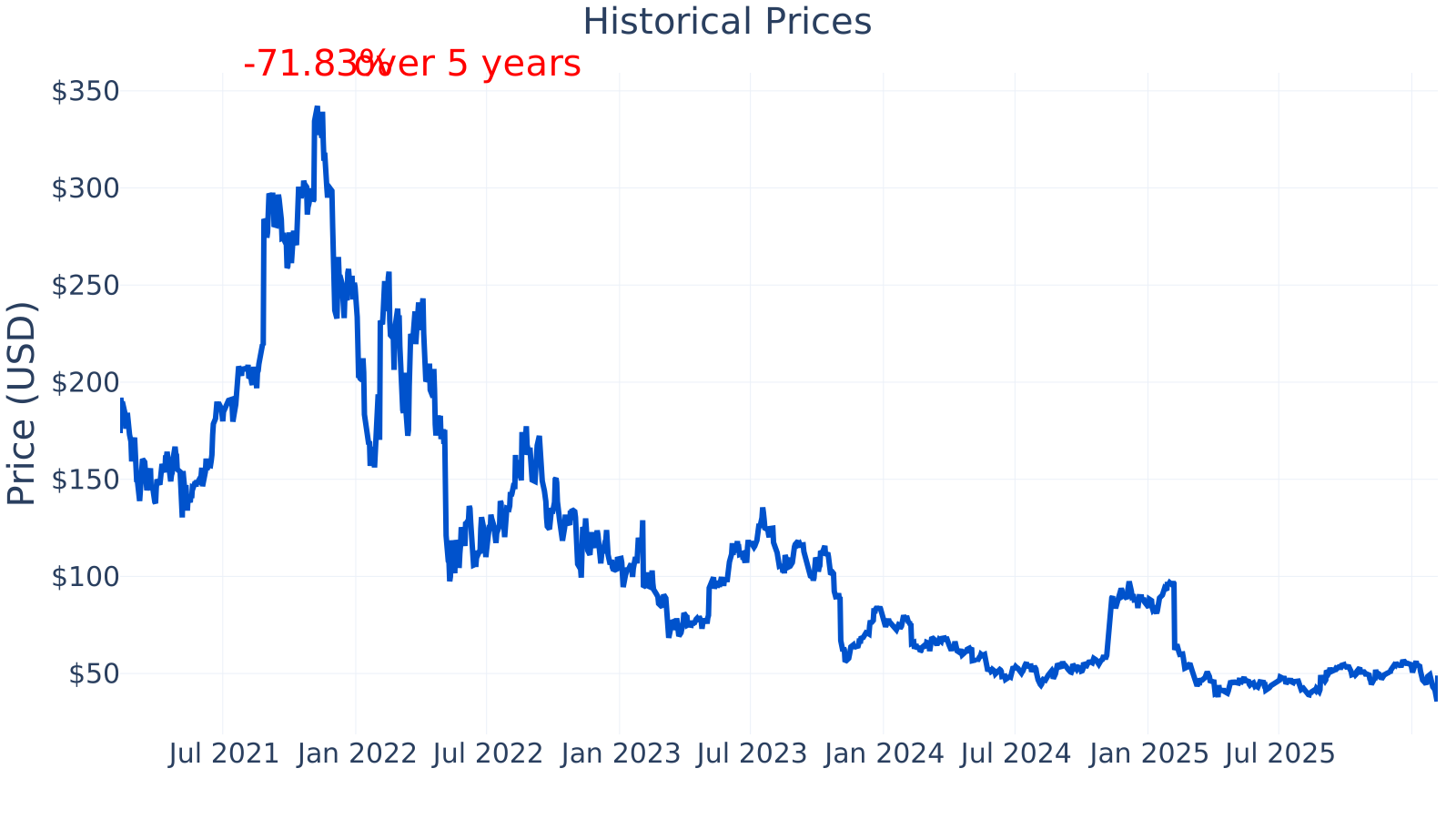
BILL’s market capitalization is about $4.9B, and its beta of 1.26 indicates the stock has tended to move more than the overall market (higher volatility than average). The latest profit margin is about -1.6%, which is below the industry median near 6.0%, showing that bottom-line profitability has been challenging and not yet consistently in line with typical profitable software peers. Year-over-year revenue growth is about 14.4%, close to the industry median around 15.8%. Debt-to-equity is about 40.9% versus an industry median near 25.2%, suggesting somewhat higher balance-sheet leverage than many peers. Free cash flow over the last twelve months is about $348M, showing meaningful cash generation even though accounting profits have been uneven. A PEG ratio around 0.74 is often interpreted as “price relative to growth,” but it is highly sensitive to assumptions and forecast methods, so it is best treated as a directional indicator rather than a decisive measure.
Growth (Medium)
BILL operates in the broader shift from manual, paper-based financial operations toward cloud-based automation. Many SMBs still rely on spreadsheets, email approvals, and bank portals for routine tasks, so the long-term opportunity is tied to continued digitization of back-office work and adoption of integrated software tools.
The company’s strategy—combining recurring software subscriptions with transaction-based revenue—can create two growth drivers: adding new customers and increasing payment volume (and related services) among existing customers. If customers deepen their usage over time (more vendors paid, more invoices sent, more workflows routed through the platform), revenue may expand without needing the same pace of new customer acquisition.
The chart shows revenue growth has slowed from extremely high levels earlier in the period (common for companies coming off a smaller base) to the mid-teens more recently. The latest reading is about 14% year over year, which is still growth, but at a more mature pace than in earlier years.
Free cash flow improves markedly over time, moving from negative in 2021–2022 to strongly positive by 2024–2025 (roughly $334M–$348M in the most recent periods shown). For many software businesses, improving cash generation can be an important milestone because it may provide flexibility for product investment, acquisitions, or balance-sheet resilience without relying as heavily on external financing.
Risks (High)
This article is for informational purposes only and does not constitute financial advice. Some content is AI-generated. See Disclaimer


