Stock Analysis · BigBearai Holdings Inc (BBAI)
Overview
BigBear.ai Holdings, Inc. (BBAI) is a technology services company focused on applying analytics and artificial intelligence (AI) to help organizations make decisions faster and manage complex operations. In practical terms, it builds and integrates software and services that can bring together many data sources, run advanced analysis, and support planning in areas such as logistics, supply chains, and mission-oriented operations. The company has historically served government-related customers and also markets solutions to commercial customers, but its results can be influenced by the timing and scope of large contracts.
BigBear.ai’s revenue is primarily generated from delivering technology services and solutions under contracts. Based on how companies in this space typically disclose results, revenue commonly comes from a mix of service work (such as engineering and integration) and solution-related work (software and analytics capabilities delivered as part of programs). Specific percentage splits by revenue source are not included in the provided figures here, and detailed breakdowns (by customer type and contract category) are generally found in the company’s annual report (Form 10-K).
From an income-statement perspective, the business has shown relatively steady annual revenue in recent years, while profitability has been pressured by operating costs and other expenses. Revenue was about $145.6M (2021), $155.0M (2022), $155.2M (2023), and $158.2M (2024). Over that same period, operating income and net income remained negative, and 2024 showed a particularly large net loss.
Looking at the multi-year flow of revenue into costs and expenses, revenue has been fairly stable from 2021 to 2024, but operating expenses have been large relative to gross profit. In 2024, operating income declined sharply (more negative), and interest expense increased versus prior years, which added additional pressure on net results.
Key Figures
| Metric | Value | Industry ⓘ |
|---|---|---|
| Date | Feb 08, 2026 | |
| Context | ||
| Sector | Technology | |
| Industry | Information Technology Services | |
| Market Cap ⓘ | $2.16B | |
| Beta ⓘ | 3.21 | |
| Fundamental | ||
| P/E Ratio ⓘ | N/A | 21.42 |
| Profit Margin ⓘ | -295.61% | 4.91% |
| Revenue Growth ⓘ | -20.10% | 6.15% |
| Debt to Equity ⓘ | 18.51% | 54.49% |
| PEG ⓘ | N/A | |
| Free Cash Flow ⓘ | -$39.22M | |
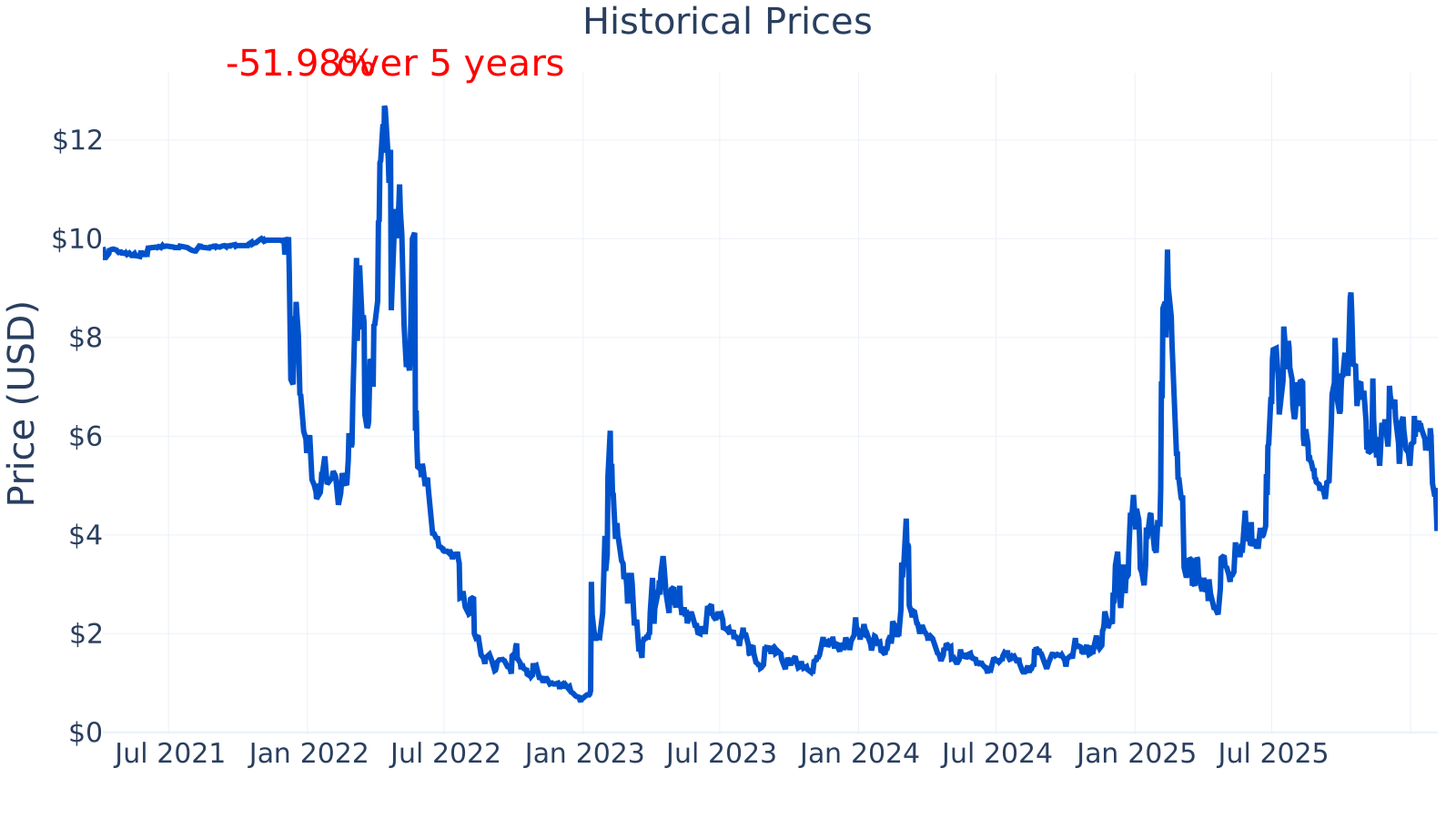
At a market capitalization of about $2.16B, BigBear.ai sits in the small-cap range, where stock prices can be more sensitive to contract news and changes in investor sentiment. The stock’s beta of 3.21 signals historically high volatility versus the broader market.
Profitability and growth (recently) are the most notable weak points in the metrics shown. The latest profit margin is around -296% (compared with an industry median near +4.9%), and the latest year-over-year revenue growth is about -20.1% (versus an industry median near +6.15%). The latest free cash flow (trailing twelve months) is about -$39.2M, meaning the business used cash rather than generating it over the period.
On leverage, the latest debt-to-equity is ~18.5%, below the industry median shown (~54.5%). That said, this ratio has moved dramatically over time, which can happen when equity changes materially (for example, from losses, financing activity, or accounting adjustments).
Growth (Medium)
BigBear.ai operates in a part of the technology market tied to AI-enabled decision support, analytics, and large-scale systems integration. Broadly, demand for AI and advanced analytics has been rising as organizations try to improve efficiency, automate workflows, and manage complex environments. This is a favorable long-term backdrop for many companies offering AI-related services and solutions.
However, company-specific growth has not been consistent quarter-to-quarter. The year-over-year revenue growth pattern has swung between positive and negative rates, including periods of contraction. That kind of variability is often associated with project-based work and contract timing, where the start, completion, renewal, or scope change of a few large programs can noticeably affect reported revenue.
From the growth chart, revenue growth has been volatile: it was strongly positive in some quarters (including a period above 20%), but more recently turned negative, reaching roughly -20% in the latest point shown. For a long-term narrative to strengthen, investors often look for more consistent expansion or a clearer explanation for the variability (for example, improved backlog conversion, new awards scaling into revenue, or a larger mix of recurring software-like revenue).
Another important part of the growth story is whether the company can fund its plans internally. When free cash flow is negative, a company may need to rely more on its cash balance, new financing, or improvements in operating performance.
The free cash flow trend shown remains negative across the periods presented (roughly between -$17.5M and -$53.8M, with the latest around -$39.2M). For future growth, a key catalyst would be sustained progress toward cash generation—either through higher gross margins, improved utilization and delivery efficiency, or a larger share of work that scales without proportional cost increases.
Risks (High)
This article is for informational purposes only and does not constitute financial advice. Some content is AI-generated. See Disclaimer


