Stock Analysis · Best Buy Co. Inc (BBY)
Overview
Best Buy Co., Inc. (BBY) is a specialty retailer focused on consumer electronics and related services. The company sells products such as computing devices, mobile phones, TVs, appliances, and accessories through a mix of physical stores and digital channels, and it also offers services like delivery, installation, protection plans, and technical support. In simple terms, Best Buy operates at the intersection of retail and tech support, aiming to be a convenient place to buy, set up, and maintain technology at home.
From a business model perspective, Best Buy’s results are closely tied to consumer demand for discretionary “big ticket” items (like TVs and appliances) and to upgrade cycles for devices (like laptops and phones). Its service offerings can help smooth results because services are often less dependent on one-time product purchases, but the company is still primarily a retailer with earnings that can rise and fall with demand and pricing conditions.
Main sources of revenue are typically organized around product categories and services, with the largest contributors generally coming from major electronics categories (computing, mobile phones, home theater) plus appliances and services. Exact percentages can vary by fiscal year and are detailed in the company’s annual report (Form 10‑K) segment and category disclosures.
Over the last several fiscal years shown, total revenue declined from about $51.8B (FY2022) to about $41.7B (FY2026). Operating income and net income also fell from FY2022 levels and then partially stabilized, illustrating how profitability can compress when sales volumes decline and retail pricing becomes more competitive.
Key Figures
| Metric | Value | Industry ⓘ |
|---|---|---|
| Date | Mar 09, 2026 | |
| Context | ||
| Sector | Consumer Cyclical | |
| Industry | Specialty Retail | |
| Market Cap ⓘ | $14.01B | |
| Beta ⓘ | 1.44 | |
| Fundamental | ||
| P/E Ratio ⓘ | 22.01 | 22.01 |
| Profit Margin ⓘ | 2.56% | 6.27% |
| Revenue Growth ⓘ | -1.00% | 5.10% |
| Debt to Equity ⓘ | 118.36% | 103.28% |
| PEG ⓘ | 1.25 | |
| Free Cash Flow ⓘ | $1.26B | |
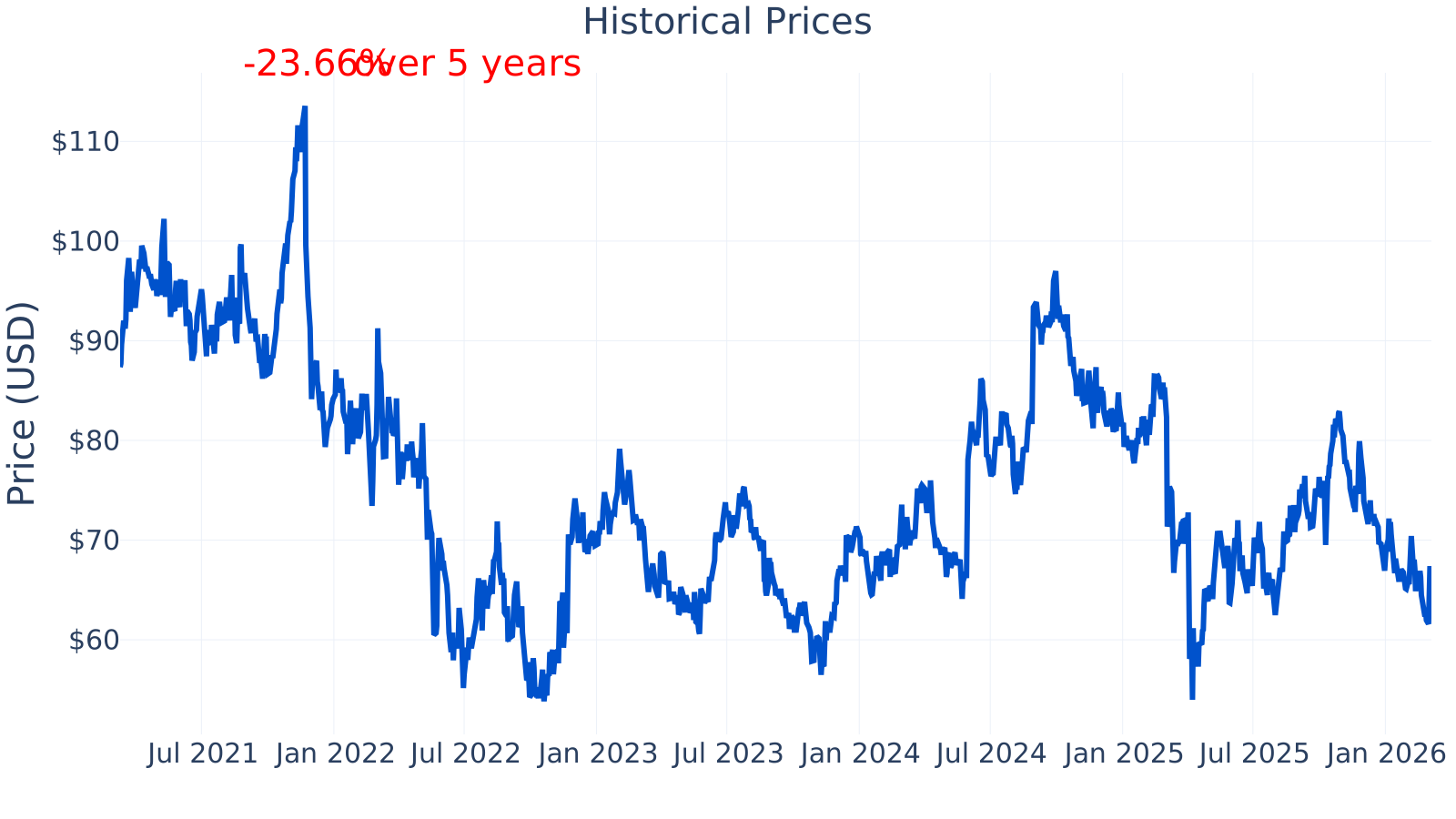
Best Buy’s market capitalization is about $14.0B. The stock’s beta of 1.44 indicates it has tended to move more than the broader market (higher volatility). The P/E ratio is about 22.0, which is in line with the industry median shown. Profit margin is about 2.56%, below the industry median (about 6.27%), reflecting the reality that consumer electronics retailing is often a low-margin business. Year-over-year revenue growth is about -1.0% versus a positive industry median (about +5.1%), suggesting Best Buy’s recent top-line performance has lagged the typical peer group. Debt-to-equity is about 118% (vs. an industry median near 103%), indicating a somewhat higher reliance on debt and other obligations relative to equity than the median specialty retail peer in this set. Trailing twelve-month free cash flow is about $1.26B, which is a key indicator of the cash the business generates after operating needs and capital spending.
Growth (Low to Medium)
Best Buy operates in a mature retail category. Consumer electronics demand is widespread and persistent, but it is not consistently high-growth; it tends to follow replacement cycles (people upgrade when devices age or new features matter) and macro conditions (interest rates, consumer confidence, housing turnover, and overall discretionary spending). That makes long-run growth more dependent on execution, market share, and services attachment than on a rapidly expanding end market.
A practical way to view Best Buy’s growth setup is that the company can benefit when upgrade cycles strengthen (for example, replacement waves for PCs, phones, TVs, and home appliances) and when it can attach services (installation, protection plans, subscriptions, support) to product sales. Services can support customer retention and potentially provide steadier demand than one-time device purchases, although the company’s reported totals remain strongly influenced by product sales.
The year-over-year revenue pattern shows a sharp slowdown after the strong growth period in 2021, followed by an extended stretch of declines and then signs of stabilization. In the most recent point shown (FY2026), revenue growth is approximately -1.0% year over year, after modestly positive readings earlier in FY2025. This pattern is consistent with a business experiencing a post-demand-surge normalization and then working toward steadier trends.
Free cash flow has been positive across the period shown but uneven: about $2.52B (FY2022), then down to about $0.89B (FY2023) and $0.68B (FY2024), then recovering to about $1.39B (FY2025) and about $1.26B (FY2026). For a retailer, sustained positive free cash flow can matter because it supports reinvestment in stores and digital capabilities and can improve flexibility during weaker demand periods.
Risks (Medium to High)
Best Buy’s core risk is demand sensitivity. Many of its products are discretionary purchases, and sales can drop when consumers delay upgrades or shift spending to essentials. In addition, consumer electronics retail tends to face frequent price competition, which can pressure margins—especially during promotional periods or when competitors prioritize market share.
Another important risk is that the company’s profitability is structurally constrained by the nature of electronics retailing. Even well-run retailers in this category can see thin net margins, and small changes in pricing, product mix, warranty/returns, and supply chain costs can meaningfully affect earnings.
Net profit margin has trended lower versus earlier years in the series. The latest value shown is about 2.56%, which is below the industry median displayed (about 5.57%). While there is a recent uptick from the low point in FY2025, the longer view suggests profitability has been under pressure compared with many specialty retail peers in this dataset.
Balance sheet structure is another consideration. Retailers often use leases and other obligations as part of operating their store base, and changes in debt levels, interest rates, or operating performance can affect financial flexibility.
Debt-to-equity is about 118% in the latest period shown. Over much of the timeline, it was frequently above the industry median displayed, and it peaked materially higher than current levels before improving in the most recent point. This indicates leverage has been meaningful and has fluctuated, which can amplify outcomes (positive or negative) depending on the operating environment.
Competition is intense. Best Buy competes with large general e-commerce retailers, mass merchants, warehouse clubs, mobile carrier stores, manufacturer direct-to-consumer channels, and other electronics specialists. In this landscape, competitive advantages tend to come from scale, service capability (delivery/installation/support), convenient fulfillment options (ship-to-home, store pickup), vendor relationships, and brand trust for higher-consideration purchases. Best Buy is a leading U.S. consumer electronics specialty retailer with broad national presence, but it competes against larger multi-category retailers with significant pricing power and logistics networks.
Valuation
The P/E ratio has risen over the period shown from single-digit levels in 2021–2022 to the low-to-mid 20s by late 2025, reaching about 23.95 at the last point on the chart. The latest P/E in the table is about 22.0, which matches the industry median shown there. Descriptively, that places Best Buy’s valuation multiple around the middle of its peer group based on this single metric.
Interpreting valuation for a retailer like Best Buy often comes down to whether profits and cash flows are expected to be stable, improving, or under pressure. The company’s recent revenue trend has been roughly flat to slightly down (about -1.0% year over year in the latest figure), and net margin is relatively low versus the peer median. At the same time, free cash flow has remained positive and has recovered from earlier lows. Those cross-currents can help explain why valuation may not look extreme versus peers while still being sensitive to future operating performance.
Conclusion
Best Buy is a large, established consumer electronics retailer whose performance is closely tied to device and appliance replacement cycles and overall consumer spending. The company has shown the ability to generate meaningful free cash flow even during a period of lower revenue, but its net profit margin is thin and below the peer median shown, highlighting the competitive and promotional nature of its category.
From a long-term perspective, the main points to weigh are (1) the maturity and cyclicality of the underlying demand environment, (2) the company’s ability to defend margins and grow or stabilize revenue through execution and services, and (3) balance sheet leverage relative to peers. On valuation, the P/E ratio appears broadly in line with the industry median shown, suggesting the market is not pricing Best Buy as a clear outlier on that measure; however, results can still be sensitive to shifts in demand and pricing.
Sources:
- U.S. Securities and Exchange Commission (SEC EDGAR) — Best Buy Co., Inc. Form 10-K (Annual Report)
- U.S. Securities and Exchange Commission (SEC EDGAR) — Best Buy Co., Inc. Form 10-Q (Quarterly Reports)
- Best Buy Co., Inc. Investor Relations — SEC Filings & Annual Reports
- Wikipedia — “Best Buy” (company overview and history)
This article is for informational purposes only and does not constitute financial advice. Some content is AI-generated. See Disclaimer