Stock Analysis · Belden Inc (BDC)
Overview
Belden Inc. (BDC) designs and manufactures products that help move data and power reliably in demanding environments. In simple terms, it sells the “connectivity building blocks” used to build and operate communication networks and industrial systems—such as cables, connectors, and network equipment—often for factories, data-intensive facilities, and other mission-critical sites where downtime can be costly.
Based on the company’s reporting, Belden organizes its business around two main areas:
- Smart Infrastructure Solutions (SIS): connectivity products and solutions commonly used in enterprise and industrial network infrastructure (for example, structured cabling and related components).
- Industrial Automation Solutions (IAS): networking and connectivity products used in industrial automation and operational technology environments (often tied to industrial Ethernet and related systems).
Revenue is primarily generated through selling these products (and, depending on the period and offering, related solutions/services) to customers in industrial, enterprise, and infrastructure end-markets. Public filings are the best place to confirm the latest segment mix percentages; the exact share by segment can shift year to year depending on demand cycles and product mix.
Looking at recent full-year income statement flows, revenue has been in the roughly $2.3–$2.7 billion range (2021–2025). Gross profit generally increased in dollars from 2021 to 2025, while operating income and net income fluctuated, reflecting changes in demand, costs, and operating expenses over time.
Key Figures
| Metric | Value | Industry ⓘ |
|---|---|---|
| Date | Feb 16, 2026 | |
| Context | ||
| Sector | Technology | |
| Industry | Communication Equipment | |
| Market Cap ⓘ | $5.93B | |
| Beta ⓘ | 1.21 | |
| Fundamental | ||
| P/E Ratio ⓘ | 25.32 | 40.50 |
| Profit Margin ⓘ | 8.75% | 4.65% |
| Revenue Growth ⓘ | 8.10% | 14.10% |
| Debt to Equity ⓘ | 109.14% | 60.64% |
| PEG ⓘ | 0.99 | |
| Free Cash Flow ⓘ | $218.69M | |
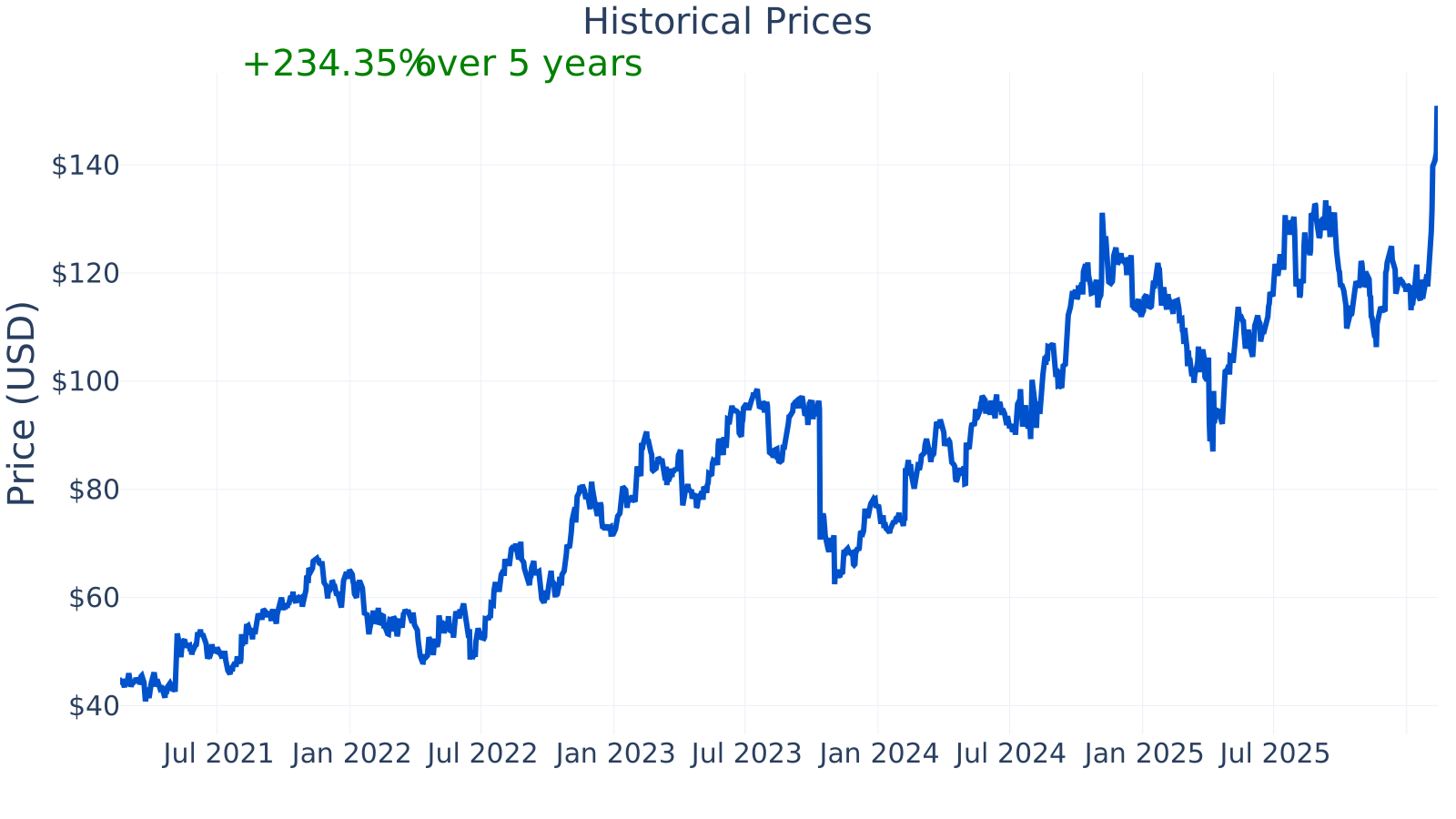
Belden’s market capitalization is about $5.93B, and its beta of ~1.21 suggests the share price has historically moved somewhat more than the broader market. The company’s P/E ratio is ~25.3 versus an industry median of ~40.5, while its profit margin is ~8.75% compared with an industry median of ~4.65%. Year-over-year revenue growth is about 8.1%, below the listed industry median of ~14.1%. Debt-to-equity is about 109%, higher than the industry median of ~61%. Trailing twelve-month free cash flow is approximately $218.7M.
Growth (medium)
Belden operates in areas supported by long-term needs: more data moving through networks, more connected equipment in industrial settings, and ongoing upgrades of network infrastructure. These themes can create durable demand, but results can still be cyclical because customers often time projects around budgets, capacity expansions, and broader economic conditions.
Recent year-over-year revenue growth shows noticeable swings: strong growth in parts of 2021–2022, a period of declines through much of 2023–mid 2024, and then a return to positive growth later in 2024 and into 2025 (ending near 8% most recently). This pattern is consistent with a business that can be influenced by project timing and industrial/enterprise spending cycles rather than a steady, uninterrupted growth curve.
Free cash flow (cash generated after operating needs and capital spending) has generally trended upward over the last several years, reaching roughly $219M in the most recent period shown. While it dipped around 2024, the rebound suggests the company has been able to convert earnings back into cash over time—an important characteristic for funding investment, reducing debt, or returning capital to shareholders (depending on management’s priorities described in filings).
Potential growth catalysts are typically tied to (1) customers resuming or expanding automation and network modernization projects, (2) product mix shifting toward higher-value solutions, and (3) operational execution such as efficiency improvements and disciplined investment in product development.
Risks (medium-high)
A key risk area is financial leverage. Belden’s debt-to-equity ratio is elevated relative to the industry median, which can matter because higher leverage may reduce flexibility during weaker demand periods and can increase the sensitivity of results to interest costs and refinancing conditions.
The longer-term trend shows leverage coming down significantly from 2021 levels but remaining around the ~100% range more recently, which is still above the peer median in the chart. This can be manageable if cash generation remains healthy, but it raises the importance of steady execution and prudent balance sheet management.
Another risk is exposure to spending cycles. Industrial automation and network infrastructure purchases are often tied to multi-quarter projects and capital expenditure budgets. Delays, cancellations, or slower ordering can lead to uneven quarterly performance. Supply chain conditions, input costs, and pricing dynamics can also influence results.
Profitability has improved versus earlier periods: profit margin moved from around break-even/low levels in 2021 to the high single digits more recently (about 8.75%), consistently above the industry median shown. Even so, margins can compress if pricing power weakens, product mix becomes less favorable, or costs rise faster than sales.
On competitive positioning, Belden participates in crowded markets that include large diversified players and specialized industrial/networking companies. Competitive advantages in this type of business often come from brand reputation in mission-critical settings, long-standing customer relationships, certifications/standards compliance, installed base compatibility, and breadth of portfolio across connectivity components and industrial networking. However, it is not a “winner-takes-all” category; customers may qualify multiple vendors, and competitors can pressure price and lead times.
Main competitor sets typically include:
- Industrial networking / automation connectivity: firms offering industrial Ethernet hardware and related components (often part of broader automation portfolios).
- Connectivity and cabling: manufacturers of cables, connectors, and structured cabling systems serving enterprise and industrial environments.
Because competitors vary by sub-category, Belden’s position is best evaluated segment-by-segment using its SEC filings (market context, customer concentration, and product lines), rather than assuming a single direct rival across the whole company.
Valuation
Belden’s current P/E ratio is about 25.3, which is below the industry median (~40.5) shown. Historically, the company’s P/E in the chart has moved widely (from low teens at times to the high 20s/near 40 in earlier periods), reflecting changes in earnings and market expectations.
Whether today’s valuation is “high” or “low” depends on how durable earnings and cash flow prove to be through cycles, and how much balance sheet risk the market assigns to the company’s leverage. In context, the combination of (1) profit margins above the industry median, (2) positive recent revenue growth, and (3) meaningful free cash flow can support a mid-range earnings multiple. At the same time, (a) growth has been uneven and (b) leverage is higher than the industry median, which can weigh on valuation during more cautious periods.
Conclusion
Belden is a connectivity-focused industrial and network infrastructure company with operations tied to long-term themes like increasing data needs and industrial digitization. Financially, it shows improved profitability versus earlier years and meaningful free cash flow generation, while recent revenue growth has returned to positive territory after a weaker stretch.
The main trade-offs visible from the fundamentals are the business’s exposure to cyclical project spending and a leverage level that remains above the peer median, even after improving from earlier highs. Over the long term, outcomes are likely to depend on sustained demand in industrial/enterprise infrastructure upgrades, the company’s ability to defend margins in competitive categories, and continued balance sheet discipline.
Sources:
- SEC EDGAR — Belden Inc. Form 10-K (Annual Report)
- SEC EDGAR — Belden Inc. Form 10-Q (Quarterly Reports)
- Belden Investor Relations — SEC Filings & Reports (company-hosted)
- Wikipedia — “Belden Inc.” (basic company background)
This article is for informational purposes only and does not constitute financial advice. Some content is AI-generated. See Disclaimer


