Stock Analysis · Bel Fuse B Inc (BELFB)
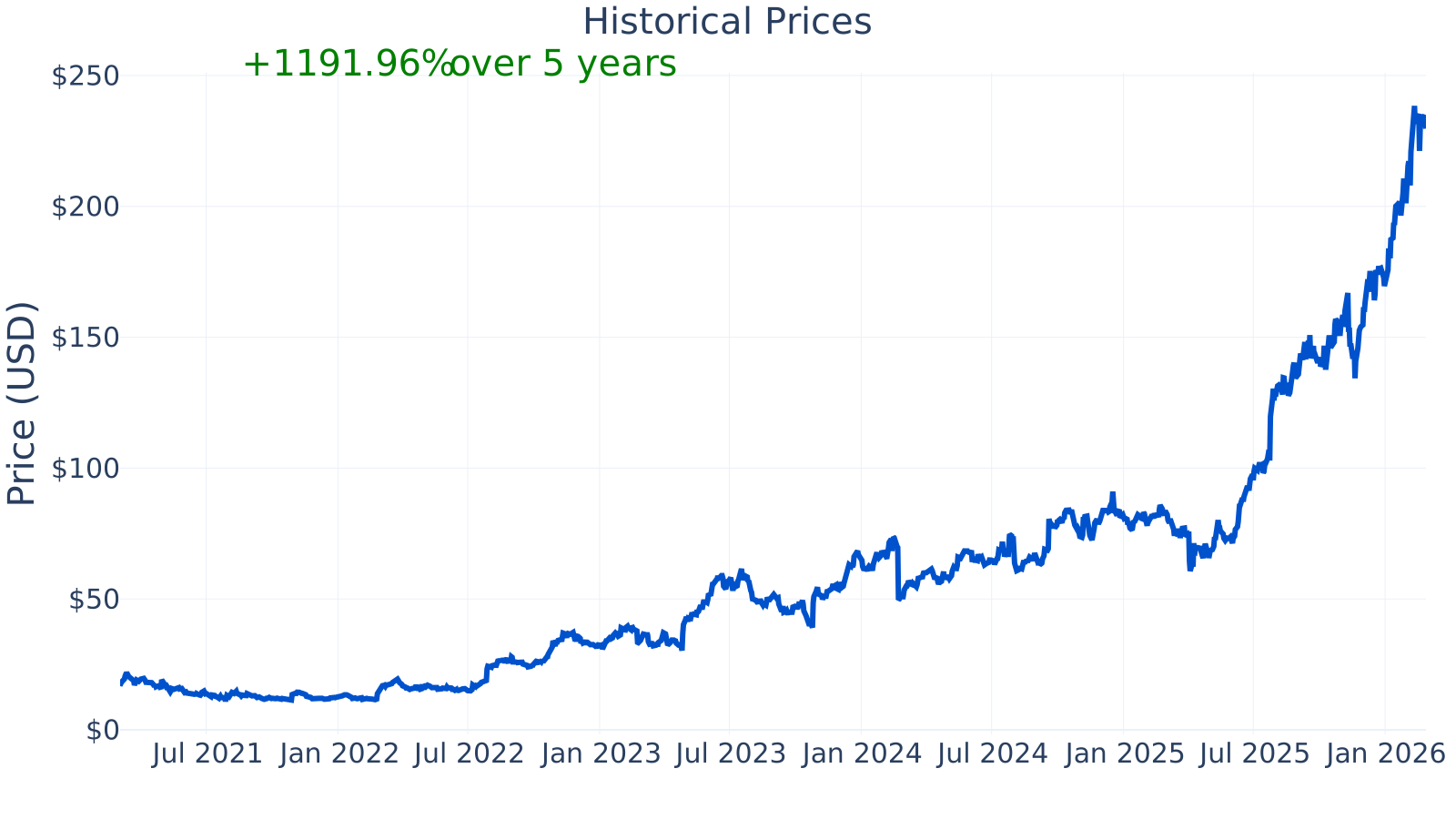
Overview
Bel Fuse B Inc. designs, manufactures, and sells electronic components used to move power and data through equipment. In simple terms, its products help devices “connect” and “convert” electricity or signals reliably. The company’s components are used across end markets such as communications networking, industrial equipment, transportation, aerospace/defense, and other electronics where reliability and performance matter.
Bel typically describes its business through product groups that reflect how customers use the components. Based on the company’s segment reporting in its SEC filings, the main revenue sources are generally organized as:
- Power Solutions (power conversion products that help turn and regulate electricity inside equipment)
- Connectivity Solutions (connectors and related parts that physically link electronics)
- Magnetic Solutions (magnetics used in networking and power applications, such as integrated connector modules and related components)
Exact percentages by segment can vary by year and should be taken from the most recent annual report segment note; the company reports these in its Form 10‑K.
The income statement pattern over the last several years shows a business where material costs are a large portion of revenue, and profitability can swing with volume, pricing, and mix. Revenue rose from about $543.5M (2021) to $675.5M (2025), while net income moved from about $24.8M (2021) to $61.5M (2025), with a noticeable dip in 2024 (net income about $41.0M) before improving again.
From 2021 to 2025, revenue increased overall (with a drop in 2024), and operating income expanded meaningfully by 2025. Over the same period, operating expenses (including R&D and SG&A) also grew, and interest expense was notably higher in 2025 than in prior years, which can matter for net results when borrowing costs rise.
Key Figures
| Metric | Value | Industry ⓘ |
|---|---|---|
| Date | Mar 02, 2026 | |
| Context | ||
| Sector | Technology | |
| Industry | Electronic Components | |
| Market Cap ⓘ | $2.91B | |
| Beta ⓘ | 1.21 | |
| Fundamental | ||
| P/E Ratio ⓘ | 49.51 | 42.60 |
| Profit Margin ⓘ | 9.11% | 6.11% |
| Revenue Growth ⓘ | 17.40% | 13.80% |
| Debt to Equity ⓘ | 55.76% | 39.00% |
| PEG ⓘ | 2.11 | |
| Free Cash Flow ⓘ | $68.61M | |
Bel Fuse B’s market capitalization is about $2.9B, and the stock’s beta of ~1.21 suggests it has tended to move somewhat more than the broader market. The company’s P/E ratio is ~49.5 versus an industry median around 42.6. Profitability is currently stronger than the industry median (~9.1% net profit margin vs. ~6.1%), and the most recent year-over-year revenue growth is ~17.4% (industry median ~13.8%). Financial leverage is higher than the industry median (debt-to-equity ~55.8% vs. ~39.0%). Trailing twelve-month free cash flow is about $68.6M, and the PEG ratio ~2.11 implies the valuation is meaningfully influenced by expected growth assumptions.
Growth (medium)
Bel Fuse operates in electronic components, a broad industry supported over the long run by trends such as electrification, increased networking bandwidth, factory automation, and the ongoing build-out of data infrastructure. Demand, however, is often cyclical: customers can reduce orders when inventory is high or when industrial and communications spending slows, and then re-accelerate later.
The revenue growth pattern shows this cyclicality clearly. Growth was strong in 2021–early 2023, then turned negative through much of 2023–2024, and returned to positive in late 2024 and throughout 2025 (ending at about +17.4% year over year). For a long-term view, this suggests results can swing, so the direction of demand in the company’s key end markets can matter as much as execution in any single quarter.
Free cash flow (cash generated after operating needs and capital spending) has also fluctuated: it was negative around 2022, then improved substantially by 2023–2024, and remained positive in 2025 (about $68.6M on a trailing basis). Consistently positive free cash flow can increase flexibility for reinvestment, debt reduction, and other corporate uses, but the history here indicates it has not been steady every year.
Potential catalysts (in a neutral, factual sense) tend to come from: recovering demand after downcycles, new program wins with large customers, improved product mix (more specialized components), and operational efficiency. Because Bel sells components into many complex systems, changes in customer build plans, inventory levels, and supply chains can quickly affect reported results.
Risks (high)
A key long-term risk is end-market cyclicality. Many component suppliers experience periods where customers slow purchasing to work through inventories, which can pressure revenue and margins. The company is also exposed to input cost swings (materials and manufacturing costs), and to customer concentration risk if a small number of customers represent a large portion of sales (the extent of this is detailed in the company’s 10‑K risk disclosures).
Leverage is another watch item. Debt-to-equity was relatively low through much of 2023–2024 (roughly in the 23%–27% range), then jumped sharply at the end of 2024 and remained elevated into 2025, ending around 55.8%. That is above the industry median (~39.0%). Higher leverage can amplify results in strong periods but can reduce flexibility during slowdowns, especially if interest expense rises (which is consistent with the higher interest expense shown in 2025).
Profitability improved meaningfully from 2021 into 2023–2024, then compressed in late 2024 and stabilized around 9%–10% during 2025. Even after the pullback, the company’s net margin of about 9.1% remains above the industry median (~6.1%), which may indicate favorable product mix, execution, or pricing discipline versus peers. Still, the variability over time reinforces that margins are not guaranteed and can shift with volumes and costs.
Competition is a structural risk. Bel operates in markets with many established component manufacturers. Depending on the product line, competitors can include large diversified suppliers and specialized connector, magnetics, and power-conversion companies. In many component categories, scale, qualification history, reliability, customer relationships, and the ability to meet demanding specifications matter as competitive advantages. Bel is not generally described as the single dominant leader across all its categories; instead, it competes across multiple niches where performance requirements and long customer qualification cycles can help incumbents—but price competition can still be intense.
Valuation
The current valuation, as reflected in a P/E ratio around 49.5, is above the industry median (~42.6). Historically (based on the chart), Bel’s P/E was much lower for several years (often in the high single digits to teens) before increasing materially in 2024–2025. A rising P/E can come from a higher stock price, lower earnings, or both; in practice it often reflects increased expectations about future earnings growth or durability.
Two practical ways to interpret the valuation in context are:
- Relative comparison: The company trades at a higher earnings multiple than the typical peer in its industry set, which implies the market is assigning a stronger outlook and/or higher business quality than the median competitor.
- Growth-adjusted view: The PEG ratio of ~2.11 suggests the valuation is meaningfully dependent on future growth assumptions. If growth proves uneven (as the company’s historical cyclicality indicates), valuation can be more sensitive to changes in expectations.
Because profitability and revenue growth have been variable across the cycle, the key valuation question for long-term analysis is whether the company can sustain improved margins and cash generation through different demand environments, while managing leverage and interest costs.
Conclusion
Bel Fuse B is an electronic components manufacturer whose products support the flow of power and data in a wide range of equipment. The company’s results over recent years show an underlying ability to generate profits and free cash flow, alongside noticeable cyclicality in revenue growth. Net margins have been stronger than the industry median recently, which can be an important sign of operating performance and product mix.
At the same time, risks appear meaningful: demand cycles can be sharp, competitive pressure is persistent in components, and leverage rose materially from late 2024 into 2025 compared with both the company’s recent history and the industry median. The current valuation multiples are also elevated compared with the company’s own history and above the industry median, which increases sensitivity to future growth and margin outcomes.
Sources:
- SEC EDGAR — Bel Fuse Inc. filings (Form 10‑K, Form 10‑Q)
- Bel Fuse Inc. Investor Relations — SEC reports and investor materials (company-hosted)
- Wikipedia — “Bel Fuse” (basic company background)
This article is for informational purposes only and does not constitute financial advice. Some content is AI-generated. See Disclaimer


