Stock Analysis · Bel Fuse A Inc (BELFA)
Overview
Bel Fuse A Inc (BELFA) is a manufacturer of electronic components that help move power and data inside many types of equipment. In practical terms, the company sells parts that let devices connect, charge, communicate, and operate reliably. Its products are used across end-markets such as networking/telecom equipment, industrial systems, transportation applications, and other electronics where rugged, high-reliability components are important.
Bel generally organizes its business around major product families rather than consumer “brand” products. Across its disclosures, revenue is commonly discussed through operating segments that include Connectivity Solutions, Power Solutions, and Magnetic Solutions (naming can vary by filing year). These categories cover items such as connectors and cable assemblies (connectivity), power supplies and power conversion (power), and magnetics used in networking/power circuitry (magnetics).
Public filings typically provide revenue detail by segment, but exact percentages can change over time and depend on the reporting period. In simple terms, the company’s revenue is usually driven by:
- Connectivity-related products (connectors, cable assemblies, and related solutions)
- Power-related products (power conversion, power supplies, and related components)
- Magnetics (magnetic components used in power and signal applications)
One useful way to look at the business is to see how sales flow through costs and operating expenses into profit over time. The chart below summarizes that flow at a high level.
Over the 2021–2025 period shown, total revenue rises overall (from about $543M in 2021 to about $675M in 2025). Profitability also improves versus 2021, with operating income and net income higher in 2025 than in 2021, although results were not linear year to year (for example, 2024 shows lower revenue and net income than 2023, followed by a rebound in 2025).
Key Figures
| Metric | Value | Industry ⓘ |
|---|---|---|
| Date | Feb 23, 2026 | |
| Context | ||
| Sector | Technology | |
| Industry | Electronic Components | |
| Market Cap ⓘ | $3.02B | |
| Beta ⓘ | 1.21 | |
| Fundamental | ||
| P/E Ratio ⓘ | 43.73 | 43.04 |
| Profit Margin ⓘ | 9.11% | 6.11% |
| Revenue Growth ⓘ | 17.40% | 13.80% |
| Debt to Equity ⓘ | 55.76% | 39.00% |
| PEG ⓘ | 1.23 | |
| Free Cash Flow ⓘ | $68.61M | |
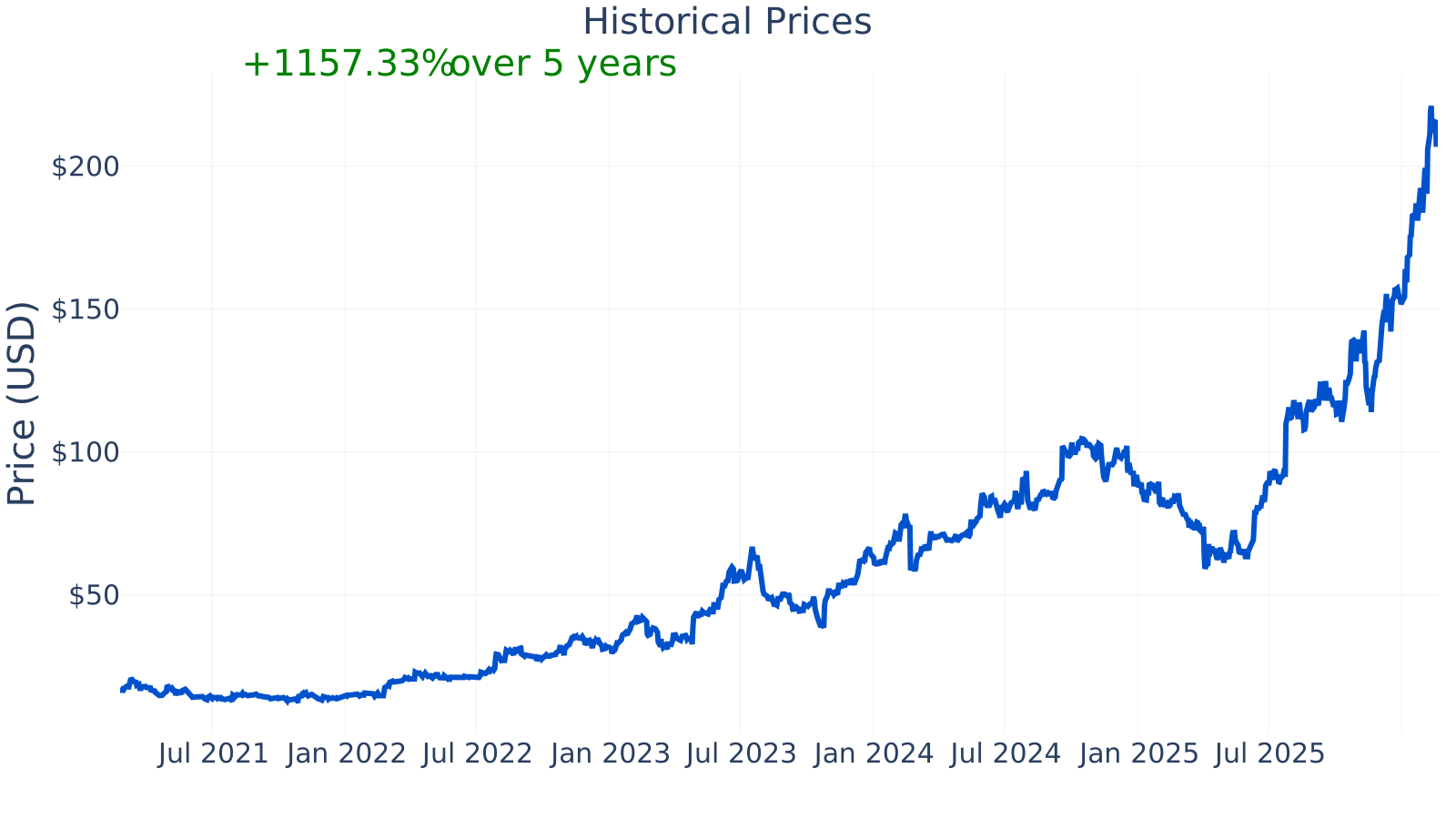
The latest snapshot shows a company with a market capitalization of about $3.0B and a beta of ~1.21, which suggests the share price has tended to move somewhat more than the overall market. The P/E ratio is ~43.7, close to the listed industry median (~43.0). Profitability appears stronger than the industry median on this view, with a net profit margin of ~9.1% versus an industry median of ~6.1%. Recent growth is also ahead of the median in this dataset, with year-over-year revenue growth of ~17.4% versus ~13.8% for the industry median. Leverage is higher than the median: debt-to-equity of ~55.8% versus an industry median of ~39.0%. The company also shows positive trailing free cash flow of about $68.6M.
Growth (Medium)
Bel operates in electronic components, which is a broad, long-lived industry tied to the ongoing build-out and refresh cycles of communications infrastructure, industrial automation, transportation electrification, and data-driven computing. Demand can be cyclical because customers often adjust inventory and capital spending, but the underlying need for power conversion and connectivity components tends to persist as systems become more electronic and more connected.
The revenue growth pattern shown is notably cyclical. Growth was strong through much of 2021–early 2023, then turned negative through 2023–2024 (consistent with a downcycle or customer inventory correction), and then improved again into late 2024 and 2025. The most recent point shown is ~17.4% year-over-year, indicating a rebound versus the prior-year period.
Free cash flow (cash generated after operating needs and capital spending) is positive on the trailing basis in most periods shown, with a dip into negative territory around 2022 and stronger positive readings in 2023–2025. The latest trailing figure shown is about $68.6M. For long-term business resilience, sustained positive free cash flow can matter because it provides flexibility for investment, debt reduction, and working capital swings during slower demand periods.
Potential long-term catalysts for a company like Bel typically come from (1) winning positions in customer designs that last several years, (2) expanding content per system as power and connectivity needs grow, and (3) operational improvements that lift margins. That said, the same end-markets can also bring periodic slowdowns, so growth tends to be uneven rather than steady.
Risks (High)
This article is for informational purposes only and does not constitute financial advice. Some content is AI-generated. See Disclaimer