Stock Analysis · Bandwidth Inc (BAND)
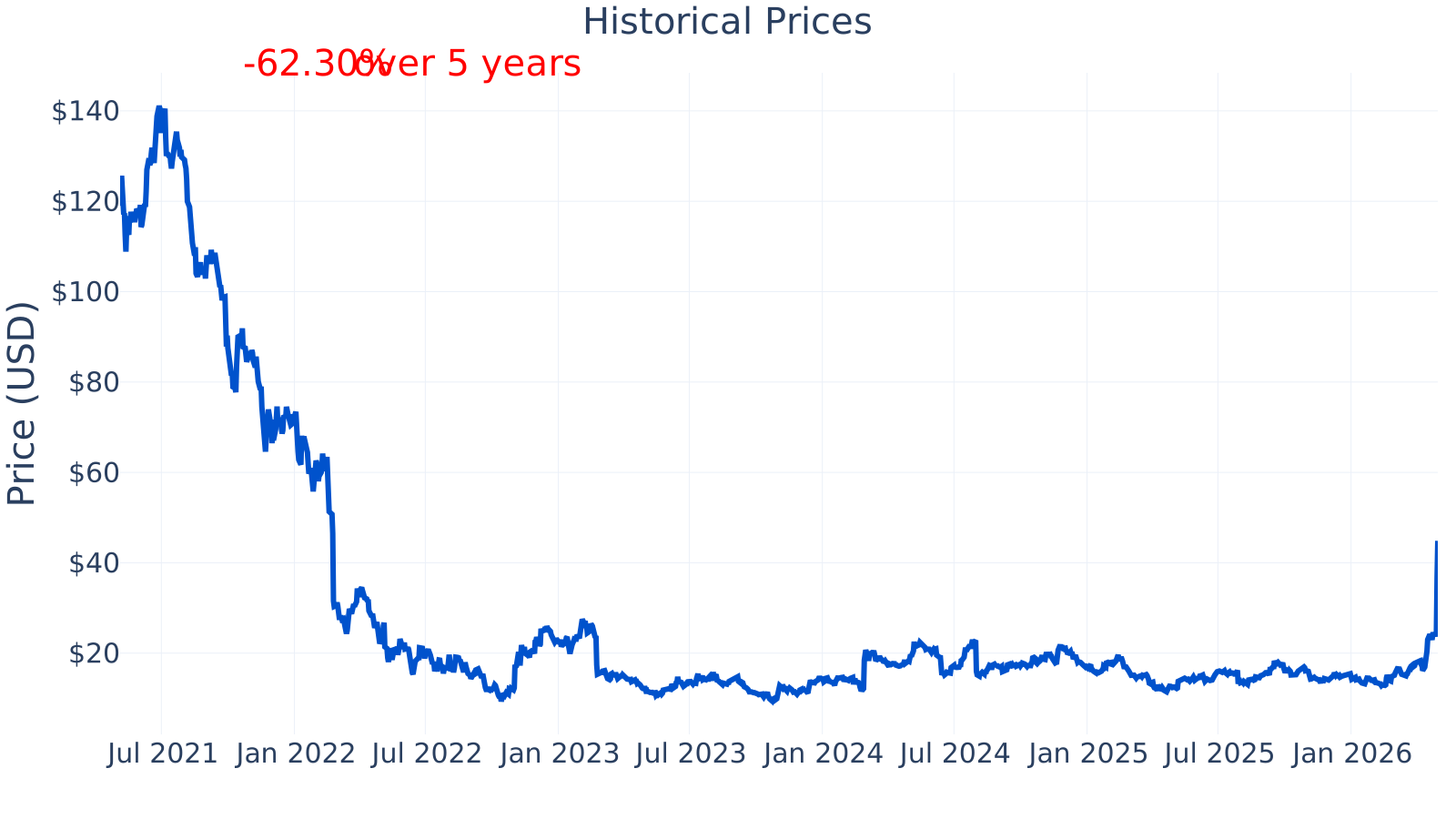
Overview
Bandwidth Inc. is a communications software company focused on “CPaaS” (Communications Platform as a Service). In simple terms, it helps other businesses add phone calls, text messaging, emergency calling (like 911), and other communication features directly into their own apps and workflows through software tools (APIs) and network services.
A key part of Bandwidth’s model is that it operates its own IP-based voice network and also provides connectivity to phone networks. This matters because it can influence cost, call quality, reliability, and control over features such as emergency services and messaging deliverability—areas that can be important for business-critical communications.
Revenue is primarily generated when customers use communication services (usage-based fees) and, in some cases, through ongoing platform/service arrangements. Public filings describe revenue in product lines, but the exact split can vary by period and may not always be presented with fixed percentages in a simple format.
Main revenue streams (typical ordering based on how CPaaS companies report their business):
- Messaging (SMS/MMS and related business messaging services)
- Voice (inbound/outbound calling, SIP trunking, call control features)
- Emergency services (E911 and related capabilities)
- Other communication-related services (additional platform features and services as described in filings)
Across the years shown, total revenue increased meaningfully (from about $490.9M in 2021 to about $753.8M in 2025). At the same time, operating income and net income moved between profit and loss, reflecting a business that has grown but has not consistently produced bottom-line profitability.
Key Figures
| Metric | Value | Industry ⓘ |
|---|---|---|
| Date | May 04, 2026 | |
| Context | ||
| Sector | Technology | |
| Industry | Software - Infrastructure | |
| Market Cap ⓘ | $1.44B | |
| Beta ⓘ | 2.73 | |
| Fundamental | ||
| P/E Ratio ⓘ | N/A | 29.58 |
| Profit Margin ⓘ | -0.64% | 6.71% |
| Revenue Growth ⓘ | 19.80% | 18.30% |
| Debt to Equity ⓘ | 91.88% | 24.92% |
| PEG ⓘ | N/A | |
| Free Cash Flow ⓘ | $1.75B | |
Bandwidth’s market capitalization is about $1.44B. The stock’s beta of ~2.73 suggests it has historically been much more volatile than the broader market. The latest profit margin is near break-even (about -0.00%), below the industry median margin (about 6.71%). Latest year-over-year revenue growth is ~19.8%, slightly above the industry median (about 18.3%). Debt-to-equity is ~91.9%, well above the industry median (about 24.9%). Trailing twelve-month free cash flow is shown as ~$1.75B; that figure is unusually large relative to the company’s size and should be cross-checked against the company’s cash flow statement for any one-time items or working-capital movements that can temporarily inflate this measure.
Growth (Medium)
Bandwidth operates in a part of the software and communications market that is tied to long-term trends: businesses continue to move customer service, notifications, authentication, and sales workflows into digital channels (texts, calls, app-based experiences). As more companies build software-driven customer experiences, demand for programmable communications can grow alongside it.
Bandwidth’s strategy—pairing a software platform with its own network capabilities—aims to compete on control, reliability, and the ability to support regulated or high-stakes use cases (for example, emergency calling). If executed well, this type of positioning can support growth with larger customers that care about service quality and compliance, not just price.
The revenue growth pattern shown is uneven: there are periods of modest growth and some quarters with negative growth, followed by a very large spike in the most recent point. Extremely large percentage changes can happen when the comparison period is unusually low or when there are one-time effects; it is typically most useful to confirm the underlying revenue levels and management’s explanation in the latest 10-Q/10-K.
Free cash flow moved from negative in 2022–2023 to positive in 2024–2025, with a very large jump in the latest value shown. For long-term business quality, readers often look for a sustained pattern of cash generation that is supported by ongoing operations (not just timing effects). In practice, confirming this trend requires reviewing the cash flow statement details in SEC filings.
Risks (High)
Bandwidth’s risk profile is shaped by three main factors: competitive pressure in CPaaS, the cost structure of telecom services (carrier fees and network costs), and the need to maintain reliable, compliant communications services at scale. Pricing pressure can be meaningful in communications, especially for high-volume messaging where customers may negotiate aggressively.
Another risk is that profitability has been inconsistent. Even with revenue growth over the multi-year period shown, net income has moved between profit and loss. That can increase dependence on careful cost control and sustained demand to reach durable profitability.
Debt-to-equity is about 91.9% in the most recent point shown, above the industry median (about 18.5%). While the ratio has improved from much higher levels in prior periods, it still indicates a higher leverage position than many peers. Higher leverage can reduce flexibility during periods of weaker demand or elevated costs.
Profit margins improved from deeply negative levels in 2021–2022 to around break-even most recently (about -0.00%). However, the company remains below the industry median margin (around 6–7% in the more recent points shown). This gap suggests peers, on average, are currently converting revenue into profit more effectively.
Competition is a major consideration. Bandwidth participates in a crowded market that includes large, well-capitalized communications platform providers and telecom-oriented service companies. In general terms, competitors may include CPaaS providers (communications APIs) and providers of voice connectivity/SIP trunking and messaging aggregation. Bandwidth’s differentiation is commonly described as tighter network ownership/control and a focus on voice and emergency services alongside messaging, but it is not the only company with significant scale in these areas.
Operational and regulatory risks also matter. Messaging and voice services depend on telecom ecosystems and regulations (for example, requirements around emergency calling, identity, and messaging rules). Changes in industry rules, carrier policies, or enforcement can affect costs, deliverability, and customer experience.
Valuation
Valuation for Bandwidth can be harder to summarize with a single traditional ratio because profitability has been near break-even and has fluctuated. When earnings are small or negative, P/E ratios can become volatile or not meaningful.
The historical P/E values shown are present in parts of 2023 (roughly in the low teens to around 50), while more recent points are not shown (set to zero on the chart when not meaningful). By comparison, the industry median P/E shown for recent periods is around the high-20s to low-30s. In situations like this, readers typically rely more on a mix of indicators—revenue growth, margins, cash generation quality, and balance sheet leverage—rather than a single earnings-based multiple.
Given the company’s higher-than-median leverage and below-median profitability, the context behind any valuation measure is closely tied to whether operating margins can sustainably improve while maintaining growth and service quality.
Conclusion
Bandwidth is a business communications infrastructure company enabling calling and messaging inside other companies’ software. Over the period shown, it expanded revenue substantially, but it has not delivered consistent profitability, with margins only recently approaching break-even.
Long-term outcomes for the company’s fundamentals are closely linked to execution in a competitive CPaaS market: maintaining reliable service, managing telecom-related costs, retaining and expanding customers, and improving operating leverage (growing profit faster than revenue). The balance sheet has improved from earlier high leverage levels, but debt-to-equity remains above the industry median, which can matter during periods of volatility.
Overall, the key facts to monitor over time are (1) consistency of revenue growth without one-time distortions, (2) sustained positive free cash flow supported by operations, (3) durable improvement in profit margins toward industry norms, and (4) continued reduction (or stable management) of leverage relative to peers.
Sources:
- SEC EDGAR — Bandwidth Inc. Form 10-K (Annual Report)
- SEC EDGAR — Bandwidth Inc. Form 10-Q (Quarterly Reports)
- Bandwidth Inc. Investor Relations — SEC Filings
- Bandwidth Inc. Investor Relations — Shareholder materials and earnings call resources (company-hosted, when available)
- Wikipedia — “Bandwidth Inc.” (basic company background)
This article is for informational purposes only and does not constitute financial advice. Some content is AI-generated. See Disclaimer


