Stock Analysis · Ball Corporation (BALL)
Overview
Ball Corporation is a packaging company focused primarily on making aluminum beverage containers. Its customers are typically large beverage producers (soft drinks, beer, energy drinks, sparkling water, and other ready-to-drink categories) that need huge volumes of consistent, lightweight packaging.
From a business-model perspective, Ball sits in the “picks-and-shovels” part of the beverage industry: demand is driven less by which brand wins shelf space and more by overall beverage volumes, container mix (cans vs. other formats), and contract pricing structures. The company also emphasizes aluminum packaging’s recyclability and the role of recycled content in reducing the need for newly produced metal—an important theme for many consumer brands’ sustainability targets.
In its SEC reporting, Ball has historically described itself as primarily a global aluminum packaging company, with results influenced by input costs (especially aluminum), operational efficiency, and long-term customer agreements. In recent years, the company has also reshaped its portfolio, which can materially affect how revenue and profit compare across periods (for example, when a business line is sold or reclassified).
Revenue mix (high-level): Ball’s public filings emphasize that the core revenue driver is aluminum beverage packaging. Exact percentage splits can change over time with restructuring and reporting updates, so the most reliable breakdown is the segment information in the latest Form 10-K/10-Q.
Over the years shown, total revenue and major cost lines move with industry volumes and pricing, but a notable feature is how sensitive net income can be to items beyond day-to-day operations (for example, changes tied to financing costs or one-time portfolio events). This helps explain why earnings-based metrics can sometimes look unusually high or low in specific years.
Key Figures
| Metric | Value | Industry ⓘ |
|---|---|---|
| Date | May 08, 2026 | |
| Context | ||
| Sector | Consumer Cyclical | |
| Industry | Packaging & Containers | |
| Market Cap ⓘ | $15.55B | |
| Beta ⓘ | 1.06 | |
| Fundamental | ||
| P/E Ratio ⓘ | 17.03 | 16.54 |
| Profit Margin ⓘ | 6.86% | 5.65% |
| Revenue Growth ⓘ | 16.30% | 1.40% |
| Debt to Equity ⓘ | 108.58% | 101.76% |
| PEG ⓘ | 1.22 | |
| Free Cash Flow ⓘ | $596.00M | |
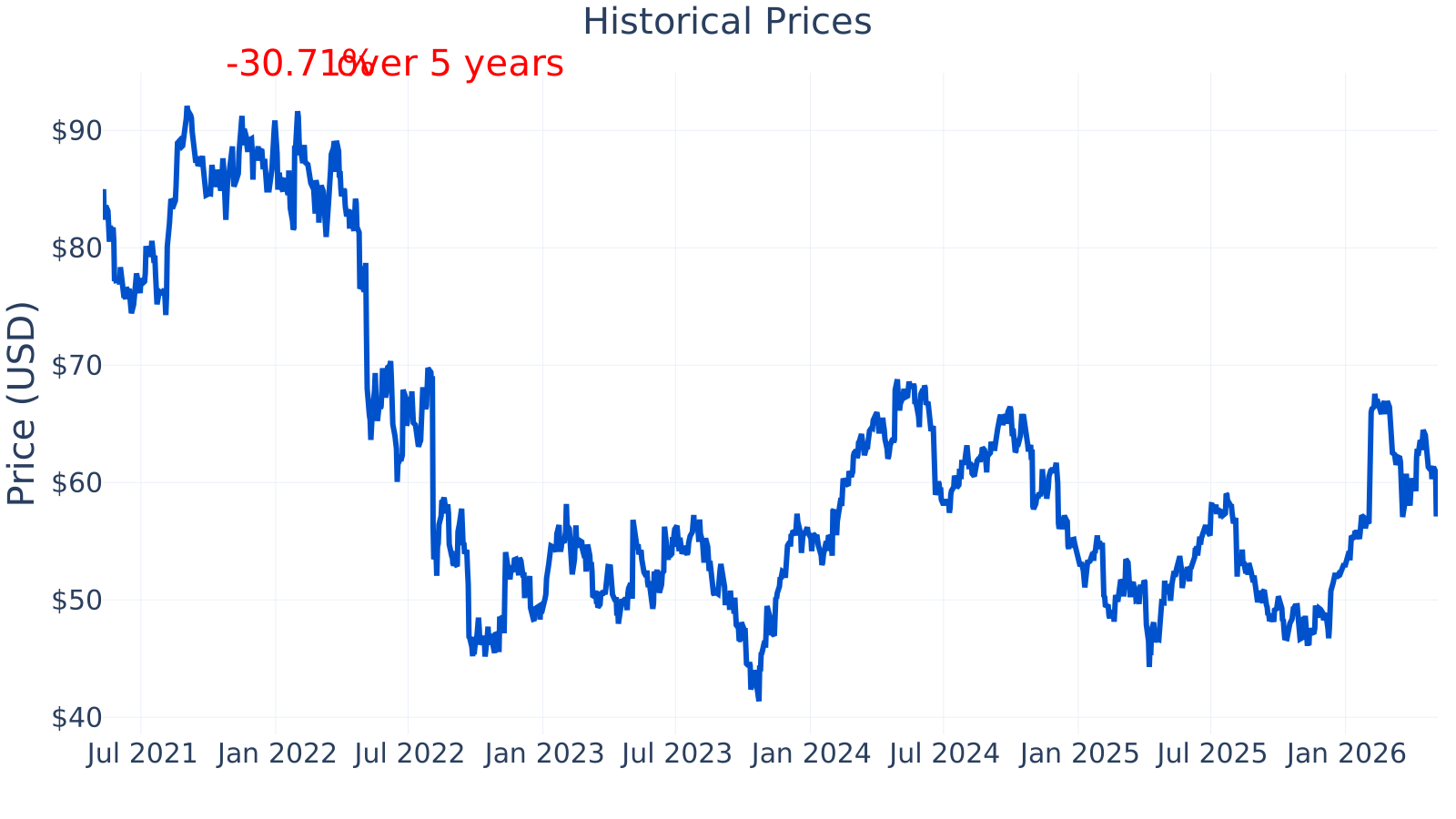
Ball’s market capitalization is about $15.6B, placing it among the larger listed packaging companies. The stock’s beta of ~1.07 suggests price movements that have been broadly similar to the overall market. On profitability, the latest profit margin is ~6.9%, above the industry median (~5.7%). Growth in the most recent year is also stronger than the industry median: revenue growth ~16.3% versus ~1.4% for the median peer group shown. Leverage is meaningful: debt-to-equity ~108.6%, slightly above the industry median (~101.8%). The trailing free cash flow shown is ~$596M, which matters because cash generation supports debt service, reinvestment, and shareholder returns.
Growth (Medium)
Ball operates in a mature but still evolving part of consumer packaging. Beverage consumption patterns, product innovation (for example, new ready-to-drink categories), and customer preferences can shift packaging demand. Over time, aluminum cans have benefited from convenience, transport efficiency, and recyclability attributes, but overall industry growth is typically steadier than fast-changing technology sectors.
For future growth, the company’s strategy generally depends on a few practical levers: maintaining high plant utilization, securing long-term customer relationships, improving manufacturing efficiency, and managing input-cost dynamics. Because packaging is a scale business, operational execution and contract structure often matter as much as (or more than) headline “market growth.”
The year-over-year revenue trend shows a downturn through much of 2023 and parts of 2024, followed by a return to positive growth in 2025 and into early 2026 (about 16% most recently). For a packaging business, this kind of swing can reflect a combination of volume changes, pricing resets, and portfolio changes—so it’s useful to pair this view with management’s segment discussion in filings.
Free cash flow improved materially from negative territory in 2022–2023 to positive in 2024 and then higher levels in 2025–2026 (about $596M most recently). For long-horizon business quality, sustained positive free cash flow is important because it can increase financial flexibility—particularly in a capital-intensive manufacturing model.
Potential catalysts in this type of company are usually not “breakthrough inventions,” but rather: sustained volume recovery, improved pricing/contract pass-through, productivity gains, and balance-sheet improvement. Large portfolio actions (selling or acquiring businesses) can also create step-changes in reported revenue, margins, and leverage.
Risks (Medium)
Ball’s main risks are tied to its role as a high-volume manufacturer. Demand can soften if beverage volumes decline or if customers reduce production. Even with long-term contracts, profitability can be pressured by unfavorable shifts in input costs, energy costs, labor, and freight, especially when timing differences exist between cost changes and pricing resets.
Leverage has come down significantly from earlier peaks (well above 200% debt-to-equity in parts of 2021–2023) to roughly 109% most recently. That is a meaningful improvement, but it still indicates a balance sheet where debt remains an important factor. In a higher-rate environment, interest expense and refinancing terms can influence net results, and debt covenants can reduce flexibility during weaker demand periods.
Profit margins have been volatile over time, including periods where margins were unusually elevated (notably in 2024) compared with both earlier company history and the industry median. The latest level (~6.9%) is modestly above the peer median (~6.3% at the most recent point shown), which suggests competitive performance, but the historical swings indicate that non-recurring items and cycle effects can materially influence reported profitability.
Competition is a key structural risk. Aluminum beverage packaging is dominated by a small group of large, scaled producers, and customers are often very large buyers with negotiating leverage. In Ball’s peer set, competitive positioning typically depends on manufacturing footprint, reliability, cost per unit, customer relationships, and the ability to invest in capacity and efficiency over time. Ball is commonly viewed as one of the major global players in aluminum beverage cans, but it competes against other large container manufacturers that also have scale and long-standing customer ties.
Ball’s competitive advantages tend to come from scale, specialized manufacturing know-how, and long-term relationships with beverage companies. However, the business is not immune to price competition, customer consolidation, or the risk that new capacity in the industry leads to oversupply and weaker pricing.
Valuation
Packaging companies are often valued on steady earnings and cash flow, but investors should note that reported earnings can be affected by one-time items (including portfolio changes), and that makes simple comparisons trickier in certain years. With that caveat, the current P/E ratio is ~17.0, close to the industry median shown (~16.5), indicating the stock is priced broadly in line with peers on this single measure.
Historically, Ball’s P/E has moved widely, including periods above the industry median and periods well below it. In the most recent point shown, the P/E (~20.3) is above the industry median (~16.2), which can happen when the market expects more stable earnings, better cash generation, or improved fundamentals—or when near-term earnings are temporarily depressed. The PEG ratio of ~1.22 provides another reference point that combines valuation with growth expectations, though it depends heavily on the growth assumptions used.
To judge whether the current price level is “expensive” or “cheap,” the most relevant context for Ball is whether revenue growth and free cash flow remain resilient while leverage stays manageable. If cash flow remains strong and margins stabilize near current levels, valuation measures based on normalized earnings may look more meaningful than metrics distorted by one-off effects.
Conclusion
Ball Corporation is primarily an aluminum beverage packaging manufacturer, operating in a scaled, operationally demanding industry where execution, contracts, and input-cost management strongly influence results. Recent performance indicators show improving free cash flow and a recovery in revenue growth, while leverage has trended down from earlier levels but remains a central part of the financial profile.
The main points to weigh for a long-term view are the durability of demand for canned beverages, Ball’s ability to maintain efficient production and disciplined capital spending, and whether cash generation remains consistently positive across the cycle. At the same time, the company’s history of margin volatility and meaningful leverage highlight why business conditions and financing costs can have an outsized impact on shareholder outcomes over time.
Sources:
- SEC EDGAR — Ball Corporation Forms 10-K and 10-Q (most recent filings)
- Ball Corporation Investor Relations — SEC filings and investor materials (company-hosted)
- Wikipedia — “Ball Corporation” (basic company background)
This article is for informational purposes only and does not constitute financial advice. Some content is AI-generated. See Disclaimer


