Stock Analysis · Avery Dennison Corp (AVY)
Overview
Avery Dennison Corp is a global materials science and manufacturing company best known for the products that help identify, label, and track items throughout supply chains. Its solutions show up in everyday life as pressure-sensitive labels (for food, beverages, household goods, and personal care), branding and information labels, and “smart” labels that use technologies like RFID to uniquely identify items and improve inventory accuracy. The company also provides materials used in apparel and other products where branding, decoration, or performance fabrics are important.
In its filings, Avery Dennison organizes its business around two main reporting segments, each with many end markets:
- Label and Graphic Materials (pressure-sensitive label materials, graphics, and reflective solutions used across consumer packaging and industrial applications)
- Retail Branding and Information Solutions (solutions for apparel and retail, including branding/packaging components and intelligent labels such as RFID-enabled items)
Because the company sells into many industries, results tend to reflect overall consumer demand, retail activity, and industrial production. The mix also matters: higher-value solutions (for example, intelligent labeling and specialized materials) can support pricing and margins when adoption increases.
Across recent years, revenue has been relatively steady in the high single-digit billions, while profitability has moved with changes in costs and operating expenses. Cost of revenue remains the largest expense line, and interest expense has increased versus earlier years, which can matter more when interest rates are higher.
Key Figures
| Metric | Value | Industry ⓘ |
|---|---|---|
| Date | May 04, 2026 | |
| Context | ||
| Sector | Consumer Cyclical | |
| Industry | Packaging & Containers | |
| Market Cap ⓘ | $12.54B | |
| Beta ⓘ | 1.00 | |
| Fundamental | ||
| P/E Ratio ⓘ | 18.34 | 17.20 |
| Profit Margin ⓘ | 7.66% | 5.65% |
| Revenue Growth ⓘ | 7.00% | 1.40% |
| Debt to Equity ⓘ | 164.75% | 112.14% |
| PEG ⓘ | 1.92 | |
| Free Cash Flow ⓘ | $872.90M | |
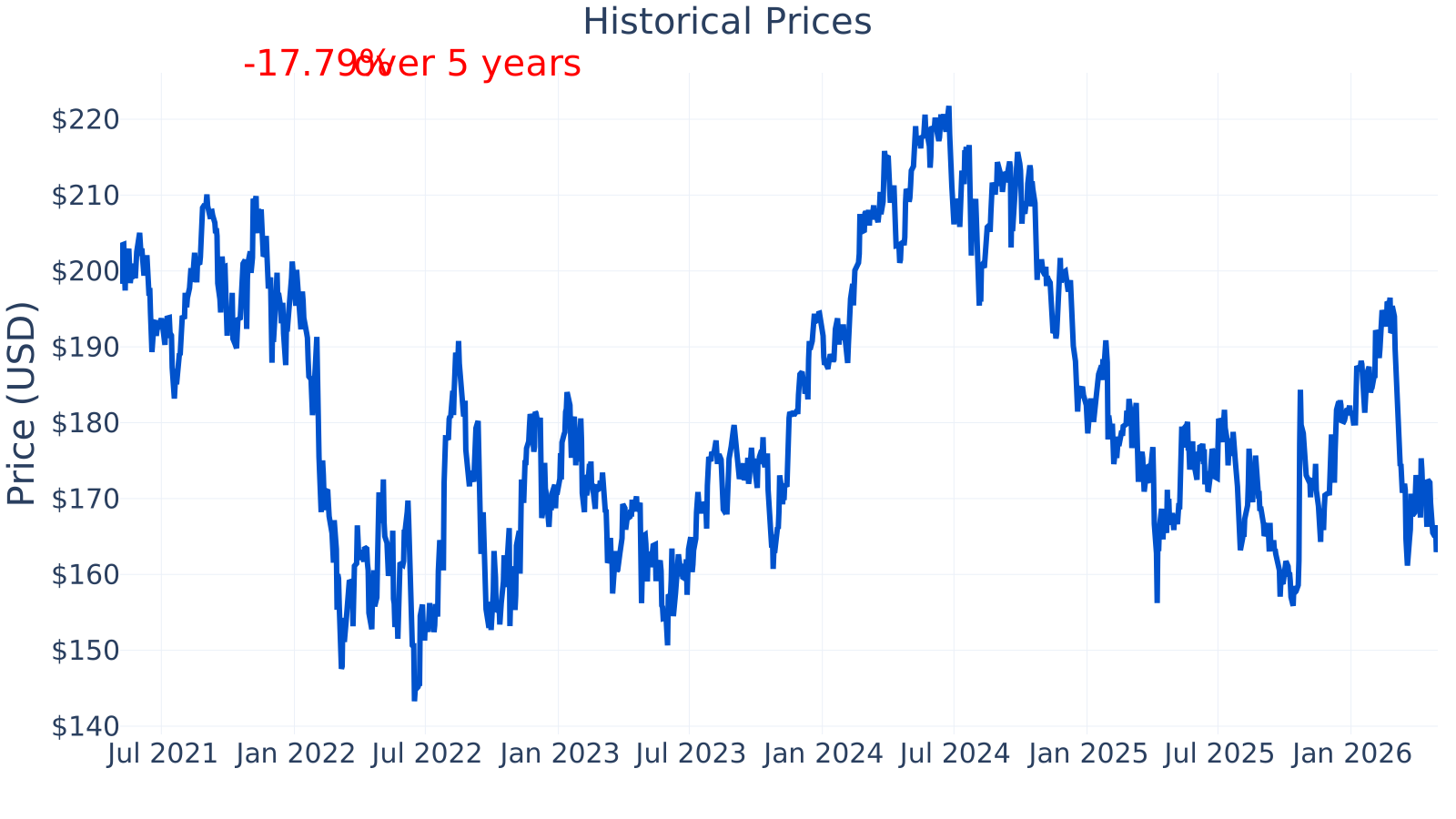
Avery Dennison’s market capitalization is about $12.5B and its beta is ~1.00, meaning the stock has tended to move broadly in line with the overall market. The company’s P/E ratio is ~18.3, slightly above the industry median (~17.2). Profitability is stronger than the industry median, with a net profit margin of ~7.7% versus ~5.7% for the median peer. Recent year-over-year revenue growth is ~7.0%, also above the industry median (~1.4%). Leverage is higher than the typical peer, with debt-to-equity ~165% versus an industry median of ~112%. Trailing twelve-month free cash flow is ~$873M, indicating meaningful cash generation after operating needs and capital spending.
Growth (Medium)
Avery Dennison participates in markets that are generally tied to ongoing, repeat demand: packaged consumer goods need labels, retailers and brands need identification and branding components, and supply chains benefit from tracking and authentication. These are not “one-time” markets; they depend on volumes, brand activity, and product innovation. That said, they are also not purely high-growth categories—parts of the portfolio behave like mature industrial businesses, with growth often linked to overall economic activity.
A key long-term growth driver described in company materials is the continued expansion of intelligent labeling (including RFID). These solutions are designed to improve inventory accuracy, reduce shrink, and support omnichannel retail operations. As adoption increases across retailers, apparel, logistics, and other verticals, the company can benefit from higher value-added content per item compared with basic labeling.
The revenue growth pattern has been cyclical: strong growth earlier in the period shown, a negative stretch during 2023, and then a return to modest growth more recently, with the latest point around ~7% year-over-year. This kind of profile is consistent with a business exposed to consumer and industrial cycles rather than a purely secular growth story.
Free cash flow has also fluctuated over time, but the latest trailing twelve-month value is the highest point in the series at about $873M. For long-term business quality, steady cash generation matters because it can support reinvestment, balance sheet management, and shareholder returns (though the specific use of cash can change year to year).
Risks (Medium)
Avery Dennison’s results are exposed to volume swings in consumer packaged goods, apparel, and general industrial demand. When customers reduce production, destock inventories, or slow new orders, label and branding volumes can soften. In addition, input costs and pricing dynamics can pressure profitability, especially if raw material costs move quickly or competitive conditions limit pricing pass-through.
The company also carries meaningful leverage, so the balance sheet and interest costs can be important to monitor.
Debt-to-equity is about 165% at the latest point, above the industry median (~112%). The trend has moved around over time, and a higher leverage level can reduce flexibility if operating conditions weaken or refinancing becomes more expensive.
Competitive positioning is shaped by scale, global manufacturing footprint, customer relationships with large brand owners, and technical know-how in adhesives/materials and high-speed converting. Avery Dennison is widely recognized as one of the large global players in labeling materials and is also a significant provider in retail branding and intelligent labeling solutions. Competitive advantages typically come from:
- Scale and global reach (serving multinational customers across regions)
- Materials science and process expertise (performance requirements, reliability, and consistency)
- Switching costs and qualification cycles (customers often qualify materials and suppliers to reduce risk in production)
- Expanding “smart” product capabilities (where software/data and ecosystem integration can matter more over time)
Main competitors vary by segment. In labeling materials, large global and regional producers of pressure-sensitive materials and label stock compete on quality, service, and price. In intelligent labeling and retail solutions, competition includes other RFID and identification solution providers, as well as in-house solutions at some large retailers/brands. The competitive landscape can lead to pricing pressure in more standardized products, while specialized and high-performance categories may be more defensible.
Net profit margin has recently been around 7%–8% and is currently about 7.7%, above the industry median (~6.3%). The chart also shows a dip into the mid-single digits during 2023 before improving again, highlighting that margins can compress during weaker demand or less favorable cost/pricing periods.
Valuation
On earnings, the current P/E ratio is ~18.3, slightly above the industry median (~17.2). Historically in the period shown, Avery Dennison’s P/E has ranged from the mid-teens to above 30, often trading at a premium to the industry median. More recently, the multiple has moved closer to the peer group, though it remains somewhat higher at the latest point on the chart.
In simple terms, a higher P/E generally implies the market is placing a higher value on each dollar of current earnings, often because it expects steadier performance, better growth, stronger margins, or lower risk. For Avery Dennison, the valuation context includes (1) profitability that has been above the industry median, (2) recent revenue growth that is above the industry median, and (3) higher leverage than the median peer. Those factors can pull valuation perception in different directions: quality/margins and growth support higher multiples, while leverage and cyclicality can limit them.
Conclusion
Avery Dennison is a large, established provider of labeling materials, branding components, and intelligent identification solutions, with broad exposure to everyday consumer and retail activity. The business has demonstrated meaningful cash generation and profitability that has recently been stronger than the typical peer group, while revenue growth has returned to positive territory after a cyclical downturn.
The main points that shape a long-term assessment are the balance between (1) durable, repeat-demand end markets and expanding intelligent labeling adoption, and (2) sensitivity to economic cycles, input/pricing pressures, and a leverage level that is above the industry median. Valuation, as reflected in the P/E ratio, sits modestly above the peer median and has varied significantly over time, suggesting that expectations and cycle positioning can meaningfully influence how the stock is priced.
Sources:
- Avery Dennison — Form 10-K (Annual Report), “Business” and “Segment Information” sections
- SEC EDGAR — Avery Dennison filings (10-K, 10-Q)
- Wikipedia — “Avery Dennison” (basic company background)
This article is for informational purposes only and does not constitute financial advice. Some content is AI-generated. See Disclaimer


