Stock Analysis · Avepoint Inc (AVPT)
Overview
AvePoint Inc. (AVPT) is a software company focused on helping organizations manage, protect, and govern their data in collaboration and cloud platforms—most notably Microsoft 365. In simple terms, its products are used to keep business information organized, secured, compliant with rules, and recoverable if something goes wrong (for example, accidental deletion, ransomware, or misconfigured access).
The company sells software and related services primarily to organizations that need strong controls around data and collaboration tools (including regulated industries and larger enterprises). AvePoint has positioned itself around the ongoing shift of workplace content and collaboration into cloud environments, where companies still need oversight, backup, and policy-based management.
From its filings, AvePoint’s revenue is generally described across the following categories (exact percentages can vary by period and are best read directly in the latest 10-K/10-Q):
- SaaS subscriptions (recurring software subscriptions)
- Term license and support (time-based licenses plus maintenance/support)
- Services (implementation, advisory, and related professional services)
A key long-term element of this mix is the emphasis on recurring subscription revenue, which tends to be more predictable than one-time license sales when retention remains strong.
Across the years shown, total revenue rises steadily (from about $192M in 2021 to about $419M in 2025). The company also shows improving operating results over time: operating income moves from negative territory in earlier years to positive by 2024 and expands further in 2025, which suggests operating leverage as the business scales.
Key Figures
| Metric | Value | Industry ⓘ |
|---|---|---|
| Date | Mar 02, 2026 | |
| Context | ||
| Sector | Technology | |
| Industry | Software - Infrastructure | |
| Market Cap ⓘ | $2.33B | |
| Beta ⓘ | 1.17 | |
| Fundamental | ||
| P/E Ratio ⓘ | N/A | 24.58 |
| Profit Margin ⓘ | 8.30% | 6.79% |
| Revenue Growth ⓘ | 28.60% | 16.35% |
| Debt to Equity ⓘ | 2.08% | 26.59% |
| PEG ⓘ | N/A | |
| Free Cash Flow ⓘ | $80.41M | |
AvePoint’s market capitalization is about $2.33B, placing it in the small-to-mid cap range. The stock’s beta of ~1.17 indicates it has historically moved somewhat more than the overall market on average (higher beta typically implies higher volatility).
On profitability, the latest profit margin shown is ~8.3%, which is above the industry median of ~6.8%. On growth, the latest year-over-year revenue growth is ~28.6%, also above the industry median of ~16.4%. Leverage appears low: debt-to-equity is ~2.1%, far below the industry median of ~26.6%. Free cash flow over the trailing twelve months is about $80.4M, indicating the business is generating cash after operating costs and capital spending.
Growth (medium)
AvePoint operates in an industry shaped by several long-running trends: cloud adoption, ongoing migration to Microsoft 365 and related services, rising cybersecurity threats, and stricter regulatory expectations around data retention, privacy, and auditability. As organizations place more critical work and documents into cloud collaboration tools, the need for governance, backup, and data lifecycle management typically increases alongside that shift.
Strategically, AvePoint’s focus on cloud-first and recurring subscriptions aligns with how many software markets have evolved. Subscription models can support long-term compounding when the company retains customers and expands usage over time (for example, adding more seats, more workloads, or additional modules such as compliance or security features).
The revenue growth trend shown remains positive across the period, with growth often in the mid-teens to high-20% range and reaching about 28.6% in the latest point shown. Relative to the industry median shown, AvePoint’s growth rate appears stronger in the most recent period, which can matter if the company can sustain that pace while improving profitability.
Free cash flow improves significantly over time, from near break-even levels earlier in the series to roughly $76.3M (as of 2025-03-31) and about $80.4M most recently. For long-term business quality, this matters because consistent cash generation can fund product development, sales expansion, or acquisitions without relying heavily on borrowing or issuing new shares.
Potential catalysts (in a neutral, factual sense) tend to be tied to execution and adoption patterns: continued Microsoft 365 expansion, increased security/compliance spending, larger enterprise wins, international growth, and the company’s ability to maintain subscription momentum while managing operating expenses.
Risks (medium)
AvePoint’s results and long-term positioning are closely tied to the Microsoft ecosystem and broader enterprise IT spending. If organizations slow cloud migrations, reduce software budgets, or consolidate vendors, revenue growth and renewals could be pressured. As with many software companies, execution risk is meaningful: hiring and retaining sales talent, maintaining product quality, and keeping customer churn low can materially influence outcomes.
Competition is another central risk. The company operates in markets where customers may compare multiple approaches to governance, backup, and data management. Competitive pressure can show up as pricing constraints, longer sales cycles, or higher sales and marketing costs. Some capabilities may also be offered by large platform providers or by other established software vendors with broad customer relationships.
In terms of competitive positioning, AvePoint is a recognized specialist in Microsoft 365 data management and governance. A specialist can benefit from deep integration, product focus, and credibility in regulated use cases, but it can also face challenges against larger vendors with broader suites. Commonly discussed competitive categories include:
- Microsoft-native capabilities (built-in tools that may cover part of a customer’s needs)
- Data protection / backup vendors that have expanded into SaaS and Microsoft 365 workloads
- Information governance and compliance software providers serving enterprise and regulated customers
Financial risk from leverage looks relatively low in the period shown. Debt-to-equity trends down to about 2.1% most recently, well below the industry median levels shown. Lower leverage can reduce vulnerability to higher interest rates or refinancing constraints, although it does not remove business-cycle or competitive risks.
Profitability improves materially over the period shown. The profit margin is negative for much of the timeline, then moves into positive territory and reaches about 8.3% at the latest point, above the industry median shown (~6.7%). While this improvement is constructive, margins in software can still fluctuate due to investment cycles (R&D, go-to-market expansion), changes in pricing, and the mix between subscription revenue and services.
Valuation
Traditional valuation measures like the price-to-earnings (P/E) ratio may be less informative for companies transitioning from losses to profitability or experiencing uneven earnings over time. In the P/E history shown here, AvePoint’s values are not displayed (shown as 0), while the industry median sits roughly in the high-20s to low-30s range across the periods shown. This typically happens when earnings are low, negative, or otherwise not comparable for a standard P/E calculation.
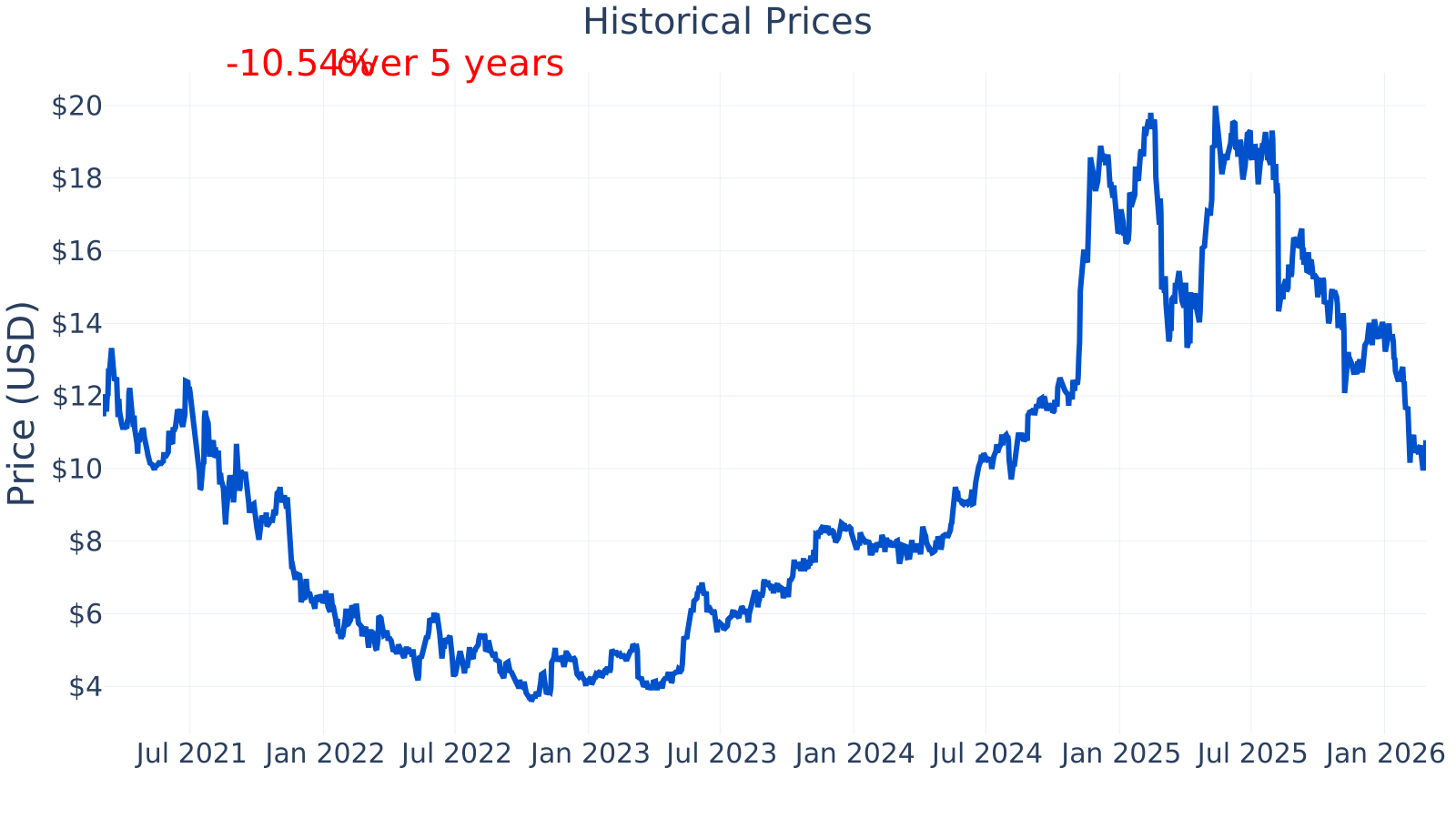
In practice, valuation discussions for companies like this often lean more on a combination of factors: (1) durability of revenue growth, (2) progress on sustainable profitability, and (3) cash generation. The company shows strong recent revenue growth (~28.6%) and positive free cash flow (~$80M trailing twelve months), alongside improving margins. At the same time, the stock price has shown significant swings historically, which is consistent with a market that can re-rate software names quickly based on growth expectations and profitability momentum.
Whether the current price is “expensive” cannot be concluded from P/E in the periods shown; the more relevant question becomes how stable growth and margins are over multiple years, and whether cash generation continues while the company invests in product and sales capacity.
Conclusion
AvePoint is a software company positioned around a clear long-term theme: organizations moving critical work into cloud collaboration platforms and needing governance, protection, and compliance controls around that data. Over the multi-year view shown, revenue expands steadily, free cash flow improves sharply, and profitability trends upward—reaching a positive profit margin most recently.
The main uncertainties are typical for an infrastructure software company in a competitive market: reliance on enterprise IT budgets, competition from both specialists and broader platform ecosystems, and the need to sustain growth while balancing operating costs. Financial leverage appears low, which reduces one category of risk, but does not eliminate execution and competitive pressures.
From a long-term, fundamentals-focused perspective, the most decision-relevant items to monitor over time are: subscription momentum and retention, the consistency of free cash flow generation, and whether improving profitability persists as the company continues investing for growth.
Sources:
- SEC EDGAR — AvePoint Inc. Form 10-K (Annual Report)
- SEC EDGAR — AvePoint Inc. Form 10-Q (Quarterly Reports)
- AvePoint Investor Relations — Investor presentations and shareholder materials
- AvePoint Investor Relations — Earnings call materials and transcripts (company-hosted/public)
- Wikipedia — “AvePoint” (basic company background)
This article is for informational purposes only and does not constitute financial advice. Some content is AI-generated. See Disclaimer


