Stock Analysis · AutoNation Inc (AN)
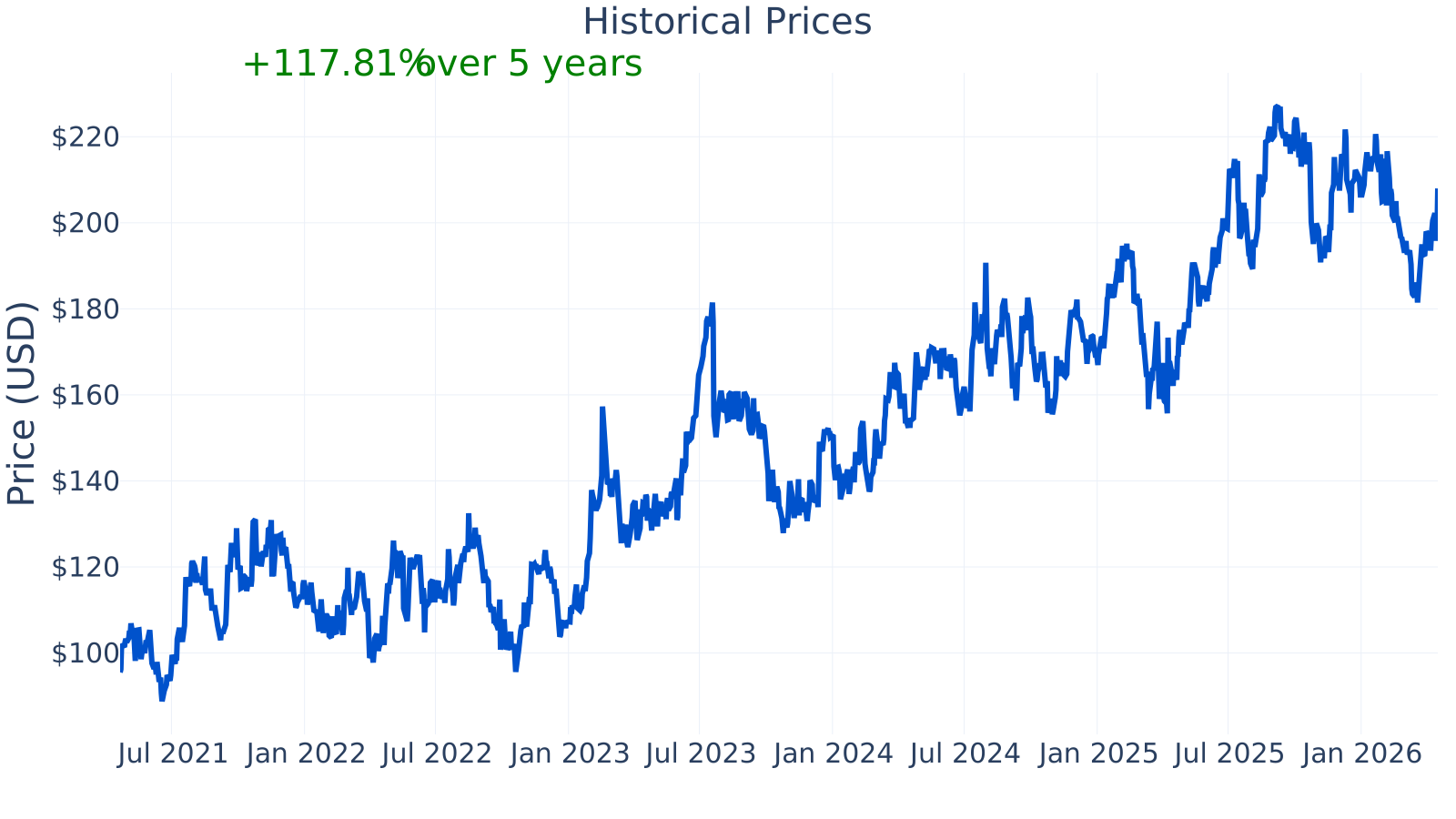
Overview
AutoNation, Inc. is one of the largest automotive retailers in the United States. It sells new and used vehicles through a network of dealerships, and it also earns money after the sale through repair and maintenance services and parts. In addition, AutoNation participates in vehicle financing and insurance-related products (often called “F&I”), which are typically offered at the time of purchase (for example, arranging financing or selling service contracts), and it has also been expanding into aftermarket and service-oriented offerings that can generate repeat customer visits.
In a dealership business model, revenue is usually driven mainly by vehicle sales (especially new vehicles), while a significant share of profit can come from higher-margin activities like service/parts and F&I. Based on how large U.S. auto retailers typically report results (and as described in AutoNation’s filings), the main revenue sources are:
- New vehicle sales (largest revenue driver)
- Used vehicle sales
- Parts and service (repairs, maintenance, and parts)
- Finance and insurance (F&I) and other dealership-related revenue
Percentages by segment can vary year to year and are best read directly from the company’s most recent annual filing segment disclosures.
Scale snapshot (income statement flow): Total revenue has been in the high-$20B range in recent years (about $27.6B in 2025). Over the same period, profitability has moved lower from earlier peaks: net income declined from roughly $1.37B (2021–2022) to about $649M (2025), while interest expense rose versus earlier years (reflecting higher borrowing costs and/or leverage).
From 2021 to 2025, revenue stayed broadly stable (mid-to-high $20B), while operating income and net income trended downward. A notable change over that span is the increase in interest expense (from about $119M in 2021 to about $369M in 2025), which can matter for shareholder outcomes when rates are higher or debt levels rise.
Key Figures
| Metric | Value | Industry ⓘ |
|---|---|---|
| Date | Apr 20, 2026 | |
| Context | ||
| Sector | Consumer Cyclical | |
| Industry | Auto & Truck Dealerships | |
| Market Cap ⓘ | $7.22B | |
| Beta ⓘ | 0.81 | |
| Fundamental | ||
| P/E Ratio ⓘ | 12.21 | 21.63 |
| Profit Margin ⓘ | 2.35% | 2.54% |
| Revenue Growth ⓘ | -3.90% | 3.90% |
| Debt to Equity ⓘ | 435.02% | 127.90% |
| PEG ⓘ | 0.78 | |
| Free Cash Flow ⓘ | -$197.50M | |
AutoNation’s market capitalization is about $7.2B, and the stock has had a beta of ~0.81, which indicates it has historically moved somewhat less than the broader market on average (though it can still be volatile). The company’s P/E ratio is ~12.2, below the industry median shown (~21.6). Profit margin is about 2.35% versus an industry median of about 2.54%. Recent year-over-year revenue growth is about -3.9% compared with an industry median of about +3.9%. Leverage stands out: debt-to-equity is ~435% versus an industry median near 128%. Free cash flow over the trailing twelve months is shown as negative (~-$198M).
Growth (Medium)
AutoNation operates in an industry that is essential but cyclical. Over long periods, demand is supported by the ongoing need for personal transportation and an aging vehicle fleet that requires maintenance. However, annual results can swing with interest rates, consumer confidence, vehicle affordability, and the availability of new-car inventory.
A practical long-term growth angle for dealership groups is that parts and service can be steadier than vehicle sales. As vehicles stay on the road longer and become more complex, service needs can support recurring traffic. AutoNation’s strategy (as described in its filings) includes expanding customer lifetime value through the ownership cycle—selling the vehicle, then capturing service, parts, and related products over time.
Revenue growth has fluctuated meaningfully over the last several years—strongly positive in parts of 2021, then moving through periods of low growth and occasional declines. The most recent reading shown is a year-over-year decline of about 3.9%, which contrasts with the industry median displayed as positive. This pattern is consistent with a mature, competitive, and rate-sensitive retail category where growth often depends on execution and the broader auto cycle rather than a smooth upward trend.
Free cash flow has moved from strongly positive levels (over $1.1B–$1.5B in 2022–2023) to roughly breakeven in 2024 and then negative by 2025. For long-term business strength, this shift is important to monitor because free cash flow helps fund debt reduction, reinvestment (such as new locations or service capacity), and shareholder returns. Negative free cash flow can happen for reasons such as higher inventory needs, investments, or working-capital changes, but it reduces flexibility when sustained.
Risks (High)
Auto retail has several structural risks that can affect results from year to year. First, it is highly exposed to macroeconomic conditions: higher interest rates can reduce affordability and loan approvals, pressuring unit sales and margins. Second, profitability can be influenced by vehicle supply and pricing dynamics (for both new and used vehicles), which can change quickly. Third, dealership groups face operational execution risks—managing inventory, staffing service departments, and controlling costs across many locations.
Leverage is a key company-specific consideration. Higher debt can amplify outcomes: it can help scale the business, but it also raises the importance of stable cash generation and manageable interest costs.
The debt-to-equity ratio has risen markedly over time, reaching roughly 435% at the latest point shown, versus an industry median around 157%. This gap suggests AutoNation is using more balance-sheet leverage than many peers in its industry set. In higher-rate environments, leverage can weigh on net income through interest expense and can reduce flexibility if industry conditions weaken.
Profitability is another area to track closely because dealership margins can compress when pricing becomes more competitive or when costs rise.
Profit margin has trended down from earlier highs (around 5%–6% in 2021–2022) to roughly 2.35% most recently. The latest level is close to the industry median shown (~2.54%), indicating AutoNation is not currently displaying meaningfully higher margins than the typical peer in this comparison set. Lower margins leave less cushion if volumes soften or expenses increase.
Competition is intense and comes from multiple directions: other large U.S. dealership groups, smaller local dealer groups, and online-focused used-vehicle retailers. Large publicly traded dealer groups commonly referenced as peers include Lithia Motors, Penske Automotive Group, Group 1 Automotive, Sonic Automotive, and Asbury Automotive Group. AutoNation’s competitive advantages generally relate to scale (purchasing, systems, marketing), brand relationships with automakers, and the ability to drive repeat business through service and customer relationships. Still, the business does not have a monopoly-like position; advantages tend to be operational and incremental rather than absolute.
Valuation
On an earnings multiple basis, AutoNation’s P/E ratio has generally been below the industry median throughout most of the period shown. The latest P/E is about 12.6 on the timeline (and about 12.2 in the latest snapshot table), compared with an industry median near 17.6–21.6 depending on the point of reference shown. A lower P/E can reflect the market’s expectation of slower growth, higher cyclicality, higher leverage, or more uncertainty about future earnings durability.
Whether the current multiple is “high” or “low” depends heavily on how one weighs (1) the company’s cyclicality and recent margin normalization, (2) the higher debt load and interest expense sensitivity, and (3) the potential for service/parts and operational execution to support earnings across the cycle. In other words, the valuation picture cannot be separated from balance-sheet risk and the sustainability of profits in less favorable auto markets.
Conclusion
AutoNation is a large U.S. automotive retailer whose results are shaped by a mix of big-ticket vehicle sales and steadier after-sale service activity. Recent years show relatively stable revenue around the high-$20B range, but with lower net income and higher interest expense compared to earlier peaks. The company’s recent profile also includes negative trailing free cash flow and a debt-to-equity level well above the industry median shown, both of which increase sensitivity to the economic cycle and financing conditions.
From a long-term, fundamentals-focused perspective, the main monitoring points are straightforward: whether service and other recurring activities can help stabilize profitability, whether free cash flow returns to consistently positive levels, and whether leverage trends improve or remain elevated. The stock’s earnings multiple has been below the peer median shown, which may be consistent with these risks and the cyclical nature of the business.
Sources:
- AutoNation, Inc. — Form 10-K (Annual Report), “Business,” “Management’s Discussion and Analysis,” and “Financial Statements” sections
- SEC EDGAR — AutoNation, Inc. filings (10-K, 10-Q, 8-K)
- AutoNation Investor Relations — Company press releases and shareholder materials (as posted by the company)
- Wikipedia — “AutoNation” (basic company background only)
This article is for informational purposes only and does not constitute financial advice. Some content is AI-generated. See Disclaimer


