Stock Analysis · AutoNation Inc (AN)
Overview
AutoNation, Inc. is one of the largest automotive retailers in the United States. It operates franchised dealerships that sell new and used vehicles and also runs a large after-sales business that includes maintenance and repairs. In addition to retail vehicle sales, AutoNation participates in vehicle financing and insurance-related products (often offered at the point of sale), and it has expanded into areas such as collision services and other automotive services through acquisitions and new locations, as described in its SEC filings.
In a typical dealership model (including AutoNation’s), revenue is mainly driven by selling vehicles, with additional contributions from higher-margin services and financing-related products. Based on how the company describes its operations in annual filings, the main revenue streams generally include:
- New vehicle sales (typically the largest portion of revenue)
- Used vehicle sales
- Parts and service (maintenance/repair work and parts sales)
- Finance and insurance (F&I) (commission-type income and product sales tied to vehicle transactions)
Because vehicles are high-priced items, they usually account for most revenue dollars, while service/F&I can be disproportionately important for profits.
Over recent years, total revenue has been relatively steady in the high-$20B range, while profitability has fluctuated more meaningfully. For example, operating income and net income were notably higher earlier in the period shown and trended lower by 2024–2025, while interest expense rose sharply into 2024, which can pressure net results even when revenue is stable.
Key Figures
| Metric | Value | Industry ⓘ |
|---|---|---|
| Date | Feb 07, 2026 | |
| Context | ||
| Sector | Consumer Cyclical | |
| Industry | Auto & Truck Dealerships | |
| Market Cap ⓘ | $7.90B | |
| Beta ⓘ | 0.88 | |
| Fundamental | ||
| P/E Ratio ⓘ | 12.72 | 16.79 |
| Profit Margin ⓘ | 2.38% | 2.73% |
| Revenue Growth ⓘ | 6.90% | 5.70% |
| Debt to Equity ⓘ | 390.41% | 143.50% |
| PEG ⓘ | 0.82 | |
| Free Cash Flow ⓘ | -$178.20M | |
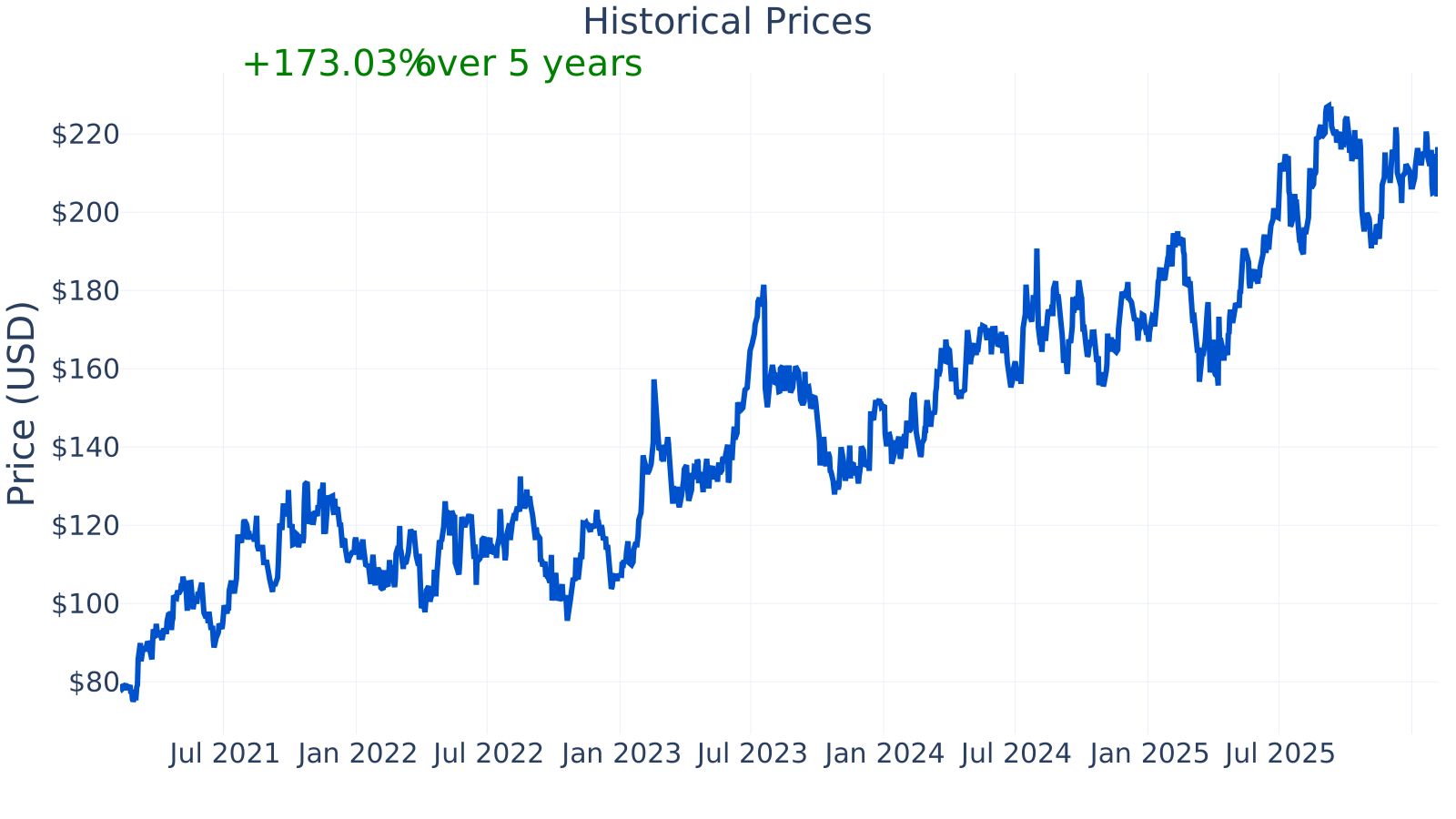
AutoNation’s market capitalization is about $7.9B and its beta is 0.88, which describes how the stock has tended to move relative to the broader market (historically somewhat less volatile than a beta of 1.0). The company’s current P/E ratio is 12.7 versus an industry median of 16.8. Profit margin is about 2.38% (industry median 2.73%), reflecting the thin-margin nature of auto retail. Recent year-over-year revenue growth is about 6.9% (industry median 5.7%). Leverage is elevated: debt-to-equity is ~390% versus an industry median near 143%. Trailing twelve-month free cash flow is negative (-$178M), which contrasts with the strongly positive cash generation seen earlier in the period shown below.
Growth (Medium)
Auto retail is a mature industry, and growth tends to be cyclical: demand is influenced by interest rates, consumer confidence, employment, and vehicle affordability. Over the long run, unit growth in the overall market is usually not rapid, so dealership groups often emphasize a combination of (1) expanding scale via acquisitions, (2) improving the mix of higher-value revenue streams (service, parts, collision), and (3) increasing operational efficiency through technology and centralized processes.
One reason large dealership groups can still pursue durable growth is that the industry remains fragmented, and scale can matter. Larger groups can often spread technology, advertising, procurement, and back-office functions across more locations. In addition, service and repair demand is supported by the size and age of the vehicle fleet on the road—people maintain cars regardless of whether new-vehicle sales are strong, although customers can still defer non-urgent work during difficult economic periods.
The year-over-year revenue growth pattern has been uneven, including periods of contraction. More recently, growth has been positive in several quarters shown (mid-to-high single digits at times), but the variability highlights the cyclical nature of dealership revenue.
Free cash flow has weakened materially over the period shown: it was strongly positive earlier (over $1B in prior years shown) and moved close to break-even before turning negative by 2025. For long-term business compounding, sustained free cash flow generation matters because it can support reinvestment, acquisitions, debt reduction, and shareholder returns without relying as much on external funding.
Risks (High)
This article is for informational purposes only and does not constitute financial advice. Some content is AI-generated. See Disclaimer


