Stock Analysis · Autoliv Inc (ALV)
Overview
Autoliv Inc. is an automotive supplier focused on vehicle safety systems. Its products are designed to help protect occupants in a crash, and they are typically sold directly to vehicle manufacturers (OEMs) around the world. The company’s core offering includes airbags and seatbelts, along with related safety electronics and steering wheel products used to integrate airbag modules.
Autoliv’s revenue is largely tied to global vehicle production and the mix of safety content installed in vehicles. In practice, this means results can move with auto build rates, customer production schedules, and how quickly safety regulations and new vehicle designs adopt additional safety features.
Main revenue sources (typical business mix, based on company reporting structure):
- Airbags (largest contributor)
- Seatbelts
- Safety electronics / steering wheels and related components (smaller share)
The income profile over recent years shows a business that has maintained significant scale while improving profitability. Total revenue was about $8.23B (2021), $8.84B (2022), $10.48B (2023), $10.39B (2024), and $10.82B (2025). Over the same period, operating income increased from about $674M (2021) to about $1.09B (2025), and net income increased from about $435M (2021) to about $735M (2025). R&D spending has stayed substantial (roughly $390M–$425M per year), reflecting ongoing engineering requirements in automotive safety.
From 2021 to 2025, revenue expanded overall while operating income and net income rose more meaningfully, which suggests margins improved compared with earlier years. Interest expense also increased versus 2021, which aligns with the importance of monitoring financing costs in addition to operating performance.
Key Figures
| Metric | Value | Industry ⓘ |
|---|---|---|
| Date | Apr 21, 2026 | |
| Context | ||
| Sector | Consumer Cyclical | |
| Industry | Auto Parts | |
| Market Cap ⓘ | $9.09B | |
| Beta ⓘ | 1.36 | |
| Fundamental | ||
| P/E Ratio ⓘ | 12.80 | 24.66 |
| Profit Margin ⓘ | 6.45% | 3.56% |
| Revenue Growth ⓘ | 6.80% | 4.90% |
| Debt to Equity ⓘ | 85.50% | 76.35% |
| PEG ⓘ | 0.85 | |
| Free Cash Flow ⓘ | $579.00M | |
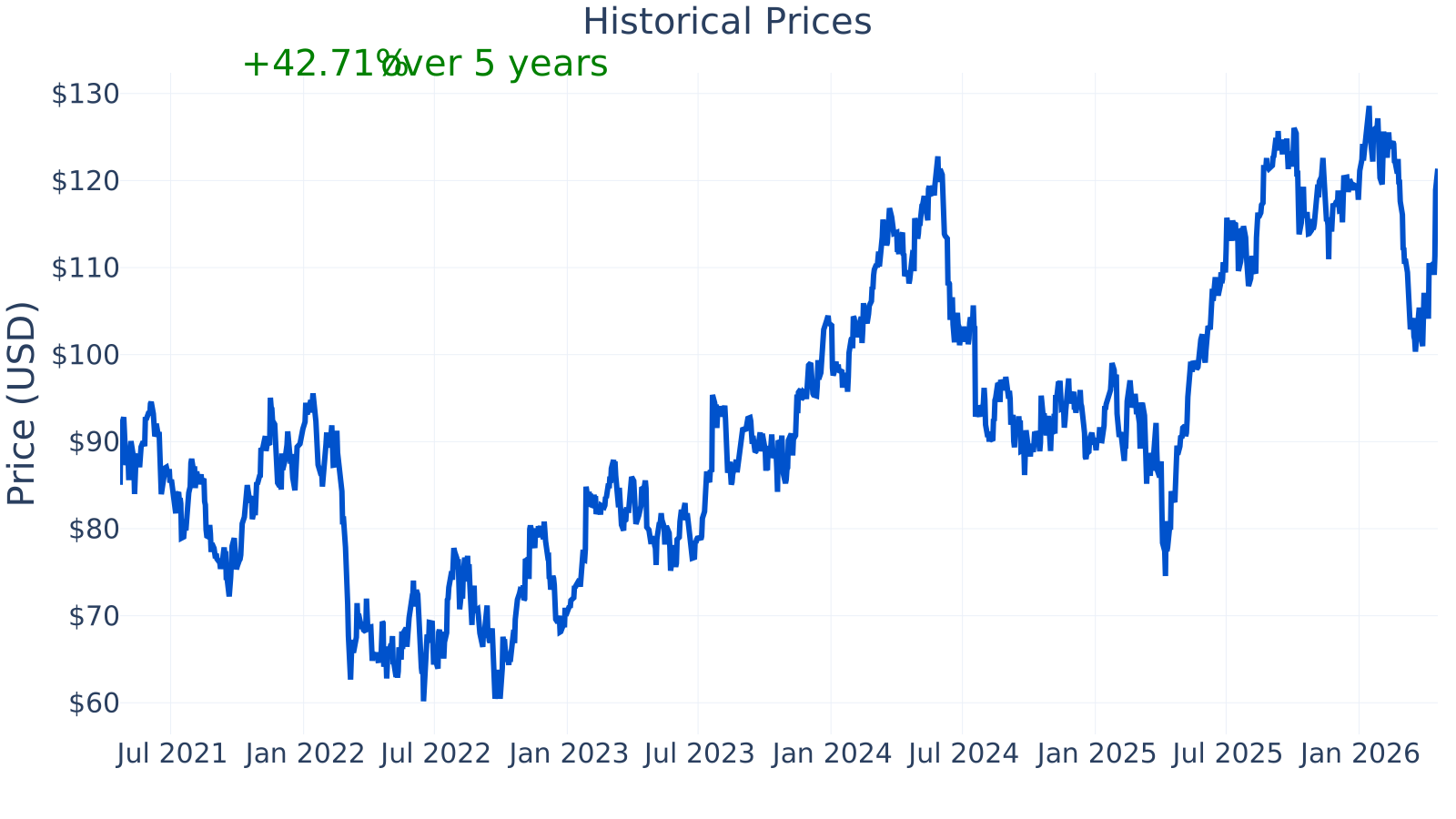
Autoliv’s market capitalization is about $9.1B, placing it among mid-sized public companies. The stock’s beta of ~1.36 indicates it has historically moved more than the broader market on average (higher ups and downs).
On profitability, Autoliv’s profit margin is ~6.45%, which is above the industry median (~3.57%) for the auto parts peer group shown. Recent year-over-year revenue growth is ~6.8%, also above the industry median (~4.9%) in the same comparison set.
Leverage is somewhat higher than the peer median: debt-to-equity is ~85% versus an industry median ~76%. Free cash flow over the last twelve months is about $579M, which is a meaningful cash generation figure relative to the company’s size.
Growth (Medium)
Autoliv operates in an industry where long-term demand is closely linked to global vehicle production, but the company’s specific niche—vehicle safety—also benefits from structural drivers such as safety regulation, consumer expectations, and increasing “safety content” per vehicle (more airbags, more advanced belt systems, and more sensors/electronics to manage restraint systems). These factors can support growth even when overall auto unit growth is modest.
Recent revenue growth has been uneven quarter-to-quarter, which is common for auto suppliers due to production cycles and comparisons versus prior-year periods. However, the most recent year-over-year revenue growth shown is positive.
A notable support for long-term business resilience is cash generation. Autoliv’s trailing twelve-month free cash flow is positive and, over the last few years, improved from a low point (including a period that was near or below zero) to several hundred million dollars.
Potential catalysts (in a neutral, factual sense) typically include: higher global vehicle builds, greater safety content per vehicle platform, successful launch execution on new programs with major OEMs, and sustained margin improvement through operational efficiency and pricing discipline. Because Autoliv sells predominantly to OEMs, winning and retaining platform awards matters for multi-year revenue visibility.
Risks (Medium-High)
Autoliv’s biggest risk category is cyclical exposure: demand is strongly tied to vehicle production volumes. Production disruptions, macroeconomic slowdowns, or OEM schedule changes can affect shipments quickly. Customer concentration is also a typical risk for large auto suppliers (a relatively small set of global OEMs represent a large share of demand), which can increase pricing pressure and contract competitiveness.
Operationally, automotive safety parts require high quality and reliability. Product defects, recalls, warranty claims, or manufacturing disruptions can create costs and reputational impact. The industry also faces ongoing cost pressure from materials, logistics, labor, and currency movements because manufacturing and sales are global.
Balance-sheet risk is important to track given the company’s use of debt financing. Autoliv’s debt-to-equity ratio is above the industry median in the peer set shown, and it has moved around over time.
Competitive position matters because many auto components are sourced through competitive bidding. Autoliv is widely recognized as one of the major global specialists in airbags and seatbelts, which can provide advantages in scale, engineering know-how, long-term OEM relationships, and manufacturing footprint. Even so, the competitive landscape includes other large auto suppliers with overlapping safety portfolios and strong OEM relationships.
Profitability trends can indicate whether a supplier is executing well despite industry pressures. Autoliv’s profit margin has improved from earlier periods and is above the peer median shown, but margins can still compress during downturns or when costs rise faster than pricing.
Main competitors are other global automotive suppliers that manufacture occupant safety systems and related components (for example, large diversified Tier 1 suppliers with restraint-system offerings). Competitive intensity is typically high because programs are awarded for multiple years, and pricing, quality performance, global capacity, and launch execution all influence who wins new business.
Valuation
Valuation is often discussed using the price-to-earnings (P/E) ratio, which compares the stock price to the company’s earnings. Autoliv’s latest P/E is about 12.8, which is below the industry median (~24.7) in the peer group provided. Historically, the company’s P/E in the chart shown has often been in the low-to-mid teens in recent periods, while the industry median has generally been higher.
A lower P/E versus peers can reflect differences in expected growth, business mix, cyclicality, balance-sheet risk, or investor confidence in how stable earnings will be through an auto cycle. In Autoliv’s case, the context includes (1) a cyclical end market, (2) a specialized product set tied to safety (which can be relatively resilient within auto components), and (3) profitability that has improved versus earlier periods. The PEG ratio shown (~0.85) is one data point that relates valuation to growth assumptions, but it is sensitive to how growth is measured and to the stability of earnings estimates over time.
Conclusion
Autoliv is a scaled, global supplier focused on core vehicle safety products, with revenue primarily tied to airbags and seatbelts sold to major automakers. Over the last several years, the company has grown revenue overall and improved operating and net income, while maintaining significant ongoing R&D investment consistent with the technical and regulatory demands of automotive safety.
The growth backdrop appears supported by long-term safety-content trends, but the business remains exposed to the auto production cycle and to execution requirements typical of Tier 1 suppliers (quality, launches, and cost control). Financially, recent margins are above the peer median shown, free cash flow is meaningfully positive, and leverage is moderately higher than the peer median, which can increase sensitivity to downturns and financing conditions.
From a valuation-description perspective, the shares trade at a P/E below the peer median provided, which may indicate a more conservative market view of cyclicality and risk, despite improved profitability. Any long-term assessment typically depends on how stable earnings and cash flows remain across future auto cycles and whether safety-content growth and operational execution continue to offset industry volatility.
Sources:
- SEC EDGAR — Autoliv Inc. Forms 10-K and 10-Q (company filings)
- Autoliv Investor Relations — Annual reports and SEC filing documents (company-hosted)
- Wikipedia — “Autoliv” (basic company background)
This article is for informational purposes only and does not constitute financial advice. Some content is AI-generated. See Disclaimer