Stock Analysis · Autodesk Inc (ADSK)
Overview
Autodesk, Inc. (ADSK) is a software company best known for tools used to design and build products and places. Its applications are widely used by architects and construction professionals (to plan buildings and infrastructure), manufacturers (to design products and factories), and media creators (to build 3D models and visual effects). In simple terms, Autodesk sells professional “digital design” software that helps customers go from an idea to a detailed plan that can be manufactured or built.
A key part of Autodesk’s business model is subscription software. Instead of selling one-time “permanent” licenses, Autodesk primarily sells time-based subscriptions that are renewed monthly or annually. This tends to make revenue more recurring and predictable, but it also means results depend heavily on renewal rates and continued customer adoption.
In its SEC filings, Autodesk commonly discusses revenue by product families and by geography, and the company’s revenue is largely tied to software subscriptions, plus related support and other services. A simplified view of the main sources of revenue is:
- Subscriptions (software access over time) — the largest share of revenue
- Maintenance and other services — smaller share (includes support and related offerings)
The income profile shown below highlights a software-like structure: high gross profit (because delivering software has relatively low “cost of revenue”), with substantial ongoing spending on research and development to keep products competitive.
From fiscal year-end 2022 to fiscal year-end 2026 (as shown), revenue increased from about $4.40B to about $6.78B, while research and development spending also rose (about $1.11B to $1.64B). This combination suggests Autodesk has been scaling while continuing to reinvest significantly in product development.
Key Figures
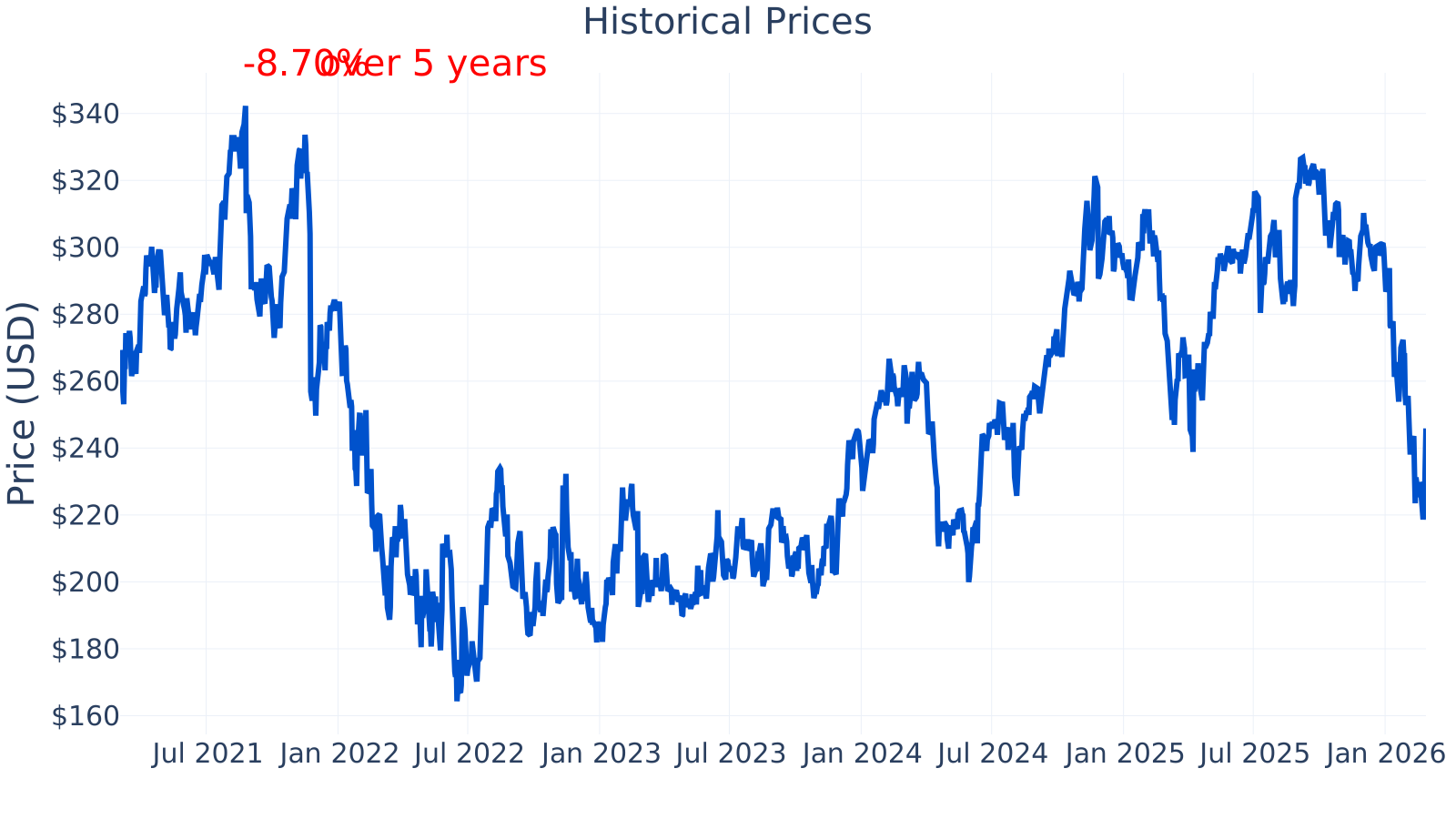
The stock price history shown reflects meaningful volatility over the period, with large swings that can occur even when a software company’s underlying business grows steadily. For long-term analysis, this kind of pattern typically means outcomes can be sensitive to broader market sentiment, interest rates, and valuation levels—not only company execution.
| Metric | Value | Industry ⓘ |
|---|---|---|
| Date | Mar 02, 2026 | |
| Context | ||
| Sector | Technology | |
| Industry | Software - Application | |
| Market Cap ⓘ | $52.37B | |
| Beta ⓘ | 1.45 | |
| Fundamental | ||
| P/E Ratio ⓘ | 47.83 | 25.64 |
| Profit Margin ⓘ | 15.60% | 7.25% |
| Revenue Growth ⓘ | 19.40% | 16.65% |
| Debt to Equity ⓘ | 89.79% | 24.64% |
| PEG ⓘ | 1.11 | |
| Free Cash Flow ⓘ | $2.40B | |
Autodesk’s market capitalization is about $52.4B, and its beta of ~1.45 indicates the stock has historically moved more than the broader market (higher volatility). The company’s profit margin is ~15.6%, above the industry median shown (~7.2%), suggesting relatively strong profitability versus many peers. Most recent year-over-year revenue growth is ~19.4%, also above the industry median shown (~16.7%). The company’s debt-to-equity is ~89.8%, which is materially higher than the industry median shown (~24.6%), indicating greater reliance on debt (and/or a smaller equity base) than many comparable software companies. Over the last twelve months, free cash flow is about $2.40B, which is an important indicator of cash generation after operating needs and capital spending.
Growth (medium)
Autodesk operates in large, long-lived markets tied to design and engineering workflows across construction and manufacturing. These fields continue to shift from paper- and file-based processes toward more integrated, cloud-enabled collaboration, where multiple stakeholders can work from a shared digital model. This broad, ongoing digitization trend supports long-term demand for design software, data management, and automation tools.
Autodesk’s strategy has centered on expanding subscription adoption, moving more workflows to the cloud, and adding capabilities that connect design to downstream execution (for example, supporting handoffs from architects/engineers to construction teams, or from product design to manufacturing). In practical terms, the growth logic is that once a customer’s workflow is built around Autodesk tools, switching costs can be meaningful because teams are trained on the software and projects may be stored in Autodesk-compatible formats.
The year-over-year revenue growth trend has generally been positive for several years, often in the low-to-mid teens. The most recent point shown is -6.5% year-over-year, which stands out versus prior periods and may reflect timing effects, comparisons against a stronger prior period, or changes in purchasing patterns. For long-term context, it can be useful to focus on multi-year revenue expansion as well: revenue in the income profile above rises from roughly $4.40B (FY2022) to $6.78B (FY2026), indicating sizable growth over that span.
Cash generation has been strong overall despite fluctuations. Trailing twelve-month free cash flow rose from about $1.46B (FY2022) to about $2.40B (FY2026), with a dip around FY2024. For a subscription software company, free cash flow matters because it is a lens into how much real cash the business can produce while funding ongoing product development.
Potential catalysts (in a neutral, descriptive sense) often discussed in Autodesk filings and investor communications include continued migration to cloud collaboration, deeper penetration in construction workflows, and ongoing product enhancements that can increase adoption across larger teams (which can lift subscription counts and/or average revenue per customer).
Risks (medium)
Autodesk’s results are tied to customer spending in construction, manufacturing, and broader business investment cycles. If economic activity slows, customers may delay new projects, reduce seat counts, or push for lower-cost alternatives. In addition, because the company relies heavily on subscriptions, performance is sensitive to renewals and to the pace at which new subscriptions are added.
Competition is another key risk. Autodesk competes with a mix of large software vendors and specialized design tools. Depending on the workflow, competitors can include:
- Dassault Systèmes (CAD/PLM and 3D design platforms, especially in manufacturing)
- PTC (CAD and product lifecycle tools, plus industrial software)
- Bentley Systems (infrastructure engineering and construction-focused software)
- Trimble (construction technology and field solutions, including layout and project workflows)
Autodesk is commonly viewed as a leading vendor in areas like general-purpose CAD (for example, AutoCAD) and has a broad portfolio spanning architecture/engineering/construction and manufacturing. Its competitive advantages typically include deep brand recognition in technical design, extensive user communities, embedded workflows in customer organizations, and a large ecosystem of third-party plug-ins and trained professionals. At the same time, leadership can vary by niche (for example, certain infrastructure or specialized manufacturing workflows may skew toward other vendors), and competition can also come from lower-cost tools and new cloud-native entrants.
The debt-to-equity ratio has improved substantially over time (from very high levels earlier in the chart to about 89.8% most recently). Even after this improvement, it remains well above the industry median shown (about 25.4%). Higher leverage can amplify outcomes: it can help boost shareholder returns in good periods, but it can also reduce flexibility if business conditions weaken or financing costs rise.
Profitability has trended lower than the unusually high levels seen earlier in the series but has been relatively stable in the mid-to-high teens more recently. The latest profit margin shown is about 16.6%, which is above the industry median shown (about 7.4%). This suggests Autodesk has been more profitable than many peers, though margins can be pressured by increased investment in product development, sales capacity, or cloud infrastructure, as well as changes in pricing and customer mix.
Valuation
Autodesk’s latest P/E ratio is about 47.8, which is above the industry median shown in the table (about 25.6). In general, a higher P/E implies the market is pricing in expectations of continued growth, durable cash generation, and/or improving profitability over time.
The historical P/E chart shows Autodesk’s valuation has varied meaningfully across the period, including times when it rose well above more typical ranges (notably around 2022). More recently, the P/E has still tended to sit above the industry median points shown in 2025, suggesting the stock has often traded at a premium versus peers. Whether that premium is justified depends on factors such as sustained revenue growth, the resilience of subscription renewals through economic cycles, margin trajectory, and the company’s ability to keep its products central to customer workflows.
Conclusion
Autodesk is a long-established design software company with a subscription-heavy model and a broad presence across architecture, construction, engineering, and manufacturing workflows. Over the multi-year period shown, revenue expanded substantially and free cash flow reached a high recent level, while profit margins have remained above the industry median shown.
The main points to weigh are the balance between durable demand for digital design tools (and Autodesk’s strong positioning in key categories) versus cyclicality in customer end-markets, competitive pressure across specialized workflows, and a valuation that has often been higher than the industry median. The company’s leverage profile has improved, but debt-to-equity remains elevated versus peers in the comparison shown, which can matter in weaker environments.
Sources:
- SEC EDGAR — Autodesk, Inc. Form 10-K (Annual Report)
- SEC EDGAR — Autodesk, Inc. Form 10-Q (Quarterly Reports)
- Autodesk Investor Relations — Quarterly results press releases
- Autodesk Investor Relations — Earnings call materials / transcripts (company-hosted, where available)
- Wikipedia — “Autodesk” (company overview and basic history)
This article is for informational purposes only and does not constitute financial advice. Some content is AI-generated. See Disclaimer


