Stock Analysis · Aurora Innovation Inc (AUR)
Overview
Aurora Innovation Inc. (AUR) develops self-driving technology focused on trucking. Its core product is commonly described as an autonomous driving system designed to operate heavy-duty trucks on highways, with the broader goal of enabling “driverless” freight transportation services at scale. The company’s business model is closely tied to long-term adoption of autonomous trucking, where value would typically come from software and services tied to miles driven, partnerships with trucking fleets, and integration with truck manufacturers and logistics networks.
Today, Aurora appears to be in a pre-scale commercialization stage, meaning the company is still spending heavily on engineering, safety validation, and operational readiness while revenue remains limited and uneven. In the financial history shown below, revenue is small compared with operating costs, which is typical for R&D-heavy companies that have not yet reached broad commercial deployment.
Main revenue sources are not stable enough to infer a durable mix from the figures shown (revenue has been very small and, in some periods, effectively zero). Based on how companies at this stage usually operate (and how Aurora describes itself in SEC filings), revenue—when present—generally comes from limited pilot activity, collaboration arrangements, and other early-stage items rather than mature, recurring product sales.
The operating picture shown highlights a company still dominated by research and development spending. For example, in 2021 and 2022 total revenue (about $82 million and $68 million, respectively) was far below R&D expense (about $697 million and $677 million). In later periods shown, revenue drops to very low levels (including near-zero in 2023–2024 and about $3 million in 2025), while R&D remains substantial (about $716 million in 2023, $676 million in 2024, and $745 million in 2025). This gap explains the persistent operating losses in the same periods.
Key Figures
| Metric | Value | Industry ⓘ |
|---|---|---|
| Date | Feb 16, 2026 | |
| Context | ||
| Sector | Technology | |
| Industry | Information Technology Services | |
| Market Cap ⓘ | $8.73B | |
| Beta ⓘ | 2.48 | |
| Fundamental | ||
| P/E Ratio ⓘ | N/A | 19.24 |
| Profit Margin ⓘ | N/A | 4.91% |
| Revenue Growth ⓘ | -91.00% | 5.85% |
| Debt to Equity ⓘ | 4.67% | 58.47% |
| PEG ⓘ | N/A | |
| Free Cash Flow ⓘ | -$612.00M | |
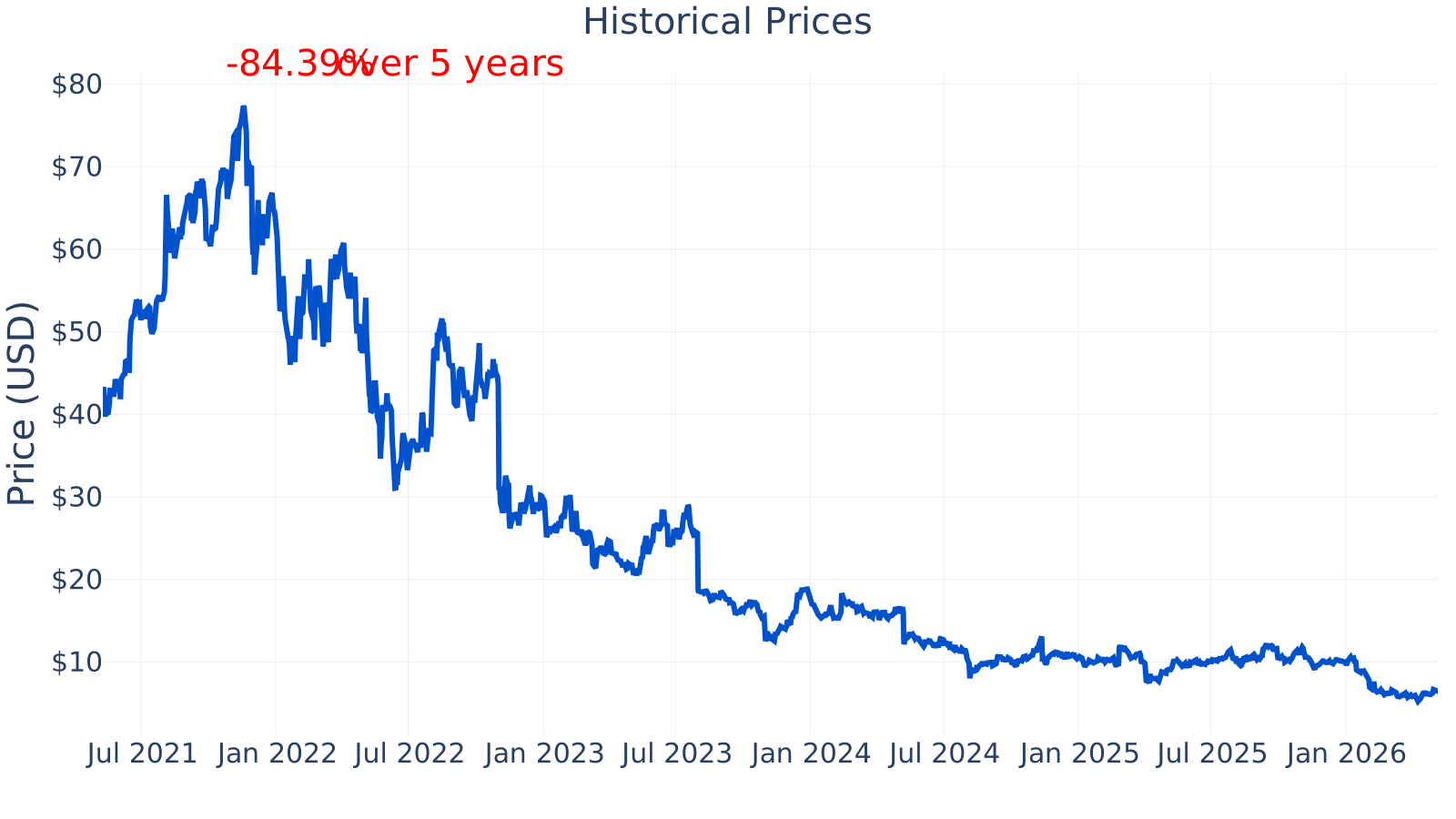
Aurora’s market capitalization is about $8.7 billion, placing it among the larger publicly listed pure-play autonomous driving developers. The stock’s beta of ~2.48 indicates that share price movements have historically been much more volatile than the overall market.
Profitability metrics also reflect the company’s current stage: the latest profit margin shown is 0% (with prior periods showing deeply negative margins), while the industry median profit margin is about 4.9%. Aurora’s latest year-over-year revenue growth shown is about -91%, versus an industry median near 5.9%, which is consistent with revenue that is not yet recurring or scaled.
On balance sheet leverage, Aurora’s debt-to-equity is about 4.7%, well below the industry median of about 58.5%. This suggests the company has relied relatively more on equity financing than debt compared with many peers in its broader industry grouping.
Growth (High)
Aurora operates in an industry with potentially large long-term demand: freight transportation is essential to the economy, and trucking faces persistent cost pressure, driver availability constraints, and safety requirements. Autonomous trucking is often positioned as a way to increase truck utilization (more hours on the road), potentially reduce certain operating costs over time, and improve route consistency—if the technology can be deployed safely and reliably and if regulators and customers accept it.
That said, the growth profile visible in the financials is not yet the classic “revenue scaling” pattern. The revenue growth chart shows significant declines, which typically signals that revenue is still tied to pilots, one-time items, or variable collaboration activity rather than ongoing commercial operations.
A key practical catalyst for future growth would be a transition from testing and pilots into repeatable commercial service (for example, regular autonomous freight runs, broader fleet rollouts, or deeper production integration with OEM partners). Another potential catalyst is progress in safety validation and regulatory acceptance, because commercialization depends not only on performance but also on approvals, operational design, and public trust.
Cash generation is also central to whether and how fast Aurora can grow. The free cash flow trend shown is consistently negative, which is common for companies investing heavily ahead of commercialization, but it also means continued funding is usually required unless spending is reduced or revenue ramps materially.
The most recent trailing twelve-month free cash flow shown is approximately -$612 million. Over multiple years in the chart, free cash flow remains around the -$500 million to -$600+ million range, indicating that the company’s growth strategy is still investment-led rather than self-funded.
Risks (Very High)
The largest risk is execution and timeline risk: autonomous trucking is technically complex and operationally demanding, and commercialization can take longer than expected due to safety validation, edge cases on real roads, weather/road conditions, and the need for robust remote assistance and support operations. Delays can matter because ongoing R&D and testing costs are high while scaled revenue may remain limited until a commercial tipping point is reached.
Another major risk is financial: persistent losses and negative free cash flow can require additional capital over time. Even with relatively low debt compared with equity, funding needs can still translate into dilution (issuing more shares) or increased leverage depending on capital market conditions.
The debt-to-equity ratio has stayed low (generally in the mid-single-digit percentages in the periods shown, with the latest near 4.7%) and far below the industry median (often around 60%–90% in the chart). Low leverage can reduce bankruptcy risk versus highly indebted companies, but it does not remove the underlying cash burn risk if commercialization takes longer than planned.
Profitability risk remains very high. Loss-making operations can be sustainable only as long as cash reserves and funding access support them, and margins may remain negative until utilization is high enough and the cost per mile (including support operations, insurance, maintenance, and computing) is competitive.
The profit margin series shows extremely negative values in many periods (for example, roughly -197% to far lower in other quarters), while the industry median stays near ~5%. This gap reflects a business that is not yet operating at commercial scale.
Competitive dynamics are also a core risk. Autonomous driving has multiple well-funded participants, and competition can come from different directions:
- Other autonomous trucking developers building full self-driving stacks and trucking-focused operations.
- Large technology companies with deep AI and compute resources that may pursue autonomy directly or via partnerships.
- Truck manufacturers and suppliers developing advanced driver-assistance and autonomy features in-house or through alliances.
Aurora’s competitive advantages, as described in its public filings, generally center on its autonomy software, safety approach, on-road testing experience, and ecosystem partnerships. However, leadership in this space is difficult to measure from financials alone because many competitors are private, and outcomes depend on real-world deployment performance, safety records, unit economics, and the ability to scale operations reliably.
Valuation
For many early-stage, loss-making technology companies, traditional valuation tools like the price-to-earnings (P/E) ratio are often not meaningful because earnings are negative. Aurora’s P/E series is shown as 0 across the timeline, which typically indicates there is no usable P/E due to losses (while the industry median P/E is shown in the ~19–33 range over time).
In practice, valuation discussions for a company at this stage often shift toward qualitative factors (commercial readiness, safety validation progress, partnerships) and balance-sheet runway, rather than current profits. With a market capitalization around $8.7 billion and ongoing negative free cash flow (about -$612 million TTM), the implied market expectations are more about future commercialization than present-day financial performance. Whether the current price level is “expensive” cannot be determined from earnings-based metrics here; it depends mainly on how quickly and successfully the company can move from development into scaled operations, and how durable its position is relative to competitors.
Conclusion
Aurora Innovation is positioned in a potentially transformative segment—autonomous trucking—where long-term demand could be significant if the technology reaches safe, scalable deployment. The company’s financial profile, however, reflects a business still in an investment-heavy phase: revenue has been small and inconsistent in the periods shown, profit margins have been deeply negative, and free cash flow has remained meaningfully negative.
The main variables to watch over time are progress toward repeatable commercial operations, the pace of cash burn relative to available funding, and evidence that the business can eventually achieve favorable unit economics in real-world freight service. Competitive pressure and regulatory/safety milestones remain central uncertainties, making the overall risk profile very high despite relatively low balance-sheet leverage compared with the broader industry median.
Sources:
- SEC EDGAR — Aurora Innovation Inc. filings (Form 10-K, Form 10-Q, Form 8-K)
- Aurora Innovation — Investor Relations materials and press releases
- Wikipedia — “Aurora Innovation” (basic company background)
This article is for informational purposes only and does not constitute financial advice. Some content is AI-generated. See Disclaimer