Stock Analysis · Atlassian Corp Plc (TEAM)
Overview
Atlassian Corp Plc is a software company best known for workplace collaboration and “work management” tools used by technical and non-technical teams. Its products help organizations plan work, track tasks, manage software development, document knowledge, and run internal service/support operations. Many customers start with a single product (for example, Jira for tracking work) and later expand usage across multiple teams and additional Atlassian tools.
Atlassian primarily sells software subscriptions, increasingly delivered through its cloud platform. It also earns revenue from maintenance and support for customers running older self-managed versions of its software, along with smaller amounts from professional services and other items. In its filings, Atlassian typically reports revenue by product categories and/or delivery model (cloud vs. data center/server) rather than a simple “top 3 revenue lines” list, and the exact mix shifts over time as customers move to the cloud.
In general terms, its revenue sources are commonly described as:
- Subscriptions (primarily cloud): recurring fees for access to Atlassian products hosted by Atlassian
- Data center / self-managed subscriptions and support: recurring fees and support related to customer-managed deployments
- Other (smaller): services and other revenue items (typically not the main driver)
One notable feature of Atlassian’s business model is its continued emphasis on product development. Over the years shown below, gross profit rises with revenue, while research and development remains a large expense line, which helps explain why accounting profits can stay negative even as the company generates cash.
Key Figures
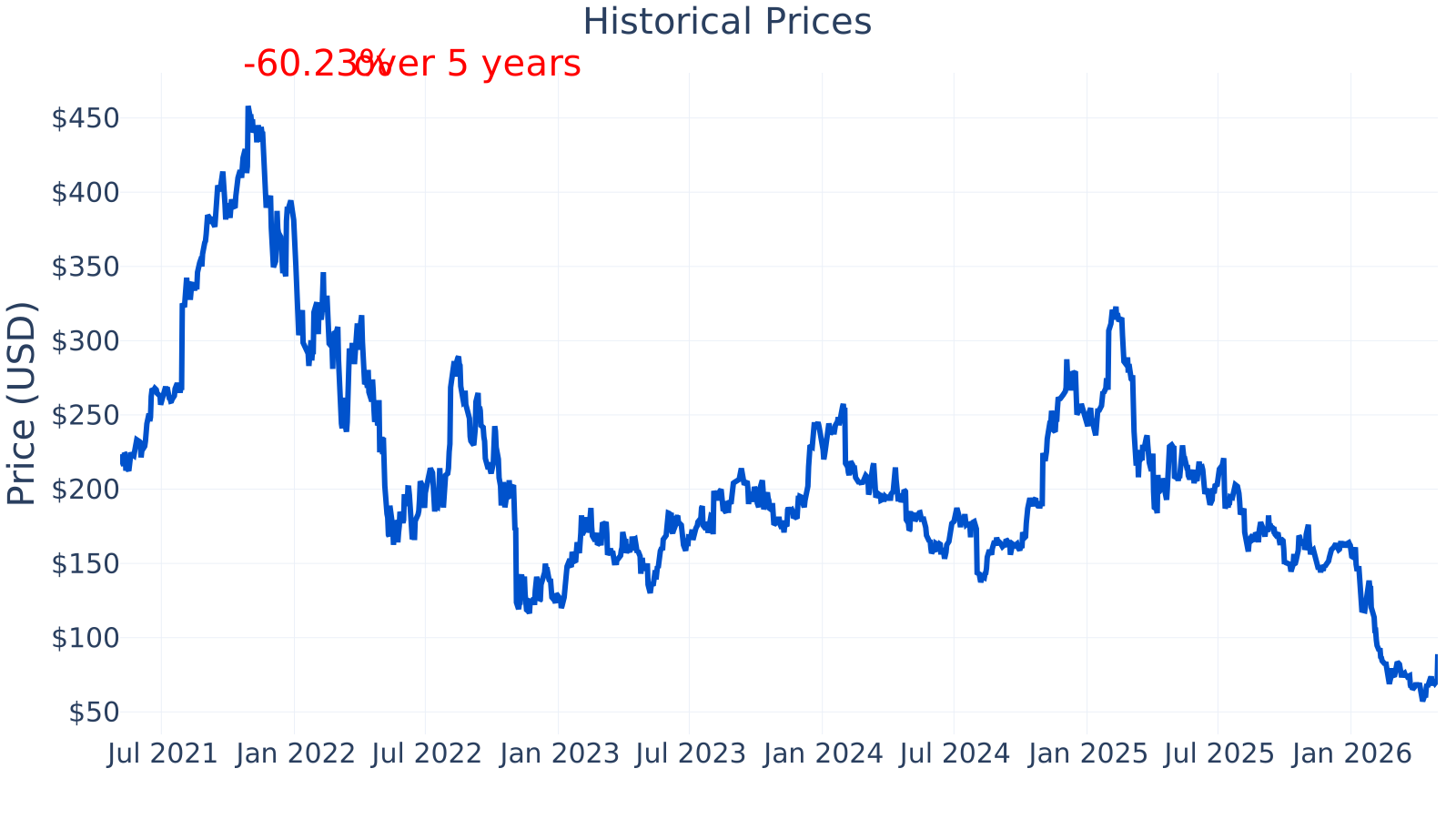
The stock price history shown is volatile, with large swings over multi-year periods. This matters for long-term owners because the market’s expectations for software companies can change quickly, even when the underlying products remain widely used.
| Metric | Value | Industry ⓘ |
|---|---|---|
| Date | May 04, 2026 | |
| Context | ||
| Sector | Technology | |
| Industry | Software - Application | |
| Market Cap ⓘ | $23.44B | |
| Beta ⓘ | 0.90 | |
| Fundamental | ||
| P/E Ratio ⓘ | N/A | 26.40 |
| Profit Margin ⓘ | -3.50% | 7.95% |
| Revenue Growth ⓘ | 31.70% | 15.60% |
| Debt to Equity ⓘ | 141.41% | 27.14% |
| PEG ⓘ | 0.80 | |
| Free Cash Flow ⓘ | $1.20B | |
At the latest point shown, Atlassian’s market capitalization is about $23.4B and its beta is about 0.90, which indicates the stock has historically moved somewhat similarly to the broader market (though individual periods can still be very volatile). The company’s year-over-year revenue growth is ~31.7%, higher than the industry median (~15.6%), while its profit margin is about -3.5% versus a positive industry median (~7.95%). Free cash flow over the trailing twelve months is about $1.20B, showing meaningful cash generation despite negative net income. Debt-to-equity is about 141%, well above the industry median (~27%), which increases financial risk compared with many peers.
Growth (medium)
Atlassian operates in the broad market for collaboration software, IT service management, and tools used to plan and deliver projects. These categories benefit from long-term trends such as distributed work, continued software adoption across industries, and the push to standardize internal processes (for example, ticketing and support workflows). These are mature enough markets to have major competitors, but still large and expanding as more types of work become “trackable” and measurable inside software tools.
A key strategic element is Atlassian’s shift toward cloud-delivered subscriptions. Cloud typically supports easier deployment, more frequent feature updates, and a recurring revenue model. It can also improve long-run unit economics if the company manages infrastructure and customer support costs effectively at scale, though the transition can be complex for large enterprise customers.
The trend displayed shows Atlassian sustaining generally strong growth rates over time, with quarterly year-over-year revenue growth moving within a wide band and most recently around 31.7%. The variability is important: growth can decelerate during tighter IT spending cycles and re-accelerate as conditions improve or as migration activity increases.
Free cash flow has been solidly positive in the periods shown, rising from about $731M (TTM) in 2022 to a peak around $1.45B in 2025, then easing to about $1.20B most recently. For a subscription software company, sustained positive free cash flow can be an important indicator of business durability, because it reflects cash generated after operating costs and capital needs, even when accounting earnings are negative.
Potential catalysts discussed in company materials often relate to continued cloud migration, expansion into larger customers, and broader adoption across departments beyond software teams (for example, using Atlassian tools for service management and general work planning). The pace and success of enterprise adoption and migration typically have an outsized influence on multi-year growth.
Risks (high)
Competition is a central risk. Atlassian participates in several crowded segments—project/work management, documentation/knowledge bases, and IT service management—where competitors can bundle features, discount aggressively, or leverage existing enterprise relationships. Customers also face switching costs, but they may still consolidate vendors if budgets tighten or if an alternative platform becomes a standard within their organization.
Atlassian does have competitive strengths often associated with its product ecosystem: widely recognized brands (such as Jira and Confluence), broad integrations with third-party tools, and the tendency for adoption to spread within organizations once teams standardize workflows. However, leadership is not absolute across every subcategory it serves; it competes against large platform vendors and focused specialists depending on the use case.
Major competitors vary by product area and can include large software suites and specialized tools (for example, collaboration suites, work management platforms, developer tooling providers, and IT service management vendors). In practice, Atlassian is frequently evaluated by customers as part of a broader stack decision: which collaboration suite to use, which system to run internal service tickets on, and which planning tools to standardize across teams.
Profitability remains a key risk area. Over the timeline shown below, margins improved substantially from deeply negative levels to closer to break-even, but they remain negative and below the industry median.
The profit margin trend improves from very negative levels earlier in the series (for example, around -33% in mid-2021) to roughly -3.5% most recently. Even with that improvement, the gap versus the industry median (around 8.4% most recently) highlights that Atlassian’s operating model continues to prioritize spending (notably product development) and/or absorbs significant costs that reduce net income.
Leverage is another meaningful consideration, especially when paired with ongoing net losses. Debt-to-equity also shows unusual volatility at certain dates (including a negative value), which can happen when equity is very small or changes sharply due to accounting items; the most recent level is still elevated relative to peers.
Most recently, debt-to-equity is about 141% versus an industry median around 29%. While this ratio alone does not show the full debt picture (such as maturities, cash on hand, or interest-rate exposure), it does indicate Atlassian is more leveraged than many companies in its application software peer set, which can reduce flexibility during slower growth periods.
Valuation
For Atlassian, the price-to-earnings (P/E) ratio is not displayed across the period shown, which is commonly consistent with companies that have negative earnings (a P/E is often not meaningful when net income is negative). In these cases, valuation discussions often shift toward other lenses (for example, revenue-based multiples or free-cash-flow-based measures), but those are not provided here.
What can be said from the available fundamentals is that the market is valuing a company with fast revenue growth (above the industry median) and strong free cash flow, while also weighing ongoing net losses and higher-than-median leverage. Whether the current stock price is “expensive” or “cheap” cannot be determined from P/E in this situation; the more relevant question becomes how durable growth and cash generation are, and whether profitability can sustainably improve over time without sacrificing product competitiveness.
Conclusion
Atlassian is a well-known application software provider focused on tools that help teams plan, build, and support work at scale. The company shows a combination of strong revenue growth and meaningful free cash flow generation, which are often viewed as important traits for subscription software businesses that are still investing heavily.
At the same time, the information above highlights two clear constraints: profit margins remain negative relative to the typical company in its industry group, and debt-to-equity is elevated versus peers. In addition, the competitive environment is intense across the categories Atlassian serves, and the stock has exhibited substantial historical volatility. The long-term picture therefore depends heavily on execution—especially sustaining cloud momentum, defending its position in key products, and continuing progress toward durable profitability.
Sources:
- U.S. Securities and Exchange Commission (SEC) EDGAR — Atlassian Corp Plc filings (Form 10-K, Form 10-Q)
- Atlassian Investor Relations — Shareholder letters / annual report materials and quarterly results press releases
- Wikipedia — “Atlassian” (basic company background and product overview)
This article is for informational purposes only and does not constitute financial advice. Some content is AI-generated. See Disclaimer