Stock Analysis · Astera Labs Inc (ALAB)
Overview
Astera Labs Inc (ALAB) is a semiconductor company focused on high-speed connectivity used inside modern data centers and AI computing systems. In simple terms, its products help move very large amounts of data quickly and reliably between key parts of advanced computers (for example, between compute, memory, and accelerator components). This type of “data plumbing” becomes more important as AI models grow and as data centers scale up.
Astera Labs generates revenue primarily by selling semiconductor-based connectivity solutions. Based on the company’s public filings, revenue is generally discussed as coming from product families and customer programs rather than consumer-facing lines, and detailed percentages by product category may vary by period.
- Semiconductor connectivity products (the core source of revenue)
- Related software/firmware and support elements (typically smaller than hardware, when applicable)
At a high level, the business model resembles many “fabless” chip companies: it designs specialized chips and associated technology, and relies on manufacturing partners to produce them, while Astera Labs focuses on design, validation, and customer adoption.
One notable pattern in the multi-year income statement is that revenue expanded significantly from 2022 through 2025, while spending on research and development also rose substantially. The 2025 period shows a meaningful shift: operating income and net income turned positive after earlier years of losses, indicating that scale and/or improved margins helped cover operating costs.
Key Figures
| Metric | Value | Industry ⓘ |
|---|---|---|
| Date | Feb 16, 2026 | |
| Context | ||
| Sector | Technology | |
| Industry | Semiconductors | |
| Market Cap ⓘ | $22.01B | |
| Beta ⓘ | N/A | |
| Fundamental | ||
| P/E Ratio ⓘ | 106.00 | 45.38 |
| Profit Margin ⓘ | 25.70% | 10.84% |
| Revenue Growth ⓘ | 91.80% | 15.50% |
| Debt to Equity ⓘ | 2.46% | 25.62% |
| PEG ⓘ | N/A | |
| Free Cash Flow ⓘ | $281.76M | |
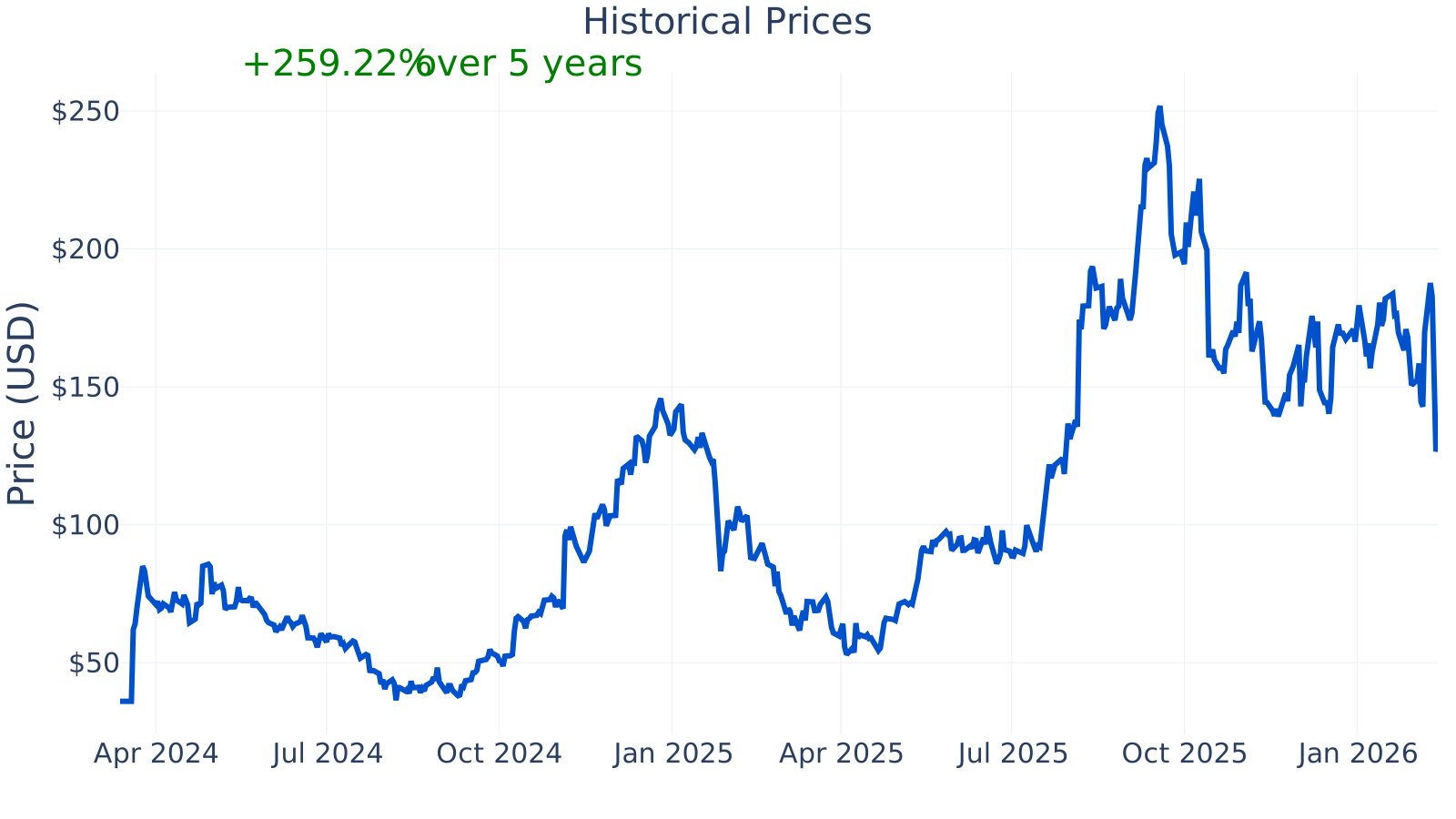
Astera Labs’ market capitalization is about $22.0B. The company’s latest P/E ratio is ~106, which is notably higher than the semiconductors industry median (~45.4), suggesting the market is pricing in substantial future growth and/or durability of earnings.
Profitability (as measured by profit margin) is shown at about 25.7%, which is higher than the industry median (~10.8%). Growth is also elevated: revenue growth year-over-year is shown at about 91.8%, far above the industry median (~15.5%), though such high growth rates often slow as companies become larger.
Financial leverage appears low: debt-to-equity is ~2.5% versus an industry median around ~25.6%. Free cash flow over the trailing twelve months is listed at about $281.8M, indicating that the business has recently been producing cash after operating needs and capital spending.
Growth (high)
Astera Labs operates in the broader semiconductor market, with demand closely tied to data center expansion and AI infrastructure buildouts. As AI workloads scale, the need for fast and reliable connections between components inside servers and accelerator systems increases. This creates a tailwind for companies supplying specialized connectivity technology, especially when performance requirements rise faster than general-purpose solutions.
The company’s strategy—designing targeted connectivity products for high-performance systems—fits a world where data movement increasingly becomes a bottleneck. When computing systems upgrade to support new AI architectures, connectivity components may need to be redesigned, requalified, and deployed across platforms, which can create multi-year product cycles and recurring demand if the company remains designed-in at major customers.
The revenue growth trend shown is extremely strong, though it moderates from very high levels over time (from roughly 179% YoY down to about 92% YoY in the periods shown). Even with deceleration, growth at these levels indicates rapid expansion relative to typical semiconductor peers.
Free cash flow improves across the periods shown (from roughly $91.6M to $108.2M in the displayed points), and the latest metrics also show a higher trailing figure. Sustained free cash flow matters for long-term resilience because it can help fund research, cover downturns, and reduce the need for external financing.
Potential catalysts, as described in company communications and filings, generally relate to adoption of new computing platforms and interconnect standards, customer ramps, and broader data center investment cycles. The strength of these catalysts depends on timing of customer deployments and how widely Astera Labs’ solutions are selected in new system designs.
Risks (high)
Semiconductors can be cyclical, meaning demand may rise and fall with data center spending, enterprise investment, and broader economic conditions. A second common risk for specialized chip suppliers is customer concentration: if a small number of large customers account for a meaningful portion of revenue, changes in purchasing plans, platform decisions, or inventory levels can have an outsized impact.
Competition is another key risk. Astera Labs participates in high-performance connectivity markets where large, well-funded semiconductor companies and platform vendors operate. Competitors may include major connectivity and silicon providers as well as companies building integrated solutions around accelerators and switching. Relative positioning typically depends on performance, power efficiency, compatibility with customer platforms, time-to-market, and the ability to support high-volume deployments with manufacturing partners.
Astera Labs’ competitive advantages, as typically discussed for semiconductor design companies, may include specialized expertise, proven performance in demanding environments, and established customer qualification. However, leadership in semiconductors can be fragile: technology shifts or platform consolidation can change which vendors are designed into next-generation systems.
Debt levels appear low versus the industry median (around 2–3% debt-to-equity versus roughly 20–26% for the median across the periods shown). Low leverage can reduce financial stress during downturns, but it does not remove execution risk (for example, product delays or demand volatility).
Profit margin shows a notable turnaround over time: it is negative in earlier periods and then rises to positive territory, reaching roughly 25.7% most recently. While that improvement is significant, margins in semiconductors can move materially with product mix, pricing, and the pace of operating expense growth.
Valuation
Astera Labs trades at a relatively high earnings multiple compared with the semiconductor industry median. The latest P/E shown (~106) is well above the industry median (~45), and the historical series also shows periods where the company’s P/E remained far above peers when it is measurable. A higher P/E commonly implies that the market expects above-average growth, strong competitive positioning, or both.
Whether the current valuation is “expensive” or “cheap” cannot be determined from a single metric alone, but the combination of (1) very strong recent revenue growth, (2) improving profitability, and (3) low debt helps explain why the stock may trade at a premium. At the same time, a premium valuation can be sensitive to changes in expectations: if growth slows faster than anticipated, if margins compress, or if major customer ramps shift, valuation multiples can re-rate quickly.
Conclusion
Astera Labs is positioned in a part of the semiconductor ecosystem that benefits from rising AI and data center complexity, where fast, reliable connectivity can be mission-critical. Financially, the company shows signs of rapid expansion, improving margins, positive free cash flow, and low leverage, all of which are constructive fundamental signals.
The main uncertainties center on how durable the current growth rate is, how concentrated revenue is among large customers, and how competition and technology transitions may influence future design wins and pricing. The valuation metrics indicate the market is assigning a premium relative to industry norms, which places greater weight on continued execution and sustained demand.
Sources:
- SEC EDGAR — Astera Labs Inc filings (Form 10-K, Form 10-Q, Form 8-K)
- Astera Labs Inc — Investor Relations materials and press releases (company-hosted)
- Astera Labs Inc — Earnings call materials or transcripts hosted by the company (when available)
- Wikipedia — “Astera Labs” (basic background only)
This article is for informational purposes only and does not constitute financial advice. Some content is AI-generated. See Disclaimer