Stock Analysis · Asbury Automotive Group Inc (ABG)
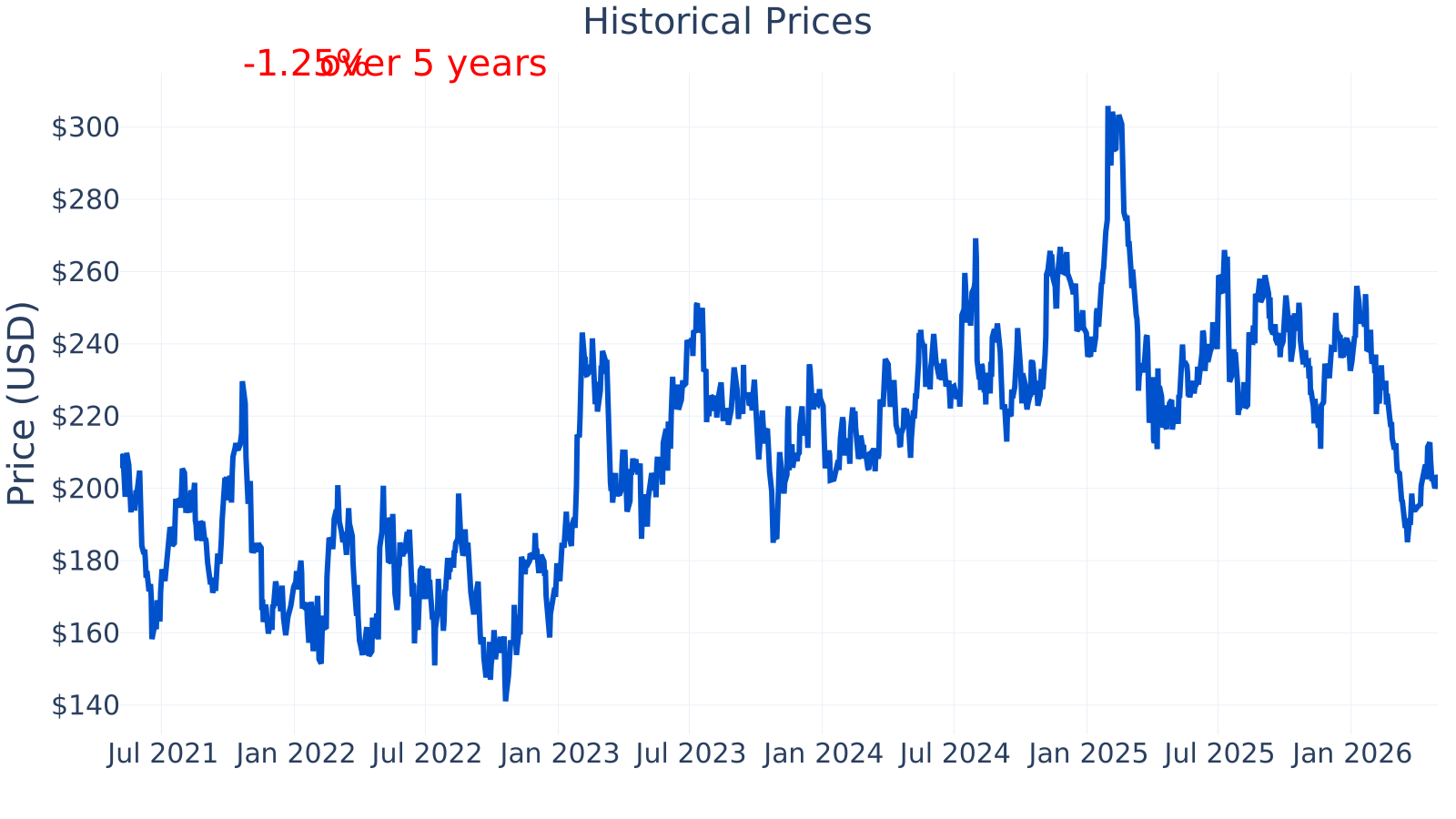
Overview
Asbury Automotive Group Inc (ABG) is a U.S. auto retailer. In simple terms, it operates car dealerships and related services: it sells new and used vehicles, arranges financing and insurance products for customers, and earns ongoing revenue from maintenance and repairs through its parts and service operations. This mix matters for long-term business stability because some parts of the business (like service and parts) can be less sensitive to ups and downs in new car sales.
Across the dealership model, revenue typically comes from vehicle sales (new and used) plus higher-margin “after-sale” activities such as service/parts and finance & insurance (F&I). In Asbury’s reporting, these activities are presented as distinct lines in its filings, and together they make up its overall performance.
Main sources of revenue (largest to smaller, typical dealership mix):
- New vehicle sales (largest share in many periods)
- Used vehicle sales
- Parts and service (maintenance, repairs, parts)
- Finance and insurance (F&I) (arranging loans/leases and selling related protection products)
The company’s income statement also shows a large “cost of revenue” line, which reflects that vehicle retailing is generally a high-revenue, lower-percentage-margin business (the vehicle itself is expensive inventory, and the dealer earns a spread plus add-on services).
From 2021 to 2025, total revenue increased from about $9.8B (2021) to about $18.0B (2025). Over the same period, gross profit rose from roughly $1.9B to roughly $3.0B. Net income peaked in 2022 (about $1.0B) and then moderated to about $492M in 2025, while interest expense increased notably by 2024–2025, which is consistent with a higher-rate environment and/or higher debt levels.
Key Figures
| Metric | Value | Industry ⓘ |
|---|---|---|
| Date | May 04, 2026 | |
| Context | ||
| Sector | Consumer Cyclical | |
| Industry | Auto & Truck Dealerships | |
| Market Cap ⓘ | $3.92B | |
| Beta ⓘ | 0.80 | |
| Fundamental | ||
| P/E Ratio ⓘ | 7.17 | 21.75 |
| Profit Margin ⓘ | 3.05% | 2.61% |
| Revenue Growth ⓘ | -0.90% | 3.25% |
| Debt to Equity ⓘ | 138.07% | 117.25% |
| PEG ⓘ | 0.58 | |
| Free Cash Flow ⓘ | $650.50M | |
Asbury’s equity value is about $3.9B, and the stock’s beta (~0.80) suggests it has historically moved somewhat less than the broader market on average (though any single stock can still be volatile). The company’s current P/E ratio (~7.17) is below the industry median (~21.75), while its latest profit margin (~3.05%) is slightly above the industry median (~2.62%). Recent year-over-year revenue growth (~-0.86%) is below the industry median (~3.25%), indicating a period of slower top-line momentum. Leverage is meaningful: debt-to-equity (~138%) is above the industry median (~117%). Free cash flow over the last twelve months is about $650.5M, and the listed PEG ratio (~0.58) indicates the P/E is low relative to the growth rate used in that metric (noting that PEG can change significantly when growth assumptions shift).
Growth (Medium)
Auto retail is a large, mature industry tied closely to consumer demand, credit conditions, and vehicle affordability. Long-term demand is supported by the ongoing need to replace aging vehicles and to maintain existing vehicles on the road, but the industry is cyclical: sales volumes and profitability can swing materially based on interest rates, vehicle supply, and consumer confidence.
Asbury’s strategy—common among large dealership groups—tends to focus on building scale (often through acquisitions), improving operational efficiency, and expanding higher-value activities around the vehicle sale. Over time, parts and service can be an important growth and resilience driver because it is tied to the installed base of vehicles (customers need repairs and maintenance regardless of whether they buy a new car this year). Similarly, F&I can contribute meaningfully to profit per vehicle, though it can be sensitive to lending conditions.
The year-over-year revenue growth pattern shows unusually high growth in 2021–2022 (reflecting a very strong period for auto retail), followed by weaker or negative comparisons in parts of 2023 and again near the most recent quarter shown (about -0.86%). This type of “surge then normalize” pattern is consistent with a cyclical industry where extraordinary conditions can temporarily lift results and then fade.
Free cash flow (a rough measure of cash left after operating needs and capital spending) dipped from about $1.28B (TTM ending 2022-03-31) to much lower levels in 2023–2024, then improved to about $650.5M most recently (TTM ending 2026-03-31). For long-term evaluation, this highlights that cash generation can vary significantly across cycles, making it important to look at multiple years rather than a single point in time.
Risks (High)
Asbury operates in a business where profitability can change quickly. Key risks include shifts in consumer demand, higher interest rates (which can reduce affordability and vehicle financing approvals), and changes in vehicle supply and pricing that affect margins on new and used vehicles. Because dealerships typically generate large revenue on relatively modest margins, small percentage changes in gross profit per vehicle or sales volume can have an outsized impact on earnings.
Competition is also intense. Asbury competes with other large publicly traded dealership groups as well as many private dealer groups in local markets. Major publicly traded peers in the U.S. dealership space include AutoNation, Lithia Motors, Penske Automotive Group, Sonic Automotive, and Group 1 Automotive. Relative positioning often comes down to local market footprint, brand mix, execution on used vehicles, service capacity, and the ability to acquire dealerships at sensible prices. Scale can be an advantage (purchasing, systems, marketing, and access to capital), but it does not remove cyclicality.
Leverage is a meaningful consideration because higher debt can amplify outcomes: it can support growth and acquisitions, but it can also increase fixed costs through interest expense and reduce flexibility in downturns.
As of the most recent point shown, debt-to-equity is about 138%, above the industry median of about 117%. The series shows this ratio moving around over time rather than steadily declining, which reinforces that balance-sheet risk should be monitored alongside earnings and cash flow—especially in a higher-rate environment.
Profitability is another area to watch closely, particularly because dealership margins tend to normalize after unusually favorable periods.
Profit margin has trended down from elevated levels in 2021–2022 (often above 5%) toward the ~2–3% range more recently, with the latest around 2.27%, close to the industry median (~2.37%). This suggests that the company’s profitability has been normalizing toward typical industry levels after a period of unusually strong results.
Valuation
On an earnings multiple basis, Asbury’s latest P/E (~7.17) is well below the industry median (~21.75), and the historical series also shows ABG often trading at a lower P/E than the industry median. A low P/E can reflect several neutral explanations: the market may be pricing in the industry’s cyclicality, expecting earnings to fall from recent levels, applying a discount for leverage, or assuming slower long-term growth.
Whether today’s multiple is “high” or “low” depends heavily on how durable current earnings and cash flow prove to be through a full auto cycle. The margin chart shows normalization versus the exceptionally strong period in 2021–2022, and the debt metrics indicate meaningful leverage. In that context, a lower multiple can be consistent with a business that has variable profitability and higher sensitivity to credit conditions.
Conclusion
Asbury Automotive Group is a scaled U.S. auto retailer with multiple earnings drivers: vehicle sales, financing/insurance income, and recurring parts and service work. Over the past several years, revenue expanded materially, but net income and profit margins have moderated from peak levels, reflecting a more typical operating environment for auto retail.
For a long-term view, the main balancing factors are the company’s ability to keep generating cash through industry cycles and the added sensitivity that comes with higher leverage. The valuation metrics shown (notably a lower P/E than the industry median) indicate the market is applying a relatively cautious multiple, which is often associated with cyclical businesses where earnings can change meaningfully with macro conditions. The most informative next steps for understanding durability would typically come from the company’s most recent annual report and quarterly filings, especially disclosures on segment performance (new vs. used vs. service), inventory and floorplan financing, and debt/interest-rate exposure.
Sources:
- SEC EDGAR — Asbury Automotive Group Inc filings (Form 10-K, Form 10-Q)
- Asbury Automotive Group — Investor Relations materials (press releases and company-hosted documents)
- Wikipedia — “Asbury Automotive Group” (basic company background)
This article is for informational purposes only and does not constitute financial advice. Some content is AI-generated. See Disclaimer


