Stock Analysis · Asana Inc (ASAN)
Overview
Asana Inc. is a software company that makes a cloud-based platform for work management. In plain terms, it helps teams plan projects, assign tasks, track deadlines, and coordinate work across people and departments. The product is typically used by businesses and organizations that want a single place to manage workflows and improve visibility on who is doing what and when.
Asana primarily earns revenue by selling subscriptions to its software (software-as-a-service). Customers usually pay based on the number of users and the plan level, often under annual or multi-year contracts. This model tends to create recurring revenue because organizations renew access to keep using the platform.
Main revenue sources (largest to smallest, based on how the business is described in filings):
- Subscription revenue (the core driver of revenue; typically the vast majority for SaaS companies like Asana)
- Professional services and other revenue (generally smaller; can include onboarding/support services)
Over the last several fiscal years, Asana’s revenue has increased while the company has still reported net losses. That combination often indicates a business that is prioritizing product development and customer acquisition, while working toward improved efficiency over time.
Looking at the company’s income statement flow over time, revenue and gross profit rise steadily from fiscal 2022 to fiscal 2026. Operating losses narrow meaningfully in fiscal 2026 compared with fiscal 2023–2025, suggesting improved cost discipline relative to revenue, even though the company remains unprofitable on a net income basis.
Key Figures
| Metric | Value | Industry ⓘ |
|---|---|---|
| Date | Mar 06, 2026 | |
| Context | ||
| Sector | Technology | |
| Industry | Software - Application | |
| Market Cap ⓘ | $1.88B | |
| Beta ⓘ | 1.07 | |
| Fundamental | ||
| P/E Ratio ⓘ | N/A | 25.64 |
| Profit Margin ⓘ | -23.90% | 7.42% |
| Revenue Growth ⓘ | 9.20% | 16.65% |
| Debt to Equity ⓘ | 135.35% | 24.02% |
| PEG ⓘ | N/A | |
| Free Cash Flow ⓘ | $84.44M | |
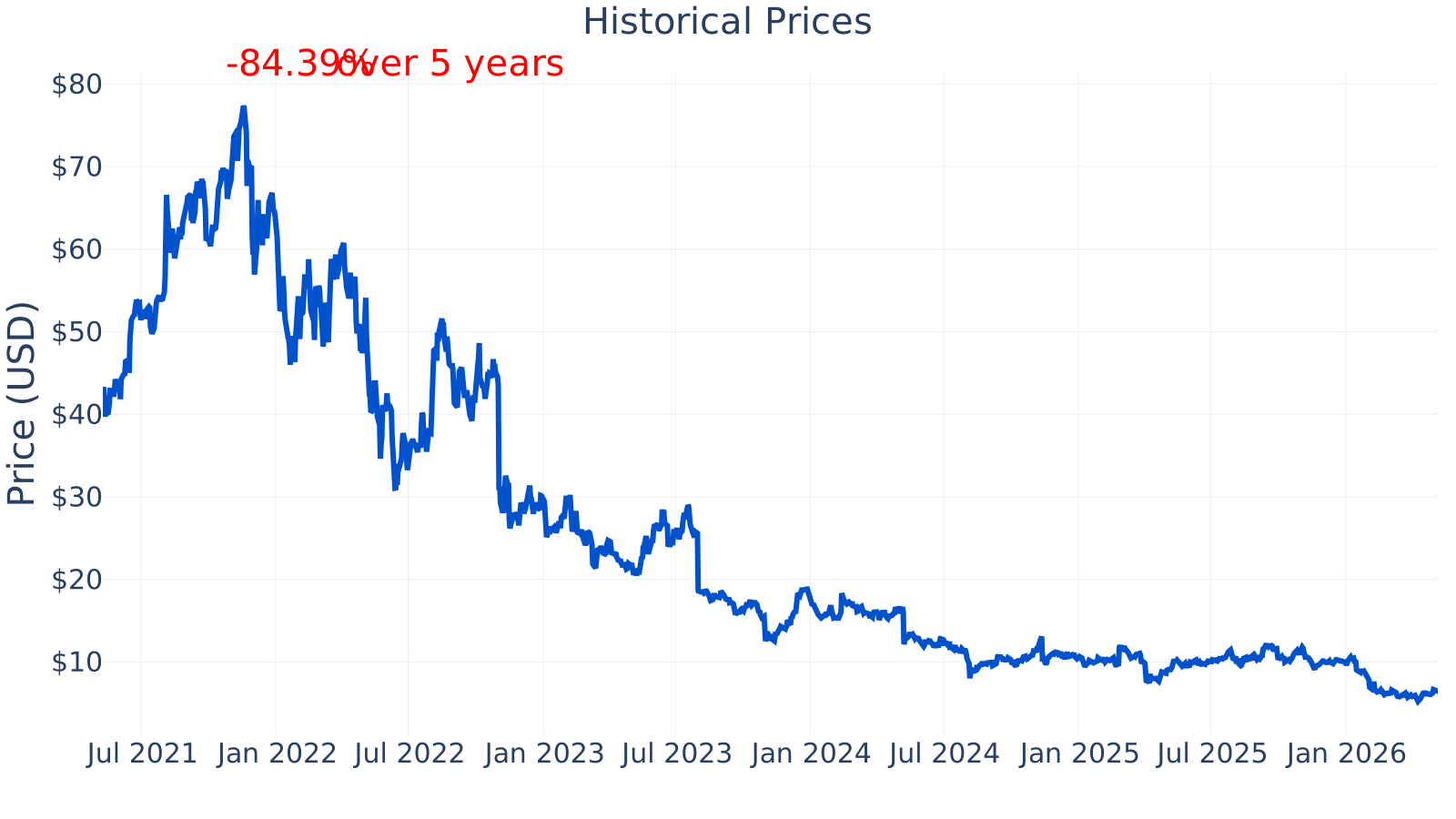
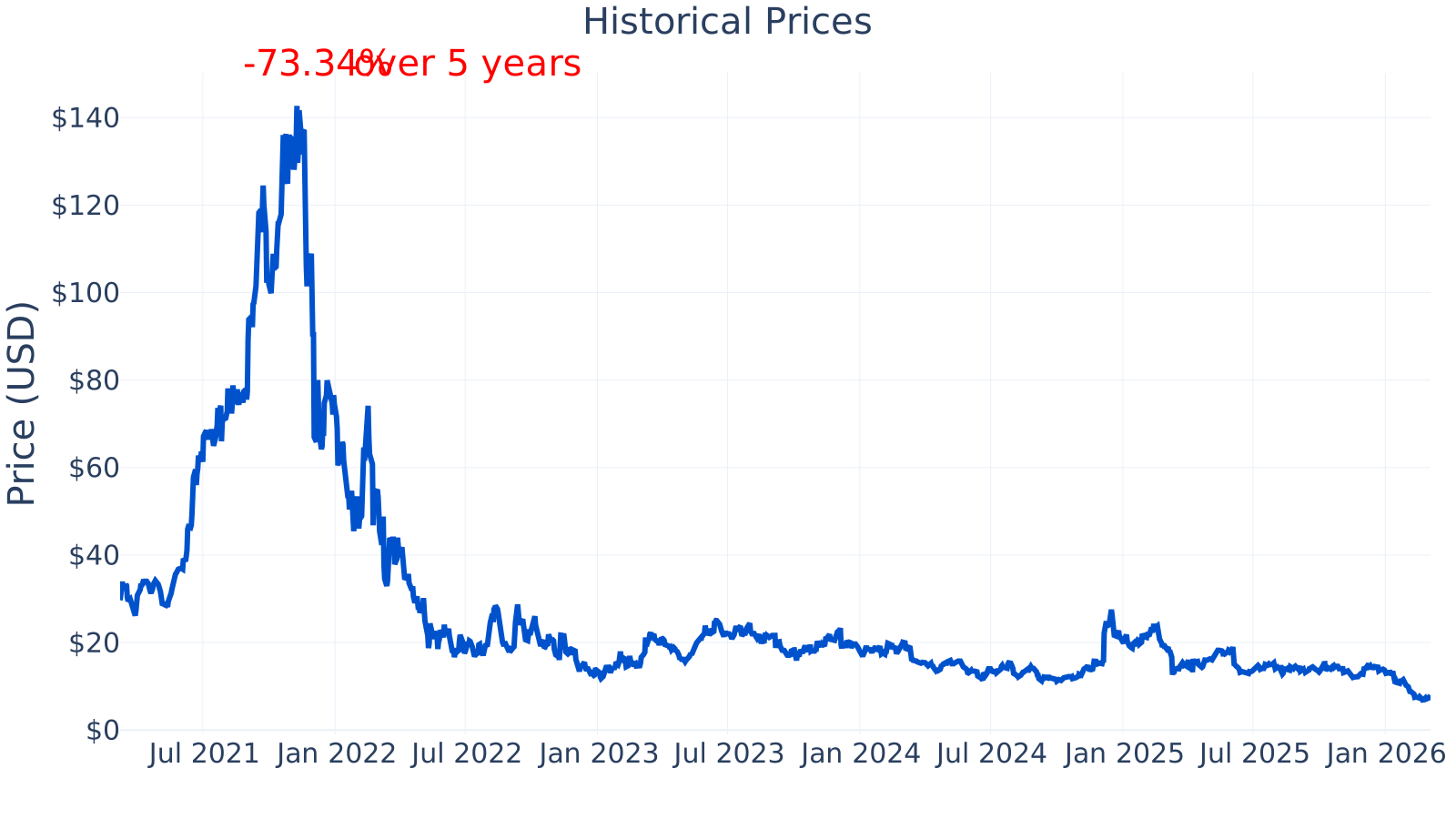
Asana’s market capitalization is about $1.88B, placing it in the smaller end of publicly traded software companies. The stock’s beta of ~1.07 suggests its price has tended to move roughly in line with the broader market, though individual periods can still be volatile.
On fundamentals, the company’s profit margin is about -23.9% versus an industry median around +7.4%, showing Asana is still operating below typical profitability for its software peer group. Revenue growth is about 9.2% year-over-year, below an industry median around 16.7%, indicating slower growth relative to many application software peers.
Balance-sheet leverage stands out: debt-to-equity is about 135% compared with an industry median around 24%. Finally, trailing twelve-month free cash flow is about +$84.4M, a notable improvement versus prior years and an important signal for a subscription software business because cash generation can improve financial flexibility.
Growth (Medium)
Asana operates in the broader work management and collaboration software space, which is supported by long-running trends such as distributed work, cross-functional projects, and the need to standardize processes across organizations. In that sense, the overall category has structural demand drivers that can persist over time as organizations modernize how they plan and execute work.
Where growth becomes more company-specific is execution: Asana’s recent year-over-year revenue growth has slowed materially from very high rates earlier in its public-company history to roughly high-single-digits more recently. That does not automatically mean the product is weak—often it reflects a company maturing from early rapid adoption into a phase where expansion depends more on larger enterprise rollouts, deeper usage within existing customers, and more efficient go-to-market execution.
The revenue growth trend shows a clear deceleration from the 50%–70% range in fiscal 2021–2022 down to roughly ~9%–10% most recently. For long-term outcomes, a key question is whether Asana can re-accelerate growth through product expansion, larger customer adoption, and improved retention/upsell, or whether it settles into a slower-growth profile typical of more mature software vendors.
A practical catalyst for long-term fundamentals is the company’s ability to convert revenue into cash. Subscription software businesses can become more resilient as they scale if they control sales/marketing and overhead growth while maintaining strong gross margins.
Free cash flow has improved substantially over the period shown, moving from meaningfully negative to approximately +$84M in the latest trailing twelve months. If that shift proves durable, it can reduce reliance on external funding and allow more flexibility for product investment while still improving financial stability.
Risks (High)
The biggest business risk is competitive pressure in a crowded software category where customers can compare many alternatives. Work management tools often compete on ease of use, integrations, enterprise controls, and pricing—factors that can raise customer acquisition costs and increase churn if users do not adopt the platform deeply across an organization.
Another core risk is profitability. While losses have narrowed, Asana is still not profitable by net income, and sustained profitability depends on balancing product investment with efficient sales execution. If growth remains modest while costs rise, margins can remain pressured for longer than expected.
Profit margin has improved markedly from deeply negative levels earlier in the timeline (around -90%+) to roughly -24% most recently, which indicates progress. However, it remains below the industry median (about +7.8% at the latest point shown), highlighting that Asana still has work to do to reach profitability comparable to many established software peers.
Financial risk is also relevant given leverage and the company’s capital structure. Higher leverage can limit flexibility if business conditions weaken or if the company needs to refinance obligations under less favorable terms.
Debt-to-equity rises to about 135% at the latest point, far above the industry median (about 25%). That gap does not automatically imply distress, but it does mean the balance sheet is more leveraged than many peers, which can increase sensitivity to execution setbacks.
On competitive positioning, Asana has recognizable brand awareness in work management and a product designed for cross-functional coordination. Its competitive advantages often center on workflow structure, usability, and integrations. Still, it is not alone: major competitors commonly include Atlassian (Jira/Confluence), Monday.com, Smartsheet, and collaboration suites that can overlap with task/project coordination features. In many organizations, tool choice is influenced by existing software ecosystems, procurement preferences, and standardization decisions—meaning leadership can vary by segment (SMB vs. enterprise; IT-led vs. business-led deployments).
Valuation
Valuation for companies with negative earnings is often harder to interpret using the price-to-earnings (P/E) ratio, because the metric may be undefined or not meaningful when net income is negative. That is the case here.
The P/E series is not shown at meaningful levels for Asana across the period provided, consistent with the company’s net losses. By contrast, the industry median P/E shown in later periods ranges roughly around the 40–60 area, illustrating that many peers have positive earnings where P/E can be calculated. In practice, discussions of valuation for Asana tend to lean more on the company’s growth trajectory, margin improvement path, cash generation, and balance-sheet strength rather than a traditional earnings multiple.
From a fundamentals perspective, two valuation-relevant cross-currents stand out: (1) revenue growth has slowed into the high-single-digits, which typically supports lower “growth-style” valuations than periods of 30%–70% growth; and (2) free cash flow has recently turned positive and profit margins have improved, which can support valuation if the market gains confidence that profitability can continue improving over time.
Conclusion
Asana is a work management software company built on a recurring subscription model, operating in a category with long-term demand drivers tied to coordination, visibility, and process management across teams. The company has grown revenue steadily over the years shown and has recently demonstrated a meaningful improvement in free cash flow.
At the same time, the business profile includes notable uncertainties for long-term shareholders: revenue growth has slowed considerably versus earlier years, profitability remains negative (despite improvement), and leverage is higher than many software peers based on debt-to-equity comparisons. Taken together, the long-term investment debate tends to center on whether Asana can sustain cash generation improvements, further narrow losses toward profitability, and defend its position in a highly competitive market where switching and consolidation into broader software suites can influence outcomes.
Sources:
- U.S. Securities and Exchange Commission — EDGAR (Asana Inc. filings, including Form 10-K and Form 10-Q)
- Asana, Inc. — Investor Relations (shareholder materials and SEC filings)
- Wikipedia — “Asana (software)” (high-level background)
This article is for informational purposes only and does not constitute financial advice. Some content is AI-generated. See Disclaimer