Stock Analysis · Arteris Inc (AIP)
Overview
Arteris, Inc. (AIP) is a technology company that sells specialized “building-block” intellectual property (often shortened to IP) used inside complex chips (semiconductors). In simple terms, its products help different parts of a chip communicate efficiently—an increasingly important need as chips add more processing blocks for AI, automotive, networking, and other data-heavy uses. Rather than manufacturing chips, Arteris licenses its technology to chip designers and provides related software tools and support.
Its business model is generally based on licensing and long-term customer relationships: customers integrate Arteris IP into their chip designs, and Arteris earns revenue from licenses (often when design work starts) and from royalties (typically when the customer’s chips ship in volume). This structure can create a time lag between “design wins” and the larger royalty stream, because chips can take years to go from design to mass production.
Main revenue sources (as described in company filings) are typically:
- License and related revenue (upfront or time-based fees for using the IP and tools)
- Royalty revenue (payments tied to customers’ chip shipments)
- Maintenance/support and professional services (implementation help and ongoing support, where applicable)
In recent years, the income statement profile has shown a high gross profit structure (typical for IP/software-like models) but also heavy spending on research and development to keep the technology competitive as chip complexity increases.
From 2021 to 2025, total revenue rose from about $37.9M to about $70.6M, while gross profit remained high each year. Over the same period, operating expenses increased materially, with research and development representing the largest share of spending—one of the main reasons operating income and net income stayed negative in each of those years.
Key Figures
| Metric | Value | Industry ⓘ |
|---|---|---|
| Date | May 04, 2026 | |
| Context | ||
| Sector | Technology | |
| Industry | Semiconductors | |
| Market Cap ⓘ | $1.33B | |
| Beta ⓘ | 1.94 | |
| Fundamental | ||
| P/E Ratio ⓘ | N/A | 53.51 |
| Profit Margin ⓘ | -49.23% | 6.16% |
| Revenue Growth ⓘ | 30.00% | 19.70% |
| Debt to Equity ⓘ | -62.08% | 20.71% |
| PEG ⓘ | N/A | |
| Free Cash Flow ⓘ | $5.34M | |
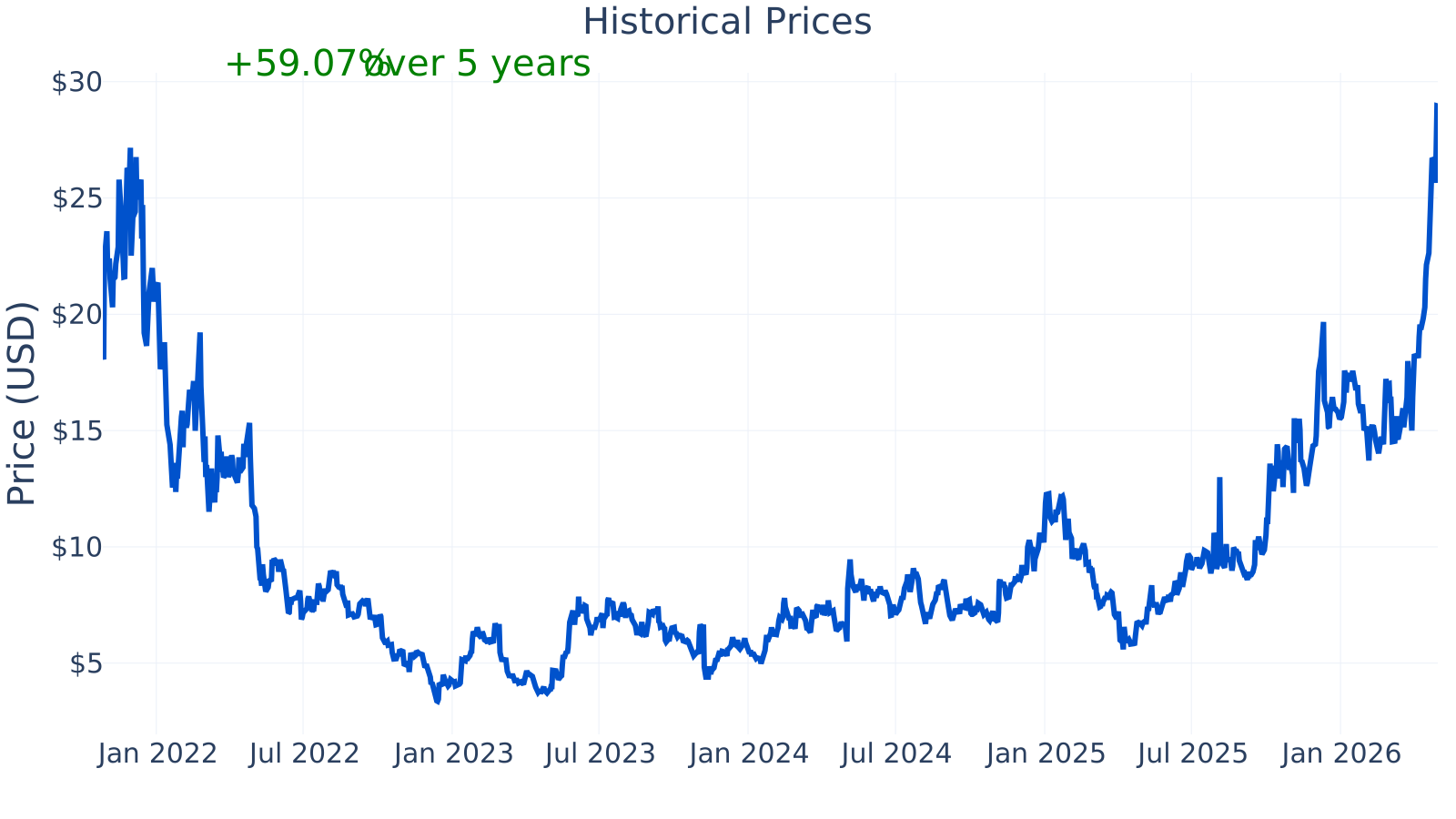
Arteris’ market capitalization is about $1.33B. The stock’s beta (~1.94) indicates it has tended to move more than the overall market. Profitability remains a central issue: the latest profit margin shown is about -49%, versus an industry median around 6%. On growth, the latest year-over-year revenue growth shown is about 30%, above the industry median near 20%. Free cash flow over the trailing twelve months is positive (~$5.3M) in the table, though historical free cash flow has varied.
Growth (Medium)
Arteris operates within the broader semiconductor ecosystem, where long-term demand is shaped by trends such as AI workloads, cloud data centers, advanced consumer devices, and the electrification and software content of vehicles. These trends generally increase chip complexity, and complexity increases the value of efficient “connectivity inside the chip,” which is the problem Arteris is focused on solving.
Strategically, the company’s emphasis on ongoing product development aligns with a market that keeps pushing toward more “systems on chip” with many processing blocks that must share data without bottlenecks. The potential growth logic is straightforward: if more chips need the type of interconnect IP and related tooling Arteris offers, the total addressable opportunity can expand, and royalties may grow as customers’ products ramp.
Revenue growth has not been linear quarter-to-quarter, but the most recent period shown reaches roughly 30% year-over-year. Earlier periods include both low/near-zero growth and re-acceleration, which is consistent with a licensing model that can be affected by customer timing and the cadence of large agreements.
Free cash flow improved from negative levels in 2022–2024 to slightly positive by 2025, and the latest table value is positive. For long-term business durability, a key question is whether this improvement can be sustained while continuing substantial R&D investment.
Risks (High)
The most visible risk is that the company is still operating at a net loss. Even with solid gross profit, Arteris spends heavily—especially on R&D—which has kept operating income negative across the years shown in the income statement. If revenue growth slows or large licensing deals shift out in time, losses could persist longer than expected.
Customer concentration and project timing are also important risks in IP licensing businesses. A small number of delayed customer programs, slower semiconductor end markets, or changes in customer design priorities can affect near-term results. In addition, the “design-to-royalty” cycle can be long, meaning current engineering engagement may not translate into near-term royalty revenue.
Competition is another major consideration. Arteris competes in the broader semiconductor IP landscape, where large, established IP vendors (and internal design teams at major chip companies) can offer alternative solutions. Competitive advantages for Arteris commonly discussed in filings include its focus on network-on-chip interconnect, its software tools around design and analysis, and accumulated know-how from prior customer deployments. However, it is not the only credible option available to chip designers, and larger competitors may have broader product portfolios and customer reach.
The debt-to-equity line becomes difficult to interpret in later periods because it turns negative (the latest point is about -62%). This typically happens when equity becomes very small or negative due to accumulated accounting losses or other balance-sheet effects, which can make the ratio less meaningful as a simple “leverage” indicator. Earlier in the series, the ratio was below the industry median, but it rose sharply before flipping negative—worth monitoring alongside the balance sheet in filings.
Profit margins have been consistently negative in the period shown, improving from roughly the -60% to -70% range to about -49% most recently, while the industry median stayed positive. This gap highlights that Arteris’ current scale and cost structure are not yet producing GAAP profitability, even as revenue grows.
Valuation
For many unprofitable companies, the traditional price-to-earnings (P/E) ratio is not meaningful because earnings are negative, and the P/E may appear as zero or be undefined depending on how it is presented. That is the case in the historical series shown here.
The chart shows Arteris’ P/E as 0 throughout, reflecting that losses make P/E-based comparisons unreliable. In this situation, valuation discussions typically shift toward other measures (such as revenue-based multiples) and toward qualitative questions: the durability of licensing relationships, the likelihood that royalties scale as customer chips ramp, and whether operating costs can grow slower than revenue over time. Based on the metrics shown in this article, the key tension is above-median growth versus ongoing losses and high operating expense intensity.
Conclusion
Arteris is positioned in a part of the semiconductor ecosystem that can benefit from long-term trends toward more complex chips, where efficient on-chip communication becomes increasingly important. The company has demonstrated meaningful revenue expansion over the multi-year period shown, with the latest year-over-year growth around 30% and recent improvement in free cash flow.
At the same time, the financial profile remains defined by negative profitability and heavy R&D-led spending, and several metrics (like debt-to-equity turning negative) require careful balance-sheet context from filings. Overall, the long-term assessment hinges on whether Arteris can convert industry tailwinds and customer adoption into sustained operating leverage—revenue growing faster than costs—while maintaining competitiveness in a crowded semiconductor IP landscape.
Sources:
- SEC EDGAR — Arteris, Inc. annual and quarterly filings (Form 10-K, Form 10-Q)
- Arteris, Inc. Investor Relations — Press releases and SEC filing links
- Wikipedia — “Arteris” (basic company background)
This article is for informational purposes only and does not constitute financial advice. Some content is AI-generated. See Disclaimer


