Stock Analysis · Arrow Electronics Inc (ARW)
Overview
Arrow Electronics, Inc. is a global distributor and value-added provider for the electronics supply chain. In simple terms, it sits between technology manufacturers and the companies that need components and computing solutions. Arrow helps customers source parts (such as semiconductors and other electronic components), manage supply logistics, and in many cases design products and integrate software and services. This “middle layer” role can matter because many end customers prefer to simplify purchasing across thousands of parts and vendors, especially when supply conditions change quickly.
The company reports its business in two main segments, which are also its primary revenue sources:
- Global Components (largest): Distribution of electronic components (including semiconductors and related products) to original equipment manufacturers and contract manufacturers.
- Global Enterprise Computing Solutions (smaller): Distribution and integration-oriented offerings for enterprise IT, including computing and storage infrastructure and related services.
From a big-picture perspective, Arrow’s economics are shaped by high revenue volume and relatively low margins, which is common in distribution businesses. Small changes in demand, pricing, and inventory conditions can therefore have an outsized impact on profitability.
Across 2021–2025, revenue and profit levels moved with industry cycles: revenue rose into 2022, then fell meaningfully in 2023–2024 before improving in 2025. Over the same period, net income also declined sharply from the 2022 level and only partially recovered by 2025, showing how sensitive results can be when volumes and pricing change in a low-margin model.
Key Figures
| Metric | Value | Industry ⓘ |
|---|---|---|
| Date | May 04, 2026 | |
| Context | ||
| Sector | Technology | |
| Industry | Electronics & Computer Distribution | |
| Market Cap ⓘ | $9.43B | |
| Beta ⓘ | 1.00 | |
| Fundamental | ||
| P/E Ratio ⓘ | 16.90 | 18.85 |
| Profit Margin ⓘ | 1.85% | 1.88% |
| Revenue Growth ⓘ | 20.10% | 18.95% |
| Debt to Equity ⓘ | 46.85% | 29.85% |
| PEG ⓘ | 0.94 | |
| Free Cash Flow ⓘ | $36.67M | |
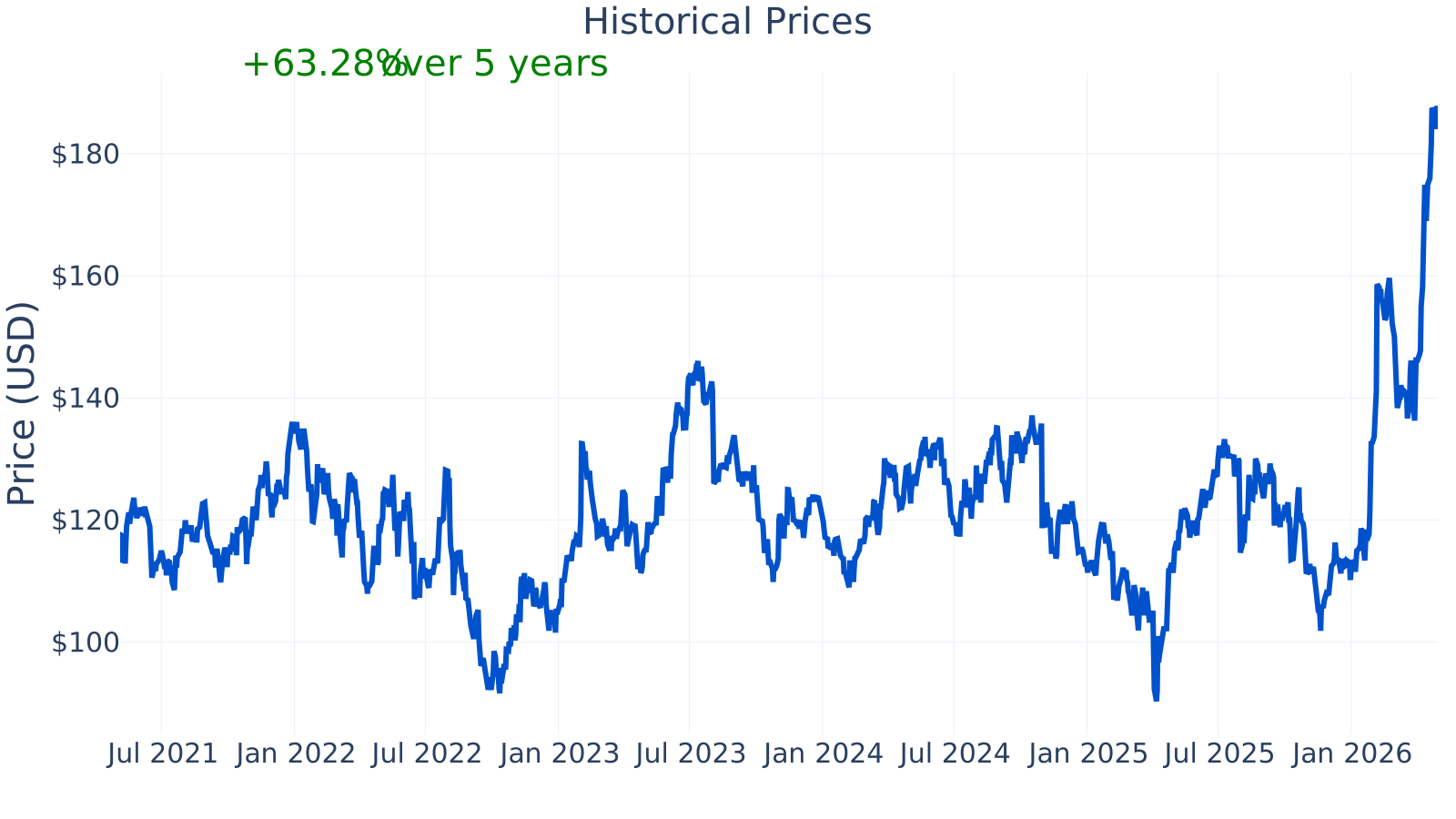
Arrow Electronics’ market capitalization is about $9.4B. The stock’s beta is ~1.00, which indicates price moves that have historically been broadly in line with the overall market. The company’s P/E ratio is ~16.9, slightly below the industry median (~18.9). Profit margin is about 1.85%, close to the industry median (~1.88%), reflecting the thin-margin nature of electronics distribution. Recent year-over-year revenue growth is ~20.1%, slightly above the industry median (~19.0%), while debt-to-equity is ~46.9%, higher than the industry median (~29.9%). Trailing twelve-month free cash flow is ~$36.7M (cash generated after operating needs and capital spending), and the PEG ratio is ~0.95 (a valuation metric that relates P/E to expected growth, though it depends heavily on the growth assumptions behind it).
Growth (Medium)
Arrow operates in electronics distribution and enterprise IT solutions—areas that are supported long-term by continued digitization, electrification, and rising electronic content in many products. However, these end markets are also well known for cyclical swings. Demand can accelerate when manufacturers ramp production and restock inventories, and then slow sharply when customers work down excess inventory or when broader economic activity softens.
Strategy-wise, Arrow’s positioning is primarily about scale, supplier relationships, and execution: carrying a broad catalog, supporting customers across many regions, and providing services that go beyond “box moving” (for example, design and engineering support in components, and solution-building capabilities in enterprise computing). In theory, these services can deepen customer relationships and reduce switching, but results can still be strongly influenced by the industry cycle.
The revenue growth pattern highlights that cyclicality clearly matters. After strong growth in 2021–2022, year-over-year revenue turned negative through much of 2023 and 2024, then improved progressively and returned to positive territory in 2025 (reaching roughly +20% by the end of 2025). For long-term readers, the key point is that growth has not been steady; it has tended to come in waves.
Free cash flow rose substantially from 2022 through 2025 (from about $141M to about $991M by March 2025 on a trailing basis), which can indicate stronger operating performance and/or favorable working-capital dynamics during that period. The latest table figure shows a much lower trailing free cash flow value (~$36.7M), suggesting cash generation can change quickly—often driven by working capital needs such as inventory and receivables in a distribution business.
Risks (High)
A central risk is cyclicality. Arrow’s results can be heavily affected by semiconductor and electronics demand, customer inventory corrections, and pricing dynamics. Because profit margins are thin, downturns can pressure earnings disproportionately compared with revenue declines.
Another key risk is inventory and working-capital management. Distributors must balance product availability with the risk of holding excess or aging inventory, especially when technology changes quickly. If demand shifts suddenly, the company may need to adjust inventory levels, which can impact cash flow and profitability.
Arrow also faces execution and competitive pressure. Distribution is competitive, and customers can be price-sensitive. The company’s advantages tend to come from scale, breadth of supplier lines, logistics capabilities, and value-added services. These can be meaningful, but they are not absolute barriers—large competitors can offer similar capabilities, and manufacturers sometimes sell more directly to large customers.
Major competitors are other large electronics and technology distributors, including Avnet and TD SYNNEX, along with various regional and specialized distributors. Compared with peers, Arrow is one of the larger global players in electronics components distribution and has an established position across both components and enterprise computing solutions, but it operates in markets where pricing power is limited and differentiation can be incremental.
Debt-to-equity trended down from peaks in 2023 (around the mid-70% range) to about 46.9% by the end of 2025, which is closer to (but still above) the industry median shown (~50.7% at that date, and ~29.9% in the latest table’s median reference). This indicates leverage has moderated versus prior periods, though balance-sheet structure remains an area to monitor given the industry’s cyclicality.
Profit margin declined from roughly 3%–4% in 2021–2022 to about 1.85% by the end of 2025, below the industry median shown (~2.12% at that date). This helps illustrate how profitability can compress when the cycle turns, even if the business remains solidly operating.
Valuation
Arrow’s current P/E ratio is about 16.9, compared with an industry median near 18.9. Historically (based on the values shown), Arrow’s P/E spent much of 2021–2024 below the industry median and then moved closer to the median more recently. Interpreting this is not straightforward: a lower P/E can reflect market concerns about cyclicality and margin pressure, while a higher P/E can reflect expectations of recovery or more stable earnings.
Given the company’s thin margins and cycle-driven earnings, valuation is often best understood alongside operating trends (revenue growth direction, margin stability, and cash generation). When revenue growth rebounds (as seen in 2025) but margins remain compressed (as seen versus 2021–2022), the market’s multiple can shift depending on whether participants expect margins and cash flow to normalize or remain pressured.
Conclusion
Arrow Electronics is a large, global technology distributor with two main engines: electronic components distribution and enterprise computing solutions. The business benefits from scale and long-standing supplier and customer relationships, and it participates in long-term technology adoption trends. At the same time, results have shown pronounced cyclical behavior, with revenue and profitability moving in waves and margins compressing notably from earlier highs.
From a long-term perspective, the main points to weigh are the company’s ability to navigate industry cycles (inventory discipline, cost control, and customer retention), whether margins can stabilize over time, and how consistently it can convert earnings into free cash flow across different demand environments. The current valuation metrics place the stock near industry norms on earnings multiples, while leverage and profitability trends remain important ongoing monitoring items.
Sources:
- SEC EDGAR — Arrow Electronics, Inc. Form 10-K (Annual Report)
- SEC EDGAR — Arrow Electronics, Inc. Form 10-Q (Quarterly Reports)
- Arrow Electronics Investor Relations — SEC Filings
- Arrow Electronics Investor Relations — Press Releases
- Wikipedia — “Arrow Electronics” (basic company background)
This article is for informational purposes only and does not constitute financial advice. Some content is AI-generated. See Disclaimer