Stock Analysis · Array Technologies Inc (ARRY)
Overview
Array Technologies Inc. designs and manufactures equipment used in large, utility-scale solar power plants. Its core products are ground-mounted “trackers,” which are mechanical systems that rotate solar panels during the day so they follow the sun. In simple terms, the company sells the hardware (and related components) that helps solar farms generate more electricity from the same site.
Array’s revenue is primarily tied to solar project activity, especially in the utility-scale segment. Based on company filings, revenue is mainly generated from product sales of solar tracking systems and related parts/services. Public filings typically describe these as a single primary business rather than many separate lines, so a precise multi-line percentage breakdown is not consistently disclosed.
Main sources of revenue (high-level, from largest to lowest):
- Solar tracking system product sales (the core of revenue; utility-scale projects)
- Related components and services (such as parts, logistics-related items, and other ancillary offerings described in filings)
At a business-model level, Array’s performance is influenced by (1) the pace of solar farm construction, (2) pricing and manufacturing costs for steel and other inputs, and (3) the company’s ability to execute large project deliveries on schedule.
Over the last several years shown, revenue and gross profit have moved materially, with a strong year in 2023 followed by a sharp revenue decline and operating loss in 2024, then partial recovery in 2025. This pattern highlights how sensitive results can be to project volumes, pricing, and operating costs.
Key Figures
| Metric | Value | Industry ⓘ |
|---|---|---|
| Date | Mar 02, 2026 | |
| Context | ||
| Sector | Technology | |
| Industry | Solar | |
| Market Cap ⓘ | $1.16B | |
| Beta ⓘ | 1.70 | |
| Fundamental | ||
| P/E Ratio ⓘ | N/A | |
| Profit Margin ⓘ | -4.07% | 7.06% |
| Revenue Growth ⓘ | -17.90% | 11.10% |
| Debt to Equity ⓘ | 41.30% | 104.92% |
| PEG ⓘ | 0.92 | |
| Free Cash Flow ⓘ | $79.81M | |
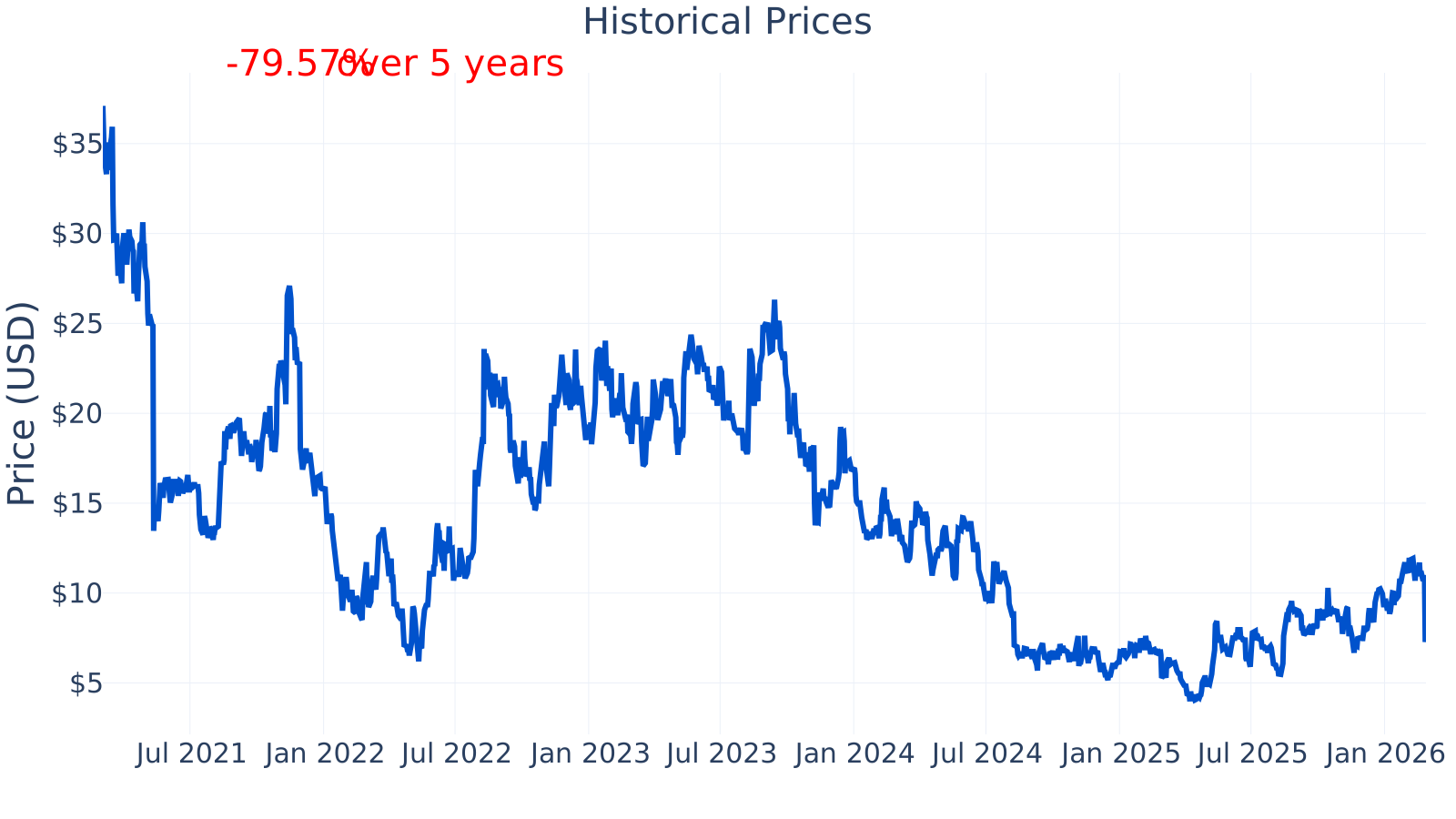
Array Technologies’ market capitalization is about $1.16 billion, placing it in the small-to-mid cap range. The stock has shown relatively high volatility (beta about 1.70), which generally means its price has tended to move more than the broader market.
Recent profitability and growth metrics are mixed versus the industry median shown in the table. The latest profit margin is about -4.1% versus an industry median around 7.1%, and the most recent year-over-year revenue growth is about -17.9% versus an industry median around 11.1%. On balance sheet leverage, the latest debt-to-equity ratio is about 41.3%, below the industry median of about 104.9% (lower leverage than the median in this peer set). Free cash flow over the trailing twelve months is about $79.8 million.
Growth (Medium)
Array operates in the utility-scale solar market, which is tied to long-term electrification and renewable generation buildout. Demand in this segment is shaped by power prices, grid interconnection timelines, financing conditions, and policy incentives. Trackers are widely used in many utility-scale projects because they can improve energy output versus fixed-tilt systems, which can support continued adoption over time when project economics favor the extra equipment.
A practical way to think about Array’s growth potential is that it depends not just on whether solar grows, but whether (1) utility-scale solar continues to be built at high volumes and (2) the company can convert demand into profitable deliveries. Execution—meeting schedules, controlling warranty/quality issues, and managing input costs—matters as much as end-market growth.
The year-over-year revenue growth pattern has been uneven. After very strong expansion in parts of 2021–2022, growth turned negative through much of 2023–2024, then rebounded sharply in early-to-mid 2025 before turning negative again in the latest point shown (about -17.9%). This kind of volatility is common in project-driven businesses, where timing of large customer orders and deliveries can shift reported results from quarter to quarter and year to year.
Free cash flow (cash generated after operating needs and capital spending) has also swung widely: negative in 2022, strongly positive in 2023–2024, and lower (but still positive) most recently at about $79.8 million. For long-term business durability, sustained positive free cash flow can matter because it can support debt reduction, reinvestment, and resilience during weaker demand periods.
Risks (High)
Array’s main risks largely come from the combination of (1) a competitive equipment market and (2) project-based demand that can be lumpy. Revenue can rise or fall quickly depending on customer project schedules and financing conditions. In addition, product margin can be pressured by changes in steel and freight costs, competitive pricing, and the cost of addressing quality or warranty items.
Leverage has shifted materially over time. The latest debt-to-equity is about 41%, which is below the industry median shown (about 70% at the latest point and about 105% in the table’s median). However, the historical series shows periods where leverage was much higher, indicating that balance sheet structure and equity levels have changed meaningfully over the cycle.
Profitability has also been volatile. Margins improved into 2023 and early-to-mid 2024 (reaching high single digits at times), then fell sharply negative in late 2024 and remained below the industry median in 2025, ending near -4%. This suggests the company’s earnings power has been sensitive to pricing, costs, and operating expense levels—an important consideration for long-term stability.
In terms of competitive positioning, Array participates in a market with well-established global and regional suppliers of solar tracking systems. Competitive advantages in this category tend to come from proven product reliability, bankability (customer confidence backed by operating history), scale in manufacturing and procurement, and the ability to support large deployments. Based on public filings, the company positions itself as a significant provider in utility-scale solar trackers, but the market remains competitive and customers can be price-sensitive.
Main competitive pressures typically come from:
- Other utility-scale tracker manufacturers competing on cost, delivery timelines, and reliability
- Alternative mounting solutions (including fixed-tilt in some projects) depending on site conditions and economics
- Customer concentration and project size, where losing a small number of large orders can noticeably affect results
Valuation
A common valuation shortcut is the price-to-earnings (P/E) ratio, but it becomes less informative when earnings are inconsistent or negative. In the periods shown, Array’s P/E is frequently not meaningful (displayed as 0 in the series), and when it appears, it varies widely (for example, in 2023–2024 it ranged from the teens to above 60). By comparison, the industry median P/E shown trends from very high levels earlier in the period toward the high teens to mid-20s more recently, depending on the date.
Because profitability has recently been negative (latest profit margin about -4%) and revenue growth has been uneven (latest year-over-year revenue growth about -18%), valuation is harder to summarize with a single ratio. In practice, market capitalization (about $1.16 billion), cash generation (free cash flow about $79.8 million), and the path back to consistent operating profitability tend to be key context points when interpreting the stock’s pricing relative to fundamentals.
Conclusion
Array Technologies is a utility-scale solar equipment provider whose results are tied to the pace of solar project development and the company’s execution on cost control and delivery. The business has shown it can generate meaningful revenue and profit in stronger periods (notably 2023), but it has also experienced sharp reversals (notably the operating loss and net loss in 2024 and continued profitability pressure into 2025).
For a long-term view based on publicly available fundamentals, the main items to weigh are the supportive long-run backdrop for utility-scale solar versus the company’s historically high volatility in revenue, margins, and leverage. The current picture combines positive trailing free cash flow with profitability below the peer median and choppy growth, meaning future outcomes may depend heavily on whether operational performance stabilizes through changing market conditions.
Sources:
- U.S. Securities and Exchange Commission (SEC EDGAR) — Array Technologies, Inc. filings (Form 10-K, Form 10-Q, Form 8-K)
- Array Technologies — Investor Relations materials and press releases (company-hosted)
- Wikipedia — “Array Technologies” (basic company background)
This article is for informational purposes only and does not constitute financial advice. Some content is AI-generated. See Disclaimer


