Stock Analysis · Array Technologies Inc (ARRY)
Overview
Array Technologies Inc. designs and supplies equipment used in large solar power plants (often called “utility-scale” solar). Its core product is a “solar tracker,” a mechanical system that helps solar panels follow the sun during the day. The goal is simple: increase energy production from the same solar panels, which can improve a project’s economics for the solar developer or power plant owner.
In practice, Array primarily earns revenue by selling tracker hardware and related components into solar projects, with additional revenue coming from services and other offerings tied to those systems (such as logistics, project support, and other contract deliverables). For many industrial companies like this, results can vary significantly from year to year because revenue depends on the timing of big project deliveries and the pace of new solar construction.
Main revenue sources typically include:
- Solar tracker systems and related hardware (core business; usually the large majority of revenue)
- Services and other project-related items (smaller portion, can fluctuate by project mix)
From 2021 to 2024, total revenue rose sharply through 2022, stayed high in 2023, and then dropped in 2024 (about $853M in 2021, ~$1.64B in 2022, ~$1.58B in 2023, and ~$916M in 2024). Profitability also swung meaningfully: net income was negative in 2021, slightly positive in 2022, strongly positive in 2023, and then negative again in 2024. This highlights how sensitive results can be to volume, pricing, costs, and one-time items.
Key Figures
| Metric | Value | Industry ⓘ |
|---|---|---|
| Date | Feb 08, 2026 | |
| Context | ||
| Sector | Technology | |
| Industry | Solar | |
| Market Cap ⓘ | $1.81B | |
| Beta ⓘ | 1.70 | |
| Fundamental | ||
| P/E Ratio ⓘ | N/A | |
| Profit Margin ⓘ | -2.50% | 0.27% |
| Revenue Growth ⓘ | 70.00% | 33.90% |
| Debt to Equity ⓘ | 168.31% | 139.55% |
| PEG ⓘ | 1.03 | |
| Free Cash Flow ⓘ | $88.26M | |
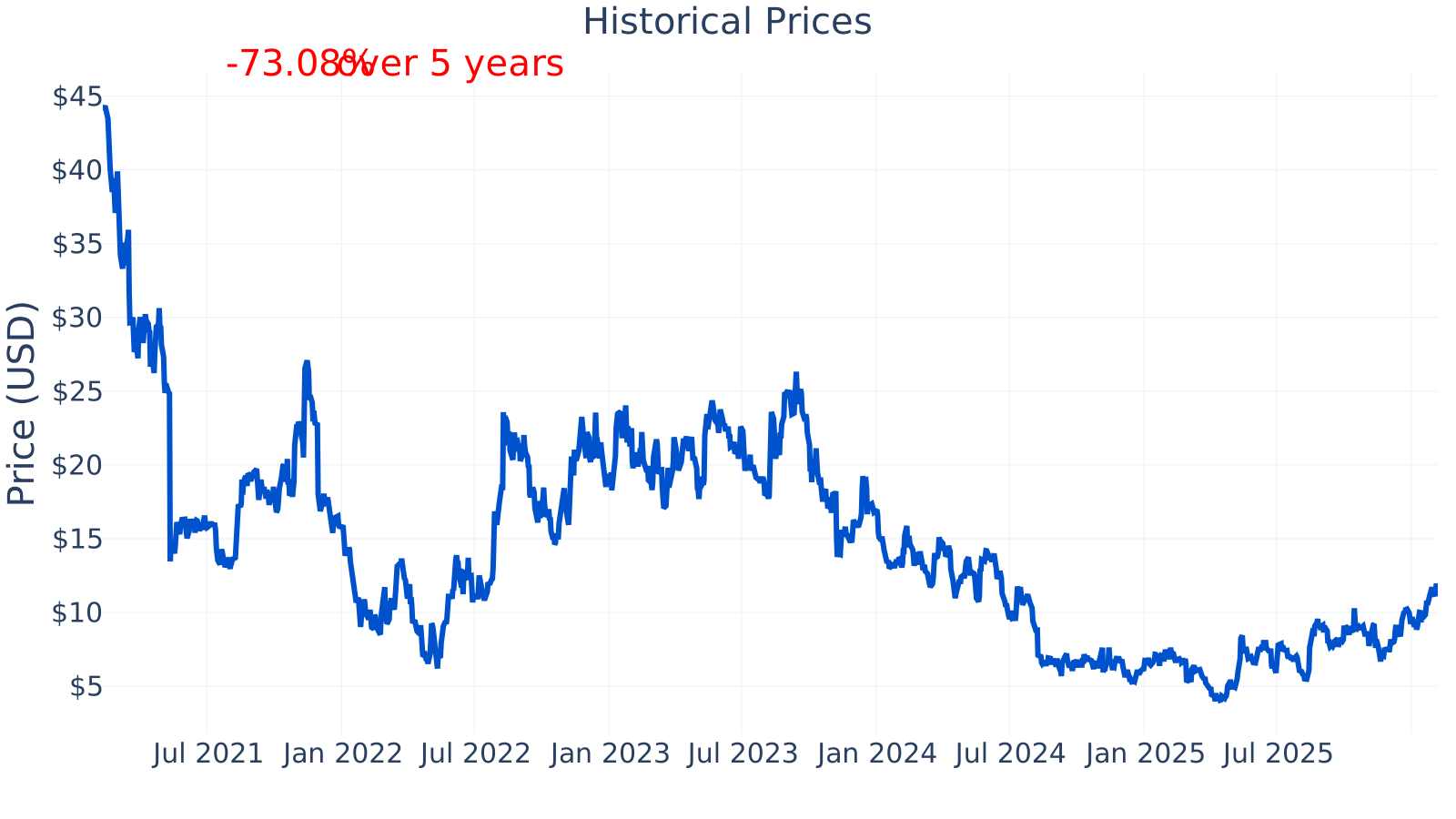
Array Technologies’ market capitalization is about $1.81B, placing it in the small-to-mid cap range. The stock’s beta of ~1.70 suggests it has tended to move more than the broader market (higher volatility). The latest profit margin is about -2.5%, below the industry median (about +0.27%), indicating the company has recently been slightly unprofitable on a net basis.
On the other hand, the most recent year-over-year revenue growth is ~70%, above the industry median (~33.9%), showing a strong rebound in sales. Debt-to-equity is ~168%, somewhat above the industry median (~140%), implying higher reliance on debt relative to equity than the typical peer set. The company also shows positive trailing free cash flow of about $88.3M, which can matter because it reflects cash generated after operating needs and capital spending (though it can still be lumpy for project-driven businesses).
Growth (Medium)
Array operates in utility-scale solar, which is supported by long-term global trends: declining solar generation costs, ongoing grid buildout, and the need for additional power generation capacity. Trackers are often used in large projects because they can improve output compared with fixed-tilt systems, which can make them a durable part of the utility-scale solar toolkit.
Still, growth in this business is rarely a straight line. Demand depends on permitting, interconnection timelines, financing conditions, and procurement cycles for big projects. When more projects reach the construction phase, tracker shipments can rise quickly; when projects are delayed, revenue can fall just as fast.
The revenue growth pattern shows that results have been volatile: very strong growth in parts of 2021–2022, then several quarters of negative growth through 2023–2024, followed by a sharp recovery in 2025 (including ~70% year-over-year in the latest period). For a long-term view, this suggests the company may experience “waves” of demand tied to the project cycle rather than steady, incremental growth.
Free cash flow has also swung meaningfully over time: positive in 2021, deeply negative in 2022, strongly positive in 2023–2024, and lower again by 2025 (still positive at roughly $88M on a trailing basis). For a hardware supplier, these changes can be driven by working capital (inventory and receivables), project timing, and supplier/payment terms—important factors to watch because they can affect cash even when reported earnings look healthy (or vice versa).
Potential catalysts for future growth are largely tied to the pace of utility-scale solar construction and the company’s ability to win share on new projects, maintain reliable deliveries, and protect margins through pricing and cost control.
Risks (High)
This article is for informational purposes only and does not constitute financial advice. Some content is AI-generated. See Disclaimer


