Stock Analysis · Arm Holdings plc (ARM)
Overview
Arm Holdings plc designs the “blueprints” (called architectures and CPU/GPU core designs) that other companies use to build chips. Instead of manufacturing semiconductors itself, Arm mainly licenses its intellectual property (IP) to chip designers and device makers, who then integrate Arm-based designs into products such as smartphones, PCs, data center servers, networking equipment, cars, and many types of connected devices.
Arm’s business model is often described as “license + royalty.” In simple terms, the company can earn money upfront when a customer signs an agreement to use Arm technology, and it can also earn ongoing payments when the customer ships products that include Arm-based chips. This model can create recurring revenue over time, but it also means results depend on customers’ product cycles and overall device demand.
Main sources of revenue (typical for Arm’s reporting):
- Royalties: ongoing payments tied to customer shipments of chips using Arm technology
- Licensing: upfront or time-based fees for access to Arm IP (including architecture licenses and core licenses)
- Other: smaller items such as software tools and services (reported as applicable)
Arm reports these revenue categories in its filings, but exact percentages can vary by period and are not included here because they change over time and depend on how the company breaks out and discusses results in each filing.
Over the years shown, total revenue increased from about $2.0B (FY2021) to about $4.0B (FY2025). Gross profit remained high relative to revenue (consistent with an IP-licensing model), while research and development spending also rose materially, reflecting continued investment to keep Arm designs competitive across phones, PCs, and data centers.
Key Figures
| Metric | Value | Industry ⓘ |
|---|---|---|
| Date | Feb 07, 2026 | |
| Context | ||
| Sector | Technology | |
| Industry | Semiconductors | |
| Market Cap ⓘ | $131.37B | |
| Beta ⓘ | 4.37 | |
| Fundamental | ||
| P/E Ratio ⓘ | 164.93 | 45.89 |
| Profit Margin ⓘ | 17.15% | 9.42% |
| Revenue Growth ⓘ | 26.30% | 13.10% |
| Debt to Equity ⓘ | 11.00% | 25.62% |
| PEG ⓘ | 1.70 | |
| Free Cash Flow ⓘ | $970.00M | |
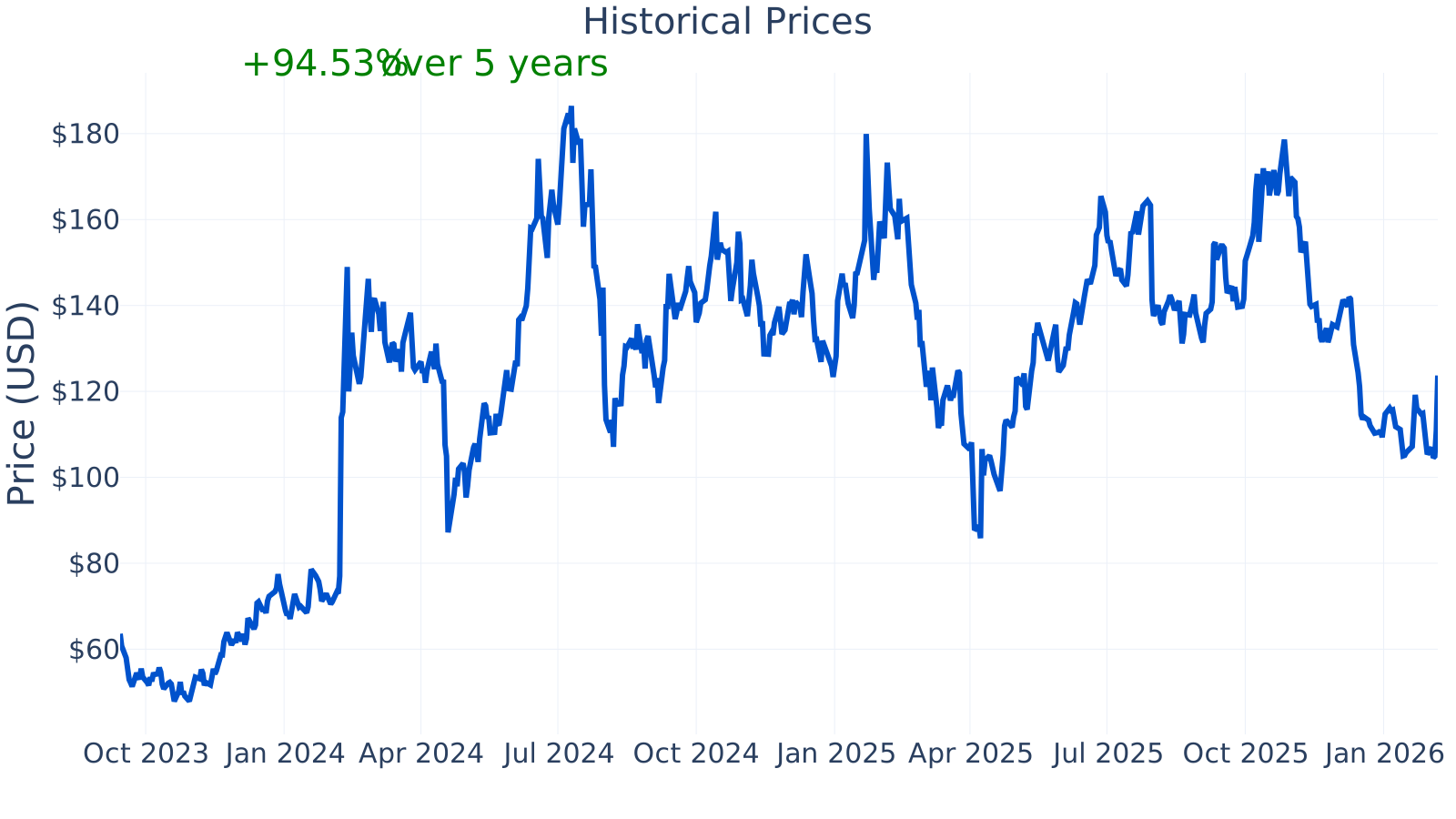
Arm’s market capitalization is about $131B. The stock has shown high historical volatility, reflected by a beta of ~4.37 (a measure that often implies larger swings than the broader market). Profitability and growth metrics stand out versus the semiconductor industry median in several areas: profit margin ~17.15% versus an industry median of ~9.42%, and year-over-year revenue growth ~26.3% versus an industry median of ~13.1%. Balance-sheet leverage appears lower than the industry median with debt-to-equity ~11.0% versus ~25.6% for the median. The valuation metrics are elevated: P/E ~164.9 versus an industry median of ~45.9, and a PEG ~1.70 (a ratio that relates P/E to expected growth assumptions). Trailing twelve-month free cash flow is shown at about $970M.
Growth (High)
Arm operates in the semiconductor ecosystem, which is shaped by long-term trends such as computing moving into more devices, rising demand for energy-efficient performance, and the spread of specialized chips for AI workloads. Because Arm’s designs are widely used across many end markets (mobile, embedded/IoT, automotive, and increasingly data centers), the company’s growth can be supported by both unit volume (more chips shipped) and content/value per chip (more advanced designs and higher-value licensing).
Strategically, Arm’s positioning is tied to two ideas that are easy to follow without deep technical detail: (1) standardization—many companies build around Arm’s instruction set and ecosystem, and (2) power efficiency—a focus that has been important in mobile and is increasingly relevant for data centers and AI due to electricity and cooling constraints. A key catalyst for long-term results is whether Arm’s technology continues expanding beyond phones into PCs and servers, while maintaining a strong presence in embedded and automotive designs.
Revenue growth has been positive but uneven across quarters, ranging from the mid-single digits to above 30% year over year in the periods shown, ending around ~26%. This pattern is consistent with a licensing-and-royalty business that can be influenced by timing of large deals, customer product launches, and broader electronics cycles.
Free cash flow is shown as positive in both periods displayed, with a large swing (about $947M to $162M on a trailing basis). For an IP-focused company, free cash flow can fluctuate due to working-capital movements, deal timing, and investment pace, so it can be helpful to look at multi-year patterns rather than one point in time.
Risks (High)
This article is for informational purposes only and does not constitute financial advice. Some content is AI-generated. See Disclaimer