Stock Analysis · Arhaus Inc (ARHS)
Overview
Arhaus, Inc. (ARHS) is a U.S. home furnishings retailer focused on premium furniture and décor. The company sells items such as sofas, dining tables, bedroom furniture, outdoor collections, lighting, rugs, textiles, and decorative accessories. Its model blends physical showrooms (where shoppers can see and customize pieces) with direct-to-consumer channels, including e-commerce and sales supported by design consultants.
Arhaus generates revenue primarily from selling home furnishings products to consumers. In its filings, the company reports revenue as a single operating segment rather than breaking it into multiple reported business lines, so precise percentages by product category are typically not provided in a standard segment split.
At a high level, revenue is generally driven by:
- Furniture and large-ticket items (typically the largest driver, as these items carry higher average order values)
- Décor and smaller accessories (incremental sales that can add to overall basket size)
- Service and delivery-related items (where applicable, based on company policies and presentation in filings)
Over the last several years, total revenue moved from about $797M (2021) to roughly $1.38B (2025). Profitability peaked in 2022–2023 (net income above $125M) and then softened in 2024–2025 (net income around the high-$60M range), reflecting how demand and costs can shift in consumer discretionary retail.
Key Figures
| Metric | Value | Industry ⓘ |
|---|---|---|
| Date | Mar 09, 2026 | |
| Context | ||
| Sector | Consumer Cyclical | |
| Industry | Specialty Retail | |
| Market Cap ⓘ | $1.08B | |
| Beta ⓘ | 2.53 | |
| Fundamental | ||
| P/E Ratio ⓘ | 15.92 | 22.01 |
| Profit Margin ⓘ | 4.88% | 6.27% |
| Revenue Growth ⓘ | 5.10% | 5.10% |
| Debt to Equity ⓘ | 138.82% | 103.28% |
| PEG ⓘ | N/A | |
| Free Cash Flow ⓘ | $58.98M | |
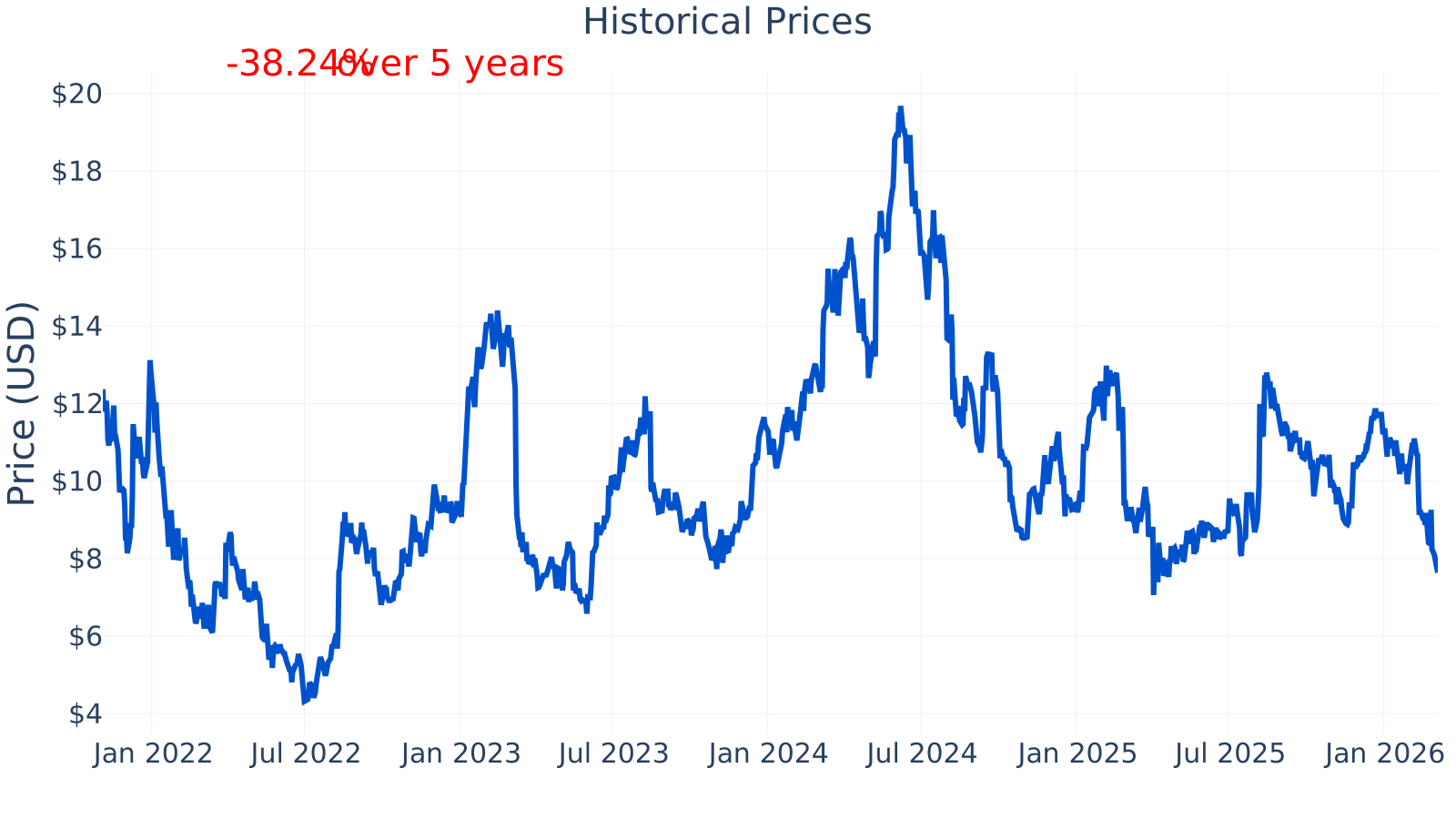
Arhaus’ market capitalization is about $1.08B. The stock has shown elevated volatility with a beta of ~2.53, meaning it has tended to swing more than the broader market. The company’s current P/E ratio is ~15.9, below the industry median of ~22.0 in its peer set. Profitability is currently modest: profit margin ~4.9% versus an industry median ~6.3%. Recent year-over-year revenue growth is ~5.1%, roughly in line with the industry median. Leverage is higher than the peer median with debt-to-equity ~139% versus an industry median ~103%. Trailing twelve-month free cash flow is about $59.0M.
Growth (Medium)
Arhaus operates in the home furnishings and specialty retail space, which is closely tied to consumer confidence, housing activity, and household formation. This is not typically a “straight-line” growth industry: demand can be strong during housing upcycles and periods of high discretionary spending, and then slow when consumers pull back or financing costs rise.
From an operating perspective, Arhaus’ strategy is built around brand positioning (premium design and materials), a showroom experience that supports higher-ticket purchases, and a direct-to-consumer approach that can expand reach beyond physical locations. For future growth, the most visible levers are usually some combination of expanding its showroom footprint, improving productivity per showroom, growing e-commerce/digital engagement, and deepening repeat purchases (for example, through new collections and complementary categories).
Revenue growth was very strong in 2021–2022 (well above 30% and reaching higher peaks), then slowed meaningfully and dipped slightly negative in parts of 2023–2024, before turning positive again in 2025 (mid-single digits to mid-teens across quarters shown). That pattern is consistent with a post-boom normalization in the category, followed by stabilization.
Free cash flow has been positive overall but uneven. It was strong in 2021, fell substantially by early 2022, briefly turned slightly negative in early 2023, and then recovered to positive territory in 2024–2025. For a retailer, this variability can be influenced by swings in earnings, inventory levels, and timing of customer deposits and deliveries.
Risks (High)
Arhaus’ results can be sensitive to the economic cycle. Big-ticket furniture purchases are often postponable, so demand may weaken when consumers feel pressured by inflation, higher interest rates, or uncertainty. The business is also exposed to execution risks typical for retailers: inventory management, promotional pressure, supply chain reliability, and maintaining brand perception in a competitive market.
Leverage is a key point to monitor. The debt-to-equity ratio has trended down from very high levels earlier in the timeline but remains elevated at about 139%, above the industry median near 103%. Higher leverage can reduce flexibility during slower demand periods, especially if operating income compresses.
Profit margin expanded significantly into 2022–2023 (reaching low double digits at its high point in the period shown) and then declined, ending 2025 at about 4.9%, slightly below the industry median (~5.6%). This suggests profitability has become more pressured than it was during the peak demand phase, which can happen as product costs, freight, labor, and promotions shift.
Competitive positioning is another important risk factor. Arhaus competes with a wide range of home furnishings sellers, including premium and mass-market brands, online-first retailers, and large omnichannel chains. Commonly cited competitors in this category include companies such as RH, Williams-Sonoma (Pottery Barn and related brands), Wayfair, and La-Z-Boy, as well as numerous private retailers. Arhaus is not the largest player in the overall furniture market, but it aims to differentiate through curated design, higher-end materials, and a showroom-led selling model. Whether that differentiation translates into sustained pricing power and repeat demand is a central question for long-term fundamentals.
Valuation
At about 15.9x earnings, Arhaus trades below the peer median P/E of roughly 22.0x in the referenced industry set. Historically (over the periods shown), Arhaus’ P/E has moved widely—from single digits at some points to the low-20s more recently—often near or below the peer median in many quarters, but occasionally above it. This wide range is typical when earnings and sentiment fluctuate in cyclical retail categories.
In context, a lower-than-peer P/E can reflect multiple possibilities, including slower expected growth, higher perceived risk (such as cyclicality or leverage), or simply differences in margins and business mix. Because Arhaus’ profit margin has compressed compared with its 2022–2023 highs and leverage remains above the peer median, valuation discussions tend to hinge on whether revenue growth and margins stabilize, and whether the balance sheet becomes more conservative over time.
Conclusion
Arhaus is a premium home furnishings retailer whose performance has followed a cycle: rapid post-2020 growth, a normalization period with slower sales and lower margins, and more recent signs of improving year-over-year revenue growth. The business produces positive free cash flow overall, but with noticeable swings that are common in furniture retail due to changes in demand and working capital needs.
The main long-term considerations are the company’s ability to sustain brand differentiation in a crowded market, keep profitability from eroding during slower demand periods, and manage leverage responsibly. On valuation, its earnings multiple sits below the peer median, while operational metrics (especially margins and debt-to-equity) suggest a business that still carries meaningful cyclicality and execution risk.
Sources:
- SEC EDGAR — Arhaus, Inc. Form 10-K (Annual Report)
- SEC EDGAR — Arhaus, Inc. Form 10-Q (Quarterly Reports)
- Arhaus, Inc. Investor Relations — Press releases and shareholder materials
- Wikipedia — “Arhaus” (basic company background)
This article is for informational purposes only and does not constitute financial advice. Some content is AI-generated. See Disclaimer


