Stock Analysis · Arhaus Inc (ARHS)
Overview
Arhaus, Inc. is a U.S. home furnishings retailer focused on premium furniture and décor. The company sells products such as upholstered furniture, dining and bedroom pieces, outdoor collections, lighting, rugs, and accessories. A core part of its model is a “showroom” experience (larger, design-forward physical locations) supported by e-commerce and design services, aiming to sell higher-ticket items that are often planned purchases rather than everyday essentials.
Arhaus generates revenue primarily from selling home furnishings to consumers through a mix of channels. In its public filings, the company describes revenue as coming from merchandise sales across its showroom network and its e-commerce channel, with delivery services and related fees typically included as part of the customer transaction. Specific revenue percentages by channel are not always disclosed in a simple fixed breakdown because sales can be influenced by customer behavior (for example, browsing in a showroom and purchasing online, or the reverse).
Main revenue sources (from largest to smaller, as described in filings):
- Furniture and outdoor products (typically the largest driver of ticket size)
- Décor and accessories (lighting, rugs, textiles, wall décor, and similar categories)
- Sales through showrooms and e-commerce (the two primary selling channels; customers may use both during a purchase journey)
From a high-level profitability perspective, recent years show a business that scaled revenue substantially from 2021 to 2023, followed by a flatter revenue picture in 2024 while costs and operating expenses remained meaningful. For example, total revenue was about $797 million (2021), $1.229 billion (2022), $1.288 billion (2023), and $1.271 billion (2024), while net income moved from about $21 million (2021) to $137 million (2022), $125 million (2023), and $69 million (2024).
The profitability bridge above highlights two important dynamics: revenue rose sharply from 2021 to 2023, but 2024 revenue was slightly lower than 2023, and net income fell notably in 2024. This suggests that margins and/or operating cost structure became less favorable versus the prior year, which matters in a consumer-driven category where demand can slow quickly.
Key Figures
| Metric | Value | Industry ⓘ |
|---|---|---|
| Date | Feb 08, 2026 | |
| Context | ||
| Sector | Consumer Cyclical | |
| Industry | Specialty Retail | |
| Market Cap ⓘ | $1.57B | |
| Beta ⓘ | 2.50 | |
| Fundamental | ||
| P/E Ratio ⓘ | 21.35 | 23.78 |
| Profit Margin ⓘ | 5.40% | 6.27% |
| Revenue Growth ⓘ | 8.00% | 5.20% |
| Debt to Equity ⓘ | 142.75% | 103.28% |
| PEG ⓘ | N/A | |
| Free Cash Flow ⓘ | $80.79M | |
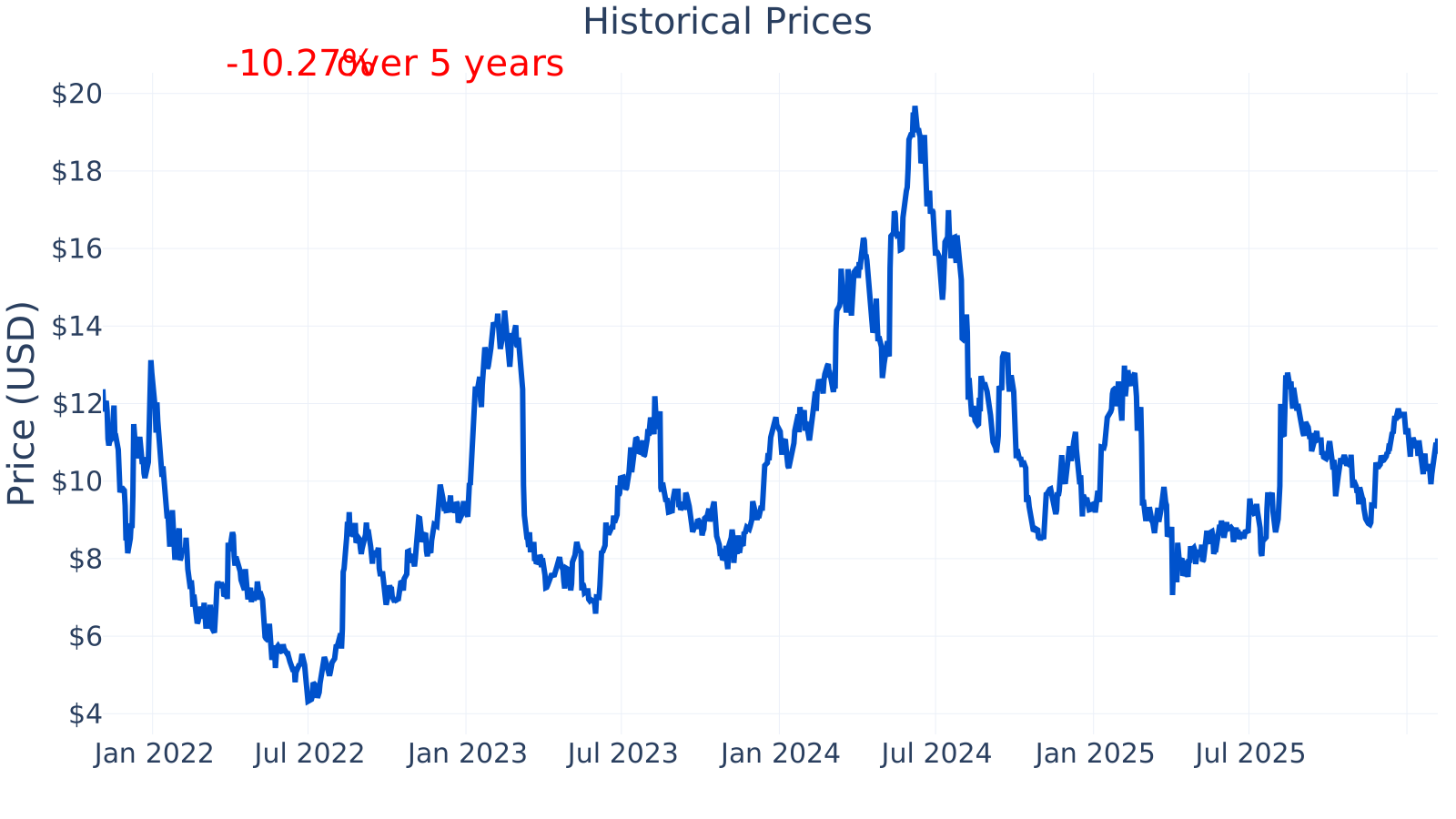
At roughly $1.57 billion in market value, Arhaus sits in the smaller end of publicly traded specialty retail. The stock has tended to be volatile (beta about 2.50, which indicates larger swings than the overall market). The latest P/E ratio is ~21.3, slightly below the specialty retail median shown (~23.8). Profitability is positive but relatively modest on a net basis: ~5.4% profit margin versus an industry median shown of ~6.3%. Recent year-over-year revenue growth is ~8%, above the displayed industry median (~5.2%). Debt compared to equity is higher than the median: ~143% debt-to-equity versus ~103%. Free cash flow over the trailing twelve months is positive at about $80.8 million.
Growth (Medium)
Home furnishings is a large, established consumer category tied closely to household formation, housing turnover, renovation cycles, and consumer confidence. It is not a “straight-line” growth industry; demand tends to surge and cool in cycles. For a long-term owner, that means growth can be real, but it may arrive unevenly, with periods where sales slow and promotions increase across the industry.
Arhaus’ strategy is oriented around expanding and strengthening a premium brand through showrooms, design services, and an integrated online/offline shopping experience. In a category where many purchases are considered and higher-priced, physical showrooms can be a practical advantage for customer engagement (seeing materials, sizing, comfort testing) while e-commerce supports research and follow-up purchasing. If execution is strong, expanding the showroom footprint and deepening customer relationships can be a plausible long-term growth path, but it requires capital and careful site selection.
The year-over-year revenue trend shows a clear cooling from very high growth rates in 2021–2022 to low or negative growth through much of 2023–2024, followed by a return to positive growth more recently (mid-to-high single digits and a stronger quarter around the mid-teens). This pattern is consistent with a demand cycle normalization after an earlier surge, and it underscores that growth is not steady quarter to quarter.
Free cash flow has been positive in several periods and negative at least once (around early 2023), then improved again. This matters because expanding showrooms, managing inventory, and fulfilling large products can create meaningful cash needs. A consistent ability to generate cash through cycles can provide more flexibility for reinvestment and resilience during slower demand periods.
Potential catalysts (in a factual, business-sense) typically include: continued showroom expansion and productivity, improved demand in home-related categories during stronger housing/consumer periods, and maintaining brand positioning without heavy discounting. However, these are influenced by broader economic conditions and competitive intensity.
Risks (High)
This article is for informational purposes only and does not constitute financial advice. Some content is AI-generated. See Disclaimer


