Stock Analysis · Applovin Corp (APP)
Overview
AppLovin Corp is a software company focused on helping app developers and advertisers grow their businesses. In simple terms, it provides tools that help mobile apps find new users (advertising and marketing), understand performance (analytics and measurement), and earn money from their audience (ad monetization). Its products are used across the mobile ecosystem, especially in mobile gaming, where user acquisition and ad revenue optimization are central to the business model.
From a business-model point of view, AppLovin sits in the “picks and shovels” layer of the app economy: rather than depending only on a single consumer app, it sells technology and services to many apps and brands. That can create diversification across customers, but it also ties results to broader conditions in digital advertising budgets and app store platform rules.
Main sources of revenue (largest to smallest) are typically presented by the company as business lines such as:
- Advertising / Software platform revenue (technology that helps advertisers buy ads and helps developers acquire users and monetize)
- Apps (revenue from apps/games owned and operated by the company)
Percentages can change by year and are best read directly in the company’s segment reporting in its annual report (Form 10‑K).
The company’s recent financial profile shows a large shift from modest profitability earlier in the period to substantially higher operating income and net income later on, alongside strong gross profit growth. Revenue grew from about $2.79B (2021) to about $5.48B (2025), while net income moved from about $35M (2021) to about $3.33B (2025). This kind of jump usually reflects a combination of scaling effects, changes in product mix, and cost structure improvements, but understanding the “why” requires reading management’s discussion in filings.
Key Figures
| Metric | Value | Industry ⓘ |
|---|---|---|
| Date | Feb 16, 2026 | |
| Context | ||
| Sector | Communication Services | |
| Industry | Advertising Agencies | |
| Market Cap ⓘ | $132.03B | |
| Beta ⓘ | 2.49 | |
| Fundamental | ||
| P/E Ratio ⓘ | 38.91 | 29.29 |
| Profit Margin ⓘ | 60.83% | 6.10% |
| Revenue Growth ⓘ | 20.80% | 8.10% |
| Debt to Equity ⓘ | 166.06% | 62.76% |
| PEG ⓘ | 1.13 | |
| Free Cash Flow ⓘ | $3.97B | |
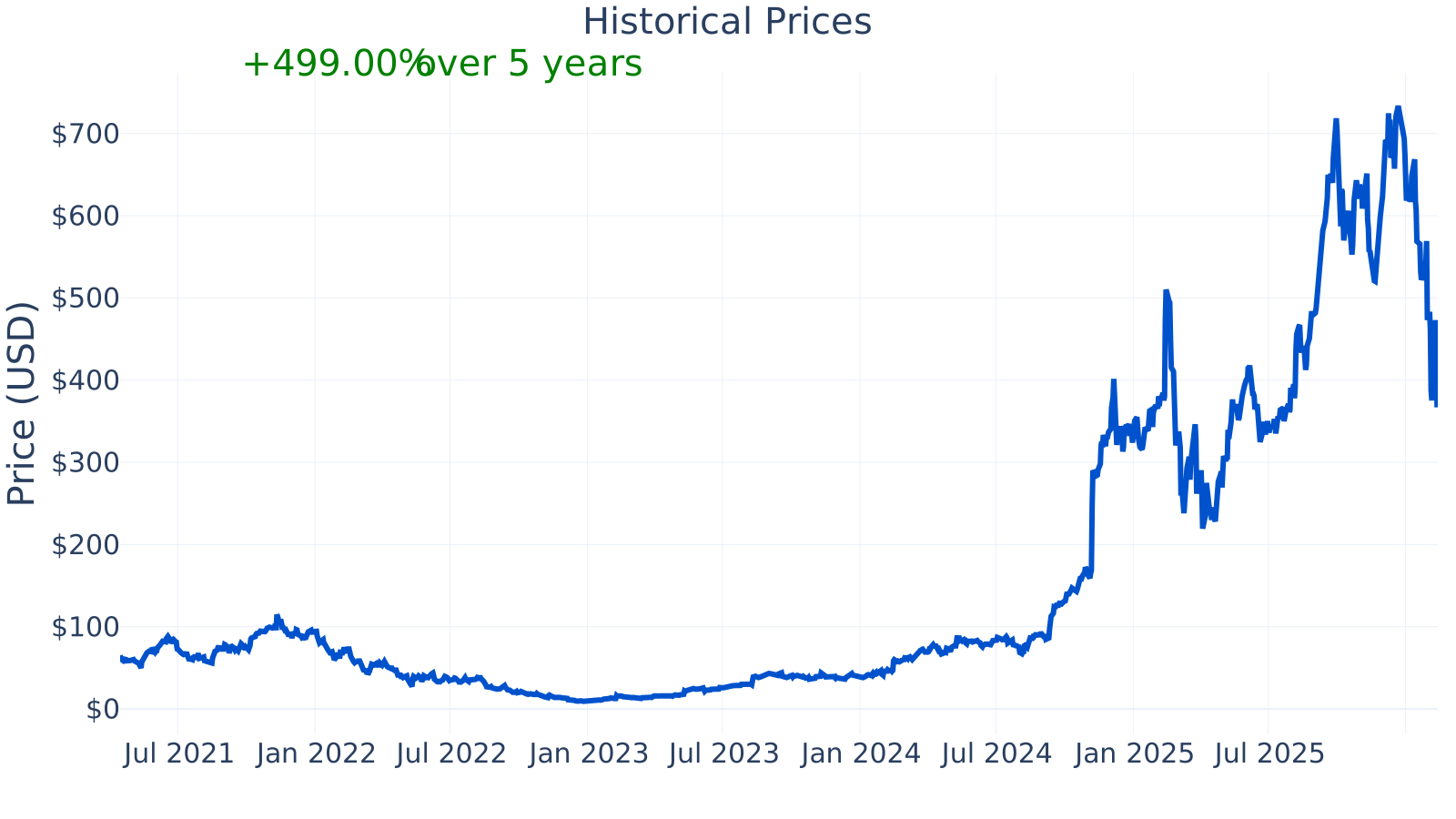
AppLovin’s market capitalization is about $132.0B, placing it among the larger public companies in digital advertising software. The stock’s beta of 2.49 signals that share-price moves have historically been much larger than the broader market (higher volatility). Profitability stands out: the latest profit margin is ~60.8% versus an industry median around 6.1%, while year-over-year revenue growth is ~20.8% versus an industry median around 8.1%. The latest debt-to-equity is ~166% (industry median ~62.8%), indicating heavier use of leverage than many peers. Free cash flow over the trailing twelve months is about $4.0B.
Growth (medium)
AppLovin operates in digital advertising and app monetization—areas that have structural tailwinds over long periods as consumer attention and commerce continue to shift toward mobile devices and apps. Within that, the company is exposed to “performance advertising,” where advertisers try to measure outcomes (such as installs or purchases). When measurement works well, budgets can scale; when tracking weakens (for example due to privacy changes), the market can become more challenging and more dependent on the quality of each platform’s technology.
A key part of the long-term growth logic is whether AppLovin can keep improving how effectively it matches advertisers with the right users and helps developers maximize lifetime value. If it can, it may earn more per ad impression and attract more advertiser spend, while also increasing the value it delivers to app developers. Potential catalysts commonly discussed in company communications include continued product improvements in its advertising stack, further scaling of software-driven revenue, and operating leverage (where costs grow slower than revenue).
Revenue growth has been uneven quarter-to-quarter, including some negative year-over-year periods, but also several very strong re-accelerations. The most recent value shown is around -2.9% year-over-year, after very high growth readings earlier in 2025 (well above 50% in some quarters). For long-term evaluation, this pattern highlights that results can be cyclical and sensitive to ad demand, optimization changes, and base effects.
Free cash flow has increased substantially over time, from roughly $0.37B (late 2021) to about $2.53B (early 2025), reaching about $4.0B on a trailing twelve-month basis in the latest metrics table. For a software-heavy model, sustained free cash flow can matter because it can support internal investment, debt reduction, and resilience during weaker ad cycles.
Risks (high)
AppLovin’s business is tied to digital advertising budgets, which can fluctuate with the economy and marketer sentiment. A slowdown in ad spend, shifts in advertiser preferences, or reduced demand from major categories can pressure revenue growth. The company is also exposed to platform-level changes (for example, mobile operating system privacy rules and app store policies) that can alter tracking, targeting, and measurement—core inputs to performance advertising.
Competition is another major risk. AppLovin operates in markets with large, well-resourced players and many specialized ad-tech firms. Depending on the exact product area, competitors and alternatives can include large digital advertising platforms and mobile advertising technology providers. Even when a company has strong technology, ad markets can change quickly due to new tools, changing auction dynamics, and advertiser shifts. Durable competitive advantage typically comes from scale (lots of demand and supply), quality optimization, and strong relationships with developers and advertisers—areas that need continuous investment to maintain.
Leverage is a notable factor. Debt-to-equity has been elevated versus the industry median for much of the period shown, peaking at very high levels before declining, and the latest reading is still around 166% versus an industry median near 62.8%. Higher leverage can amplify outcomes: it may help finance growth or acquisitions, but it can also increase risk during downturns through interest expense and reduced flexibility.
Profit margin improved sharply from negative levels in 2022 to very high levels more recently, reaching about 60.8% at the latest point shown (industry median around 7.6% in the chart). This is a strength if it proves durable, but it can also be a risk factor if margins depend on a favorable mix of revenue sources, unusually strong pricing power, or conditions that later normalize. Watching whether margins remain high through different ad cycles is often important for understanding sustainability.
Valuation
At the latest reading, AppLovin’s price-to-earnings (P/E) ratio is about 38.9 versus an industry median around 29.3. Historically, the displayed P/E values have moved widely, with periods where the ratio was much higher, and more recent values often above the industry median. In practical terms, a higher P/E generally means the market is pricing in either higher expected growth, higher expected profitability, lower perceived risk, or some combination of these factors.
Given AppLovin’s mix of strong recent profitability and meaningful revenue growth (but with visible volatility), valuation tends to be sensitive to two questions: (1) whether elevated margins and cash generation can persist over time, and (2) whether growth remains strong enough to justify paying a higher multiple than many peers. Leverage and platform-policy risk can also influence what multiple the market is willing to assign across different periods.
Conclusion
AppLovin is a scaled player in mobile advertising and app monetization software, with financial results showing strong profitability and substantial free cash flow generation in the most recent periods. Revenue growth has been strong at times but can swing meaningfully, reflecting the cyclicality and fast-changing nature of ad-tech markets.
The main long-term points to balance are the company’s apparent operating leverage and margin expansion versus the higher-risk elements: dependence on digital ad demand, exposure to platform privacy and policy changes, intense competition, and above-median leverage. Valuation metrics indicate the market is assigning a higher-than-industry multiple, which tends to require continued execution and resilience through varying market conditions.
Sources:
- SEC EDGAR — AppLovin Corp filings (Form 10‑K, Form 10‑Q)
- AppLovin Investor Relations — SEC filings and shareholder communications (company-hosted)
- Wikipedia — “AppLovin” (basic company background)
This article is for informational purposes only and does not constitute financial advice. Some content is AI-generated. See Disclaimer


