Stock Analysis · Applied Opt (AAOI)
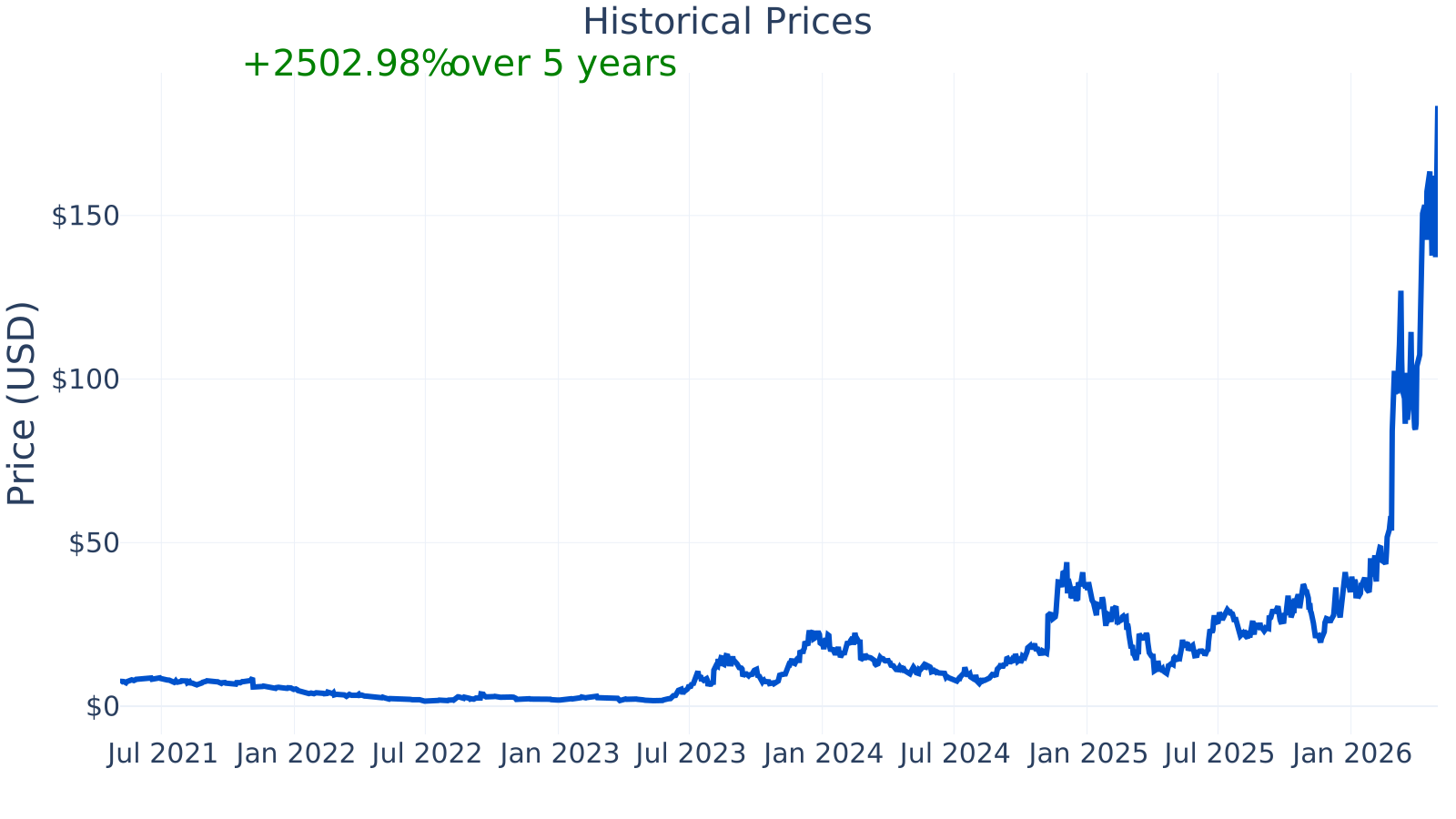
Overview
Applied Opt (AAOI) is a technology company in the communication equipment space. In plain terms, it designs and manufactures fiber-optic connectivity products that help move data through high-speed networks. These products are used in areas like data centers and telecom networks, where large amounts of information must travel quickly and reliably.
Its business is tied to long-term trends such as cloud computing, internet traffic growth, and higher-speed network upgrades. The company’s results can move significantly depending on demand cycles from large network operators and cloud/data-center customers.
Main sources of revenue are typically disclosed by product category and/or customer type in company filings. Percentages can vary materially by period, especially if one or a few large customers increase or reduce orders. A common way the company describes revenue streams includes:
- Optical transceivers (modules used to convert electrical signals to optical signals and back)
- Other fiber-optic components and related connectivity products (depending on how the company groups products in its filings)
For exact, up-to-date revenue split and customer concentration, the most reliable reference is the company’s annual report (10‑K) segment and customer disclosures.
From a high-level view of recent years, revenue increased materially into 2025, while operating costs (notably research and development and selling/general/administrative expenses) also rose. Net income remained negative over the period shown, which highlights that scaling revenue has not yet consistently translated into bottom-line profitability.
Key Figures
| Metric | Value | Industry ⓘ |
|---|---|---|
| Date | May 04, 2026 | |
| Context | ||
| Sector | Technology | |
| Industry | Communication Equipment | |
| Market Cap ⓘ | $14.68B | |
| Beta ⓘ | 3.22 | |
| Fundamental | ||
| P/E Ratio ⓘ | N/A | 52.85 |
| Profit Margin ⓘ | -8.39% | 3.98% |
| Revenue Growth ⓘ | 33.90% | 17.90% |
| Debt to Equity ⓘ | 22.80% | 78.48% |
| PEG ⓘ | 0.78 | |
| Free Cash Flow ⓘ | -$174.67M | |
Applied Opt’s market capitalization is about $14.7B, and the stock has had a high beta (~3.22), which is a statistical sign that the share price has historically moved much more than the broader market. Profitability is currently a weak point: the latest profit margin shown is about -8.4%, below the industry median (about +4.0%). On the other hand, the latest year-over-year revenue growth is about 33.9%, above the industry median (about 17.9%). Leverage looks comparatively modest with debt-to-equity ~22.8% versus an industry median near 78.5%. The company also shows negative trailing free cash flow (about -$175M), indicating that cash spending has exceeded cash generated from operations after capital expenditures over the measured period.
Growth (Medium)
Applied Opt operates in markets supported by structural demand for bandwidth: more cloud services, more video, more AI/data-intensive workloads, and continued upgrades in data-center and telecom infrastructure. These trends generally push networks toward higher speeds and greater fiber density, which increases the need for optical connectivity hardware.
Whether that demand translates into durable growth for Applied Opt depends on execution details that matter in this industry: winning and keeping large customers, meeting performance requirements at specific speeds/form factors, maintaining manufacturing yields, and keeping costs competitive. The company’s strategy—investing in product development and manufacturing capability—can be consistent with competing in a scale-driven hardware market, but it also raises the importance of cost control and efficiency as revenue grows.
Revenue growth has been volatile over time, including negative periods, followed by very strong acceleration in late 2024 and throughout 2025. The latest value shown is still strong at roughly 33.9% year over year, suggesting momentum compared with the broader industry median. For long-term context, this pattern indicates a business that may experience sharp cycle shifts rather than smooth, predictable expansion.
Free cash flow has remained negative across the periods shown and has become more negative into 2025 (down to roughly -$158M as of 2025-03-31, and about -$175M on the latest metric line). In practical terms, that means growth has required meaningful cash investment and/or working-capital absorption. A key future catalyst would be evidence that higher revenue levels begin to convert into sustained positive operating cash flow and free cash flow.
Risks (High)
The most important risk is that Applied Opt has not yet demonstrated consistent profitability. Even with improving revenue, the company has posted negative margins for an extended period, meaning costs have remained high relative to sales. In hardware businesses, margin progress can depend on factors that are not always smooth quarter-to-quarter, such as production yields, pricing pressure, product mix, and customer ramp timing.
Customer concentration is also a common risk for optical component suppliers: if a small number of large customers represent a large share of revenue, changes in their ordering patterns can quickly impact sales and factory utilization. Company filings typically describe this risk in the sections discussing major customers and market dynamics.
Balance-sheet leverage appears lower than the industry median in the latest period, with debt-to-equity around 22.8%. The longer view shows leverage was higher in prior years and then moved down materially into late 2025. Lower leverage can reduce financial pressure during downturns, but it does not remove the operational risks tied to profitability and cash burn.
Profit margin has been negative for years and, while it improved sharply in the most recent period shown (to about -8.4%), it is still below the industry median (about +1.7% at the same time point). This gap highlights a competitive challenge: even if demand is strong, the company still needs to deliver cost structure and pricing that supports sustainable net income.
Competition is intense. Applied Opt generally competes with a mix of large diversified optical and networking suppliers and specialized optical module manufacturers. In many cases, competitors can have greater scale, broader product portfolios, or deeper relationships with the largest network operators and cloud companies. Competitive advantages in this market tend to come from manufacturing efficiency, product reliability, the ability to deliver at volume, and speed of moving to new standards. Based on the financial profile shown (negative margins and negative free cash flow), leadership is not clearly evident from profitability metrics alone, even though revenue growth has recently been strong.
Valuation
A traditional price-to-earnings (P/E) ratio is not meaningful in periods where earnings are negative. That is why the company’s P/E line is shown as 0 on the chart, while the industry median P/E remains in a more typical positive range over time (often in the tens). In this situation, valuation discussions usually shift toward other measures (such as revenue-based multiples or cash-flow-based measures), but those are not included here.
What can be stated from the available information is that the market value is sizable (about $14.7B) while profitability and free cash flow are still negative. This creates a “prove-it” dynamic: sustaining strong growth while improving margins and cash generation typically matters more than any single-point valuation metric when earnings are not yet consistently positive.
Conclusion
Applied Opt participates in a long-term growth area—optical connectivity for fast networks—where underlying demand drivers are supported by continued increases in global data usage. Recent revenue growth has been strong relative to the industry median, and leverage looks moderate compared with peers.
At the same time, the company’s financial profile shows elevated uncertainty for long-term forecasting: profit margins have been negative for an extended period, free cash flow is negative, and the stock has historically been very volatile (high beta). The central long-term question is whether the company can translate demand-driven revenue growth into durable profitability and positive cash generation while remaining competitive in a tough, scale-driven market.
Sources:- SEC EDGAR — Applied Opt (AAOI) filings (10-K, 10-Q, 8-K)
- Applied Opt — Investor Relations materials and press releases
- Applied Opt — Company-hosted earnings call materials/transcripts (when available)
- Wikipedia — “Applied Opt” (basic company background)
This article is for informational purposes only and does not constitute financial advice. Some content is AI-generated. See Disclaimer


