Stock Analysis · Applied Materials Inc (AMAT)
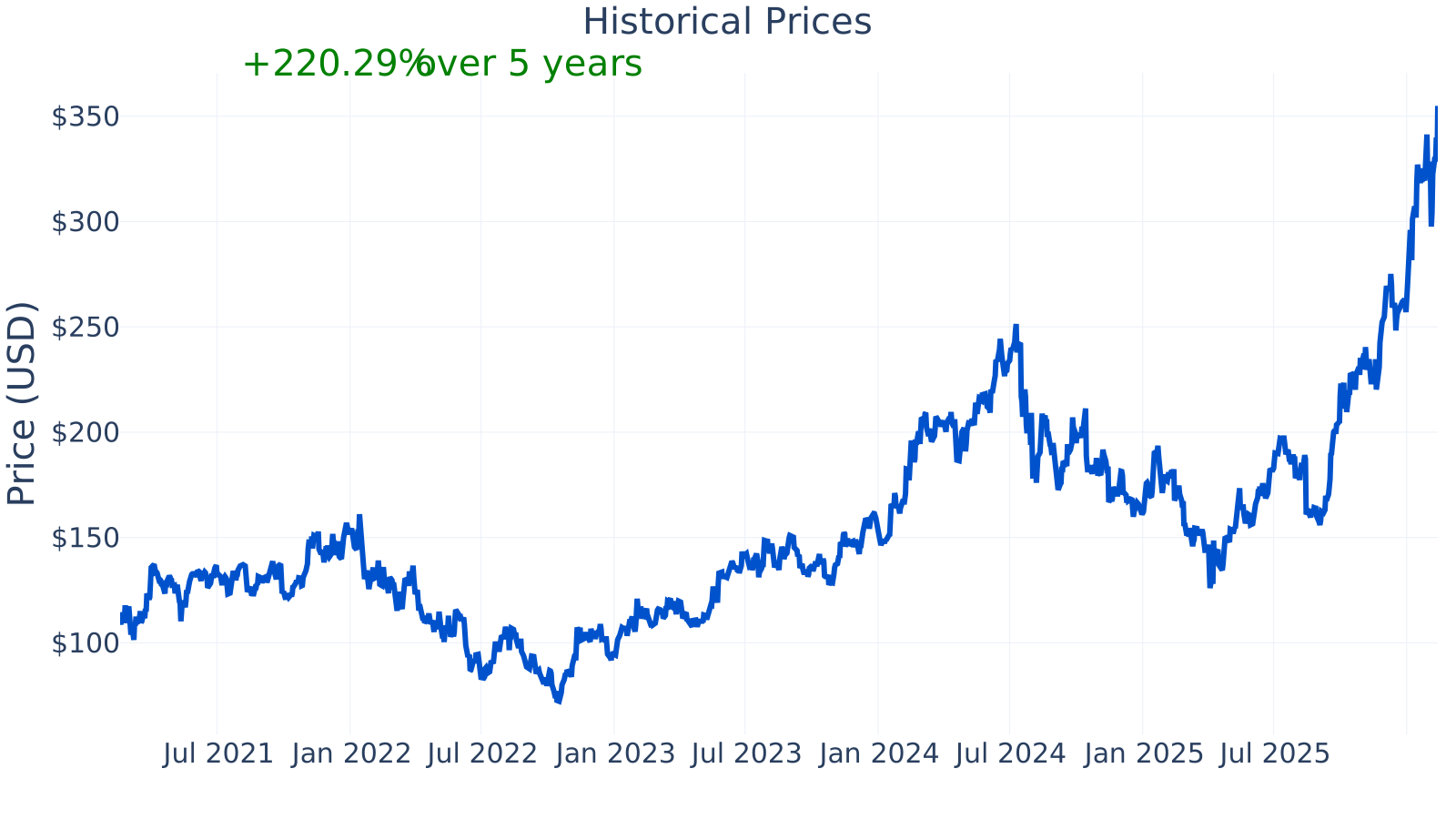
Overview
Applied Materials, Inc. (AMAT) designs and sells equipment, software, and services used to manufacture semiconductors (computer chips) and advanced displays. In simple terms, it provides many of the highly specialized machines and process steps that help turn raw materials into the tiny, complex structures inside chips and screens. Its customers are mainly large chip manufacturers and foundries around the world, along with display makers.
The company reports revenue primarily through these business segments (as described in its annual reporting):
- Semiconductor Systems: equipment used in chipmaking (the largest segment)
- Applied Global Services: services, spare parts, upgrades, and subscriptions that support installed tools
- Display: equipment used to manufacture display panels
For long-term context, this type of business tends to be linked to customers’ capital spending cycles: when chipmakers expand factories and add capacity, equipment demand rises; when they slow spending, equipment demand can soften.
Across recent fiscal years, revenue increased from about $23.1B (FY2021) to about $28.4B (FY2025), while net income remained sizable (roughly $5.9B–$7.2B in FY2021–FY2024, and about $7.0B in FY2025). Operating expenses also rose over time, including research and development spending, which reflects ongoing investment to keep tools competitive as chip technology advances.
Key Figures
| Metric | Value | Industry ⓘ |
|---|---|---|
| Date | Feb 16, 2026 | |
| Context | ||
| Sector | Technology | |
| Industry | Semiconductor Equipment & Materials | |
| Market Cap ⓘ | $281.70B | |
| Beta ⓘ | 1.68 | |
| Fundamental | ||
| P/E Ratio ⓘ | 36.36 | 48.26 |
| Profit Margin ⓘ | 27.78% | 8.62% |
| Revenue Growth ⓘ | -2.10% | 12.90% |
| Debt to Equity ⓘ | 30.17% | 20.73% |
| PEG ⓘ | 2.95 | |
| Free Cash Flow ⓘ | $5.70B | |
Applied Materials’ latest market capitalization is about $281.7B, and the stock’s beta of ~1.68 suggests it has historically moved more than the broader market (in both directions). Profitability stands out: the latest profit margin is ~27.8%, which is materially above the industry median (~8.6%) shown in the table. At the same time, the latest year-over-year revenue growth is about -2.1%, compared with a positive industry median (~12.9%), highlighting that growth can vary significantly by cycle and company mix.
Growth (Medium)
Applied Materials operates in the semiconductor equipment industry, which is closely tied to long-term computing demand. Over multi-year periods, chip content tends to rise across many areas—such as data centers, consumer devices, automotive electronics, industrial automation, and communications. However, the path is rarely smooth: the industry is known for alternating periods of heavy investment and digestion.
The year-over-year revenue growth pattern shown above illustrates this cyclicality: very strong growth in 2021 moderated over time, and more recently moved slightly negative. For a company like Applied Materials, growth is influenced not only by the total amount customers spend, but also by which chip technologies are being built (leading-edge logic, advanced memory, specialty chips) and how much process complexity increases (more steps can mean more equipment demand per wafer).
Free cash flow (cash generated after operating needs and capital spending) has remained substantial over the periods shown—about $5.99B (2022), $4.08B (2023), $7.71B (2024), and $5.94B (2025). Consistent free cash flow can matter in this industry because it can help fund research, support manufacturing and supply chain needs, and provide flexibility during downturns.
Potential catalysts that can influence longer-term results include continued technology transitions that increase manufacturing complexity (which can raise equipment intensity per chip), customer investment in new fabs, and expansion of service and installed-base support revenue (which can be less cyclical than new tool sales). The company’s strategy—combining new equipment with services and upgrades over time—fits the reality that semiconductor tools remain in factories for many years and require ongoing optimization.
Risks (High)
Applied Materials faces several meaningful risks that are common in semiconductor equipment, plus a few company-specific execution risks. A central risk is customer spending cycles: large chip manufacturers can rapidly increase or reduce capital expenditures based on end-demand, inventories, and pricing. This can cause revenue and earnings variability from year to year even if long-term chip demand trends upward.
The company’s latest debt-to-equity is ~30%, compared with an industry median of ~21% in the table. The longer history shows leverage has generally declined from the mid-40% to ~50% range earlier in the period down to around 30% most recently, which suggests balance sheet leverage has become more moderate over time. Even so, debt levels can matter in down cycles if profitability and cash generation weaken.
Profit margin has generally remained high versus the industry median across the timeline shown, ending most recently near 27.8% while the industry median shown is much lower. This gap can indicate operational strength and/or a favorable mix (including services), but margins can still compress if demand weakens, pricing becomes more competitive, or costs rise faster than revenue.
Competition is another key risk. The semiconductor equipment market includes large, specialized players across different process steps. Applied Materials competes with major equipment companies such as ASML, Lam Research, and KLA, among others. Competitive positioning is not one-dimensional because each company is strongest in different parts of the manufacturing flow. Applied Materials is widely recognized in its filings as a major provider across multiple equipment categories and also emphasizes its services business; however, leadership can vary by tool type and technology generation, and customers are sophisticated buyers that often qualify multiple suppliers.
Additional risks include technology execution (tools must meet increasingly strict performance requirements), supply chain constraints (complex components and precision manufacturing), customer concentration (a limited number of very large chipmakers account for a significant portion of industry demand), and regulatory/geopolitical constraints that can affect where advanced tools are shipped or supported. These issues are typically discussed in detail in the company’s risk factor disclosures.
Valuation
The latest price-to-earnings (P/E) ratio shown in the table is about 36.4, below the industry median of ~48.3 provided. Over the historical range displayed, the company’s P/E has moved from the mid-teens to mid-20s at different points, reflecting changes in market expectations and earnings levels. A higher P/E generally implies the market is paying more for each dollar of earnings, often because it expects higher future growth or views the earnings stream as more durable.
Two context points help interpret this: first, Applied Materials’ profitability is strong relative to the industry median shown; second, the most recent revenue growth is slightly negative, which can make valuation more sensitive to expectations about the next upcycle. The PEG ratio (~3.0) in the table is one commonly used (but simplified) way to relate valuation to growth assumptions; higher values can suggest the price is high relative to near-term growth expectations, though the usefulness of PEG can be limited for cyclical businesses where growth rates fluctuate.
Conclusion
Applied Materials is a large semiconductor equipment and services provider with a central role in the chip manufacturing ecosystem. The business shows strong profitability (with margins well above the industry median shown) and substantial free cash flow generation over time, which can support continued investment in research and long-term competitiveness.
At the same time, the company operates in a cyclical industry where results can vary with customers’ capital spending, and it faces intense competition from other major equipment suppliers. Valuation indicators presented here show a P/E that is below the industry median provided, but still elevated in absolute terms and sensitive to the pace of future growth and the timing of industry cycles. Overall, the long-term profile combines durable end-market relevance with meaningful cycle and execution risks that can influence results from year to year.
Sources:
- Applied Materials, Inc. — Annual Report on Form 10-K (Business segments, risk factors, financial statements)
- SEC EDGAR — Applied Materials, Inc. filings repository (10-K / 10-Q / 8-K access)
- Applied Materials Investor Relations — Earnings materials and shareholder information (company-hosted public documents)
- Wikipedia — “Applied Materials” (basic company background; non-technical reference)
This article is for informational purposes only and does not constitute financial advice. Some content is AI-generated. See Disclaimer


