Stock Analysis · Appfolio Inc (APPF)
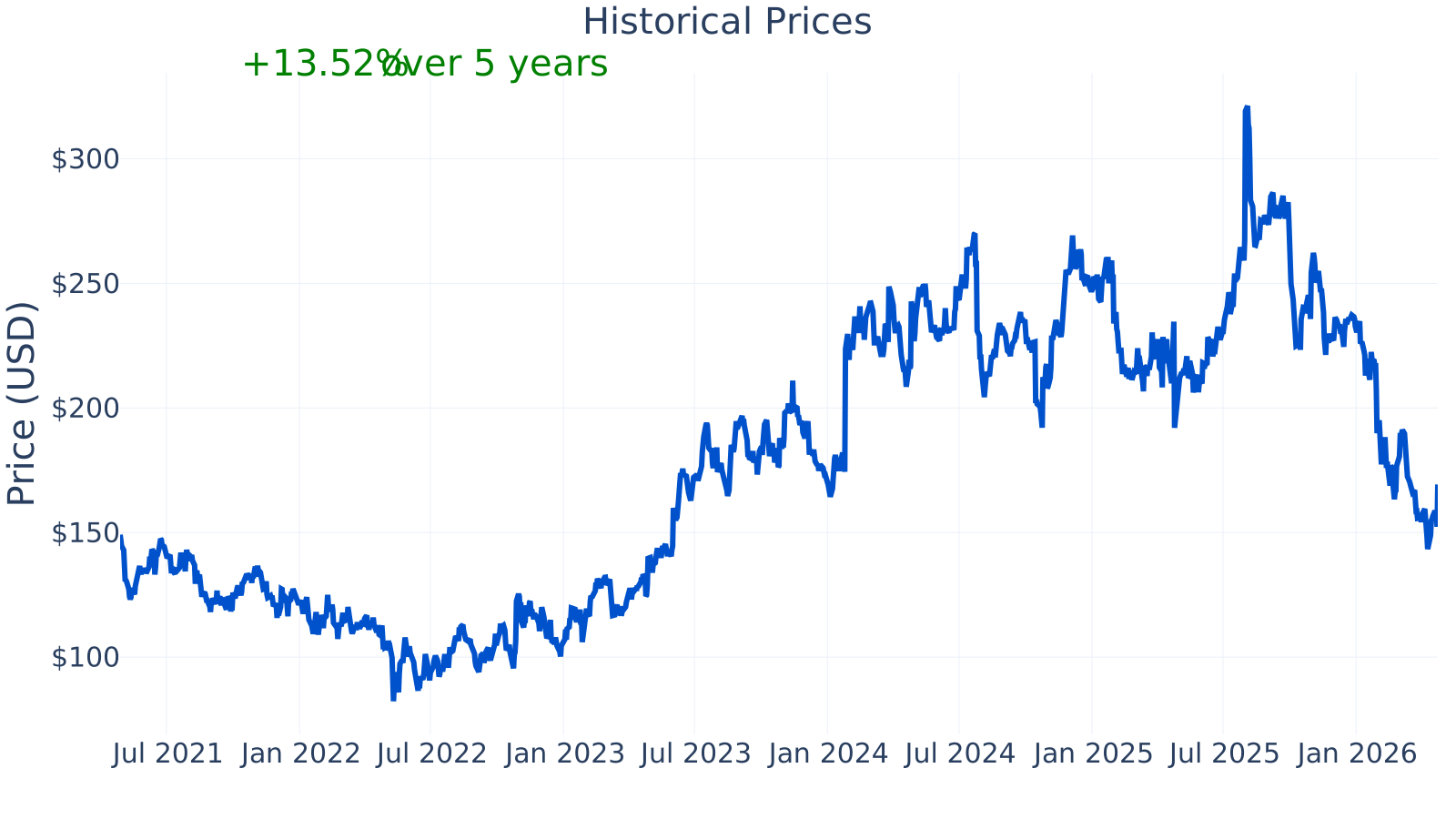
Overview
AppFolio, Inc. is a software company focused on helping property managers and rental housing operators run day-to-day activities in a more digital, automated way. Its platform is used for workflows such as marketing listings, screening applicants, signing leases, collecting rent, handling maintenance requests, accounting, and reporting. In practice, AppFolio’s goal is to replace a patchwork of spreadsheets, email, and disconnected tools with a single system built for the property management industry.
From a business model perspective, AppFolio primarily generates revenue through subscriptions to its cloud software and related services delivered through the platform. The company also offers add-on services that can scale with customers’ activity (for example, services connected to payments and other transaction-enabled features within the platform). This combination tends to produce recurring revenue characteristics (subscriptions) alongside usage-driven revenue (as customers process more activity through the system).
Main revenue sources (high-level):
- Subscription-based software (recurring platform fees)
- Transaction- and service-related revenue tied to usage of platform-enabled services
Over time, the company’s financial profile has reflected a typical software pattern: investing heavily in product development and go-to-market early, then improving profitability as revenue grows and operating costs scale more slowly than sales.
The multi-year income flow indicates strong top-line expansion (from about $359M in 2021 to about $951M in 2025). It also shows a notable shift from operating losses in 2021–2022 toward operating profitability by 2023, with much stronger operating income by 2024–2025, suggesting improved cost leverage as the business scaled.
Key Figures
| Metric | Value | Industry ⓘ |
|---|---|---|
| Date | Apr 27, 2026 | |
| Context | ||
| Sector | Technology | |
| Industry | Software - Application | |
| Market Cap ⓘ | $5.99B | |
| Beta ⓘ | 0.84 | |
| Fundamental | ||
| P/E Ratio ⓘ | 40.31 | 25.81 |
| Profit Margin ⓘ | 15.27% | 7.87% |
| Revenue Growth ⓘ | 20.40% | 16.05% |
| Debt to Equity ⓘ | 6.80% | 25.08% |
| PEG ⓘ | 7.45 | |
| Free Cash Flow ⓘ | $233.85M | |
AppFolio’s market capitalization is about $6.0B and its beta is 0.84, which indicates the stock has historically been somewhat less volatile than the broader market. The company’s P/E ratio is ~40.3 versus an industry median of ~25.8, while its profit margin is ~15.3% versus an industry median of ~7.9%. Latest year-over-year revenue growth is about 20.4% (industry median ~16.1%). Leverage is relatively low with debt-to-equity ~6.8% (industry median ~25.1%). Trailing twelve-month free cash flow is about $234M. The listed PEG ratio (~7.45) is elevated, which typically implies the valuation is high relative to the growth rate used in that calculation.
Growth (medium)
AppFolio operates in property management software, a segment supported by long-running digitization trends. Property managers and rental operators often face operational complexity (high transaction volume, compliance requirements, tenant communications, vendor coordination), which tends to favor specialized software platforms over manual processes. As customers standardize on a single system of record, switching can become inconvenient, which can support retention over time if the product remains competitive.
Strategically, AppFolio’s growth approach is closely tied to expanding adoption of its platform within its target market and increasing usage of additional, integrated services inside the platform. In simple terms: as customers manage more units and run more workflows through AppFolio, revenue can rise not only from subscription fees but also from higher platform activity. Continued investment in research and development (visible in the company’s financial statements) also signals an emphasis on adding features and improving the product, which can matter in software categories where expectations evolve quickly.
Year-over-year revenue growth has been consistently positive across the period shown, with a noticeable moderation from the 30%+ range (common earlier in scaling phases) down to around 20% most recently. Even with this slowdown, the latest rate remains above the industry median shown, indicating AppFolio is still expanding faster than many peers in its software category.
Free cash flow has increased materially over time, reaching roughly $234M in the most recent trailing twelve-month period (up from under $100M in 2024 and far above the 2022–2023 levels shown). For long-term business durability, this trend can be meaningful because it suggests the company is not only growing revenue but also generating more cash after operating costs and capital spending.
Risks (medium)
A key risk for AppFolio is competitive pressure. Property management software includes multiple vendors competing on feature breadth, ease of use, customer service, and the ability to handle payments and other integrated workflows. Competition can show up as slower new customer wins, higher sales and marketing costs, pricing pressure, or higher churn if customers switch providers.
Another risk is customer concentration by end-market: AppFolio’s results are linked to the health of rental housing and property management activity. While property management is not identical to homebuilding cycles, it can still be influenced by broader housing conditions, rental market dynamics, and customer budgets for software and services.
There is also execution risk tied to maintaining product quality and reliability at scale. Because the platform is used for “mission-critical” workflows (rent collection, accounting, operational reporting), outages, security issues, or major product disruptions can harm reputation and retention. In addition, if growth increasingly depends on expanding usage of integrated services, the company needs to keep those services efficient, compliant, and trusted by customers and end users.
Leverage appears relatively conservative. Debt-to-equity trends down across the period shown and sits near 6.8% most recently, well below the industry median displayed. Lower leverage can reduce financial risk, though it does not remove operational or competitive risks.
Profitability has improved meaningfully. After periods of negative margins in 2022 and much of 2023, the company moved into solidly positive territory during 2024 and remained positive into 2026, with the latest profit margin around 15.3% versus an industry median of about 8.2%. One important context point is that profit margins can fluctuate due to items such as tax-related effects or other non-operating factors, so it can be helpful to also monitor operating income and cash flow trends over time in the company’s filings.
In terms of competitive positioning, AppFolio is generally viewed as a specialized platform provider in property management software. Main competitors commonly include other property management software vendors and broader real estate software platforms. Competitive advantages in this space often come from product depth, workflow integration, customer support quality, and the difficulty of switching once accounting and operational processes are embedded in a system. The durability of those advantages depends on continued product execution and keeping pace with changing customer needs.
Valuation
Based on the latest metrics provided, AppFolio trades at a P/E ratio of about 40.3, above the industry median of ~25.8. The historical P/E points shown vary substantially over time, and the more recent observations include periods where AppFolio traded at a higher multiple than the median and other periods closer to or below it. In general, a higher P/E can be consistent with expectations for stronger growth, higher profitability, or more durable recurring revenue—but it also means the valuation can be more sensitive to changes in growth rates, margins, or market sentiment.
The company’s latest profile combines above-median revenue growth (about 20%) with above-median profit margin (about 15%) and low leverage. At the same time, the PEG ratio (~7.45) is high, which typically indicates that the price level is demanding relative to the growth rate used in that calculation. Whether that valuation is ultimately supported over time depends on factors such as sustaining growth, maintaining strong margins, and continuing to expand cash generation.
Conclusion
AppFolio is a property management software company with a platform built around recurring subscriptions and additional services tied to customer usage. The company has demonstrated substantial revenue expansion over the last several years and a clear shift toward stronger profitability and cash generation. Its balance sheet leverage appears modest relative to the industry median, which can reduce financial strain during weaker periods.
Key uncertainties center on competition in property management software, the company’s ability to sustain growth as it becomes larger, and the demands implied by a valuation that is above the industry median on earnings multiples. Over the long term, the main signals to track in official filings typically include customer retention indicators (if provided), revenue growth consistency, operating margin and cash flow durability, and the pace of ongoing investment in product development.
Sources:
- SEC EDGAR — AppFolio, Inc. filings (Form 10-K, Form 10-Q, Form 8-K)
- AppFolio, Inc. Investor Relations — SEC filings and shareholder materials (company-hosted)
- Wikipedia — “AppFolio” (basic company background)
This article is for informational purposes only and does not constitute financial advice. Some content is AI-generated. See Disclaimer


