Stock Analysis · Appian Corp (APPN)
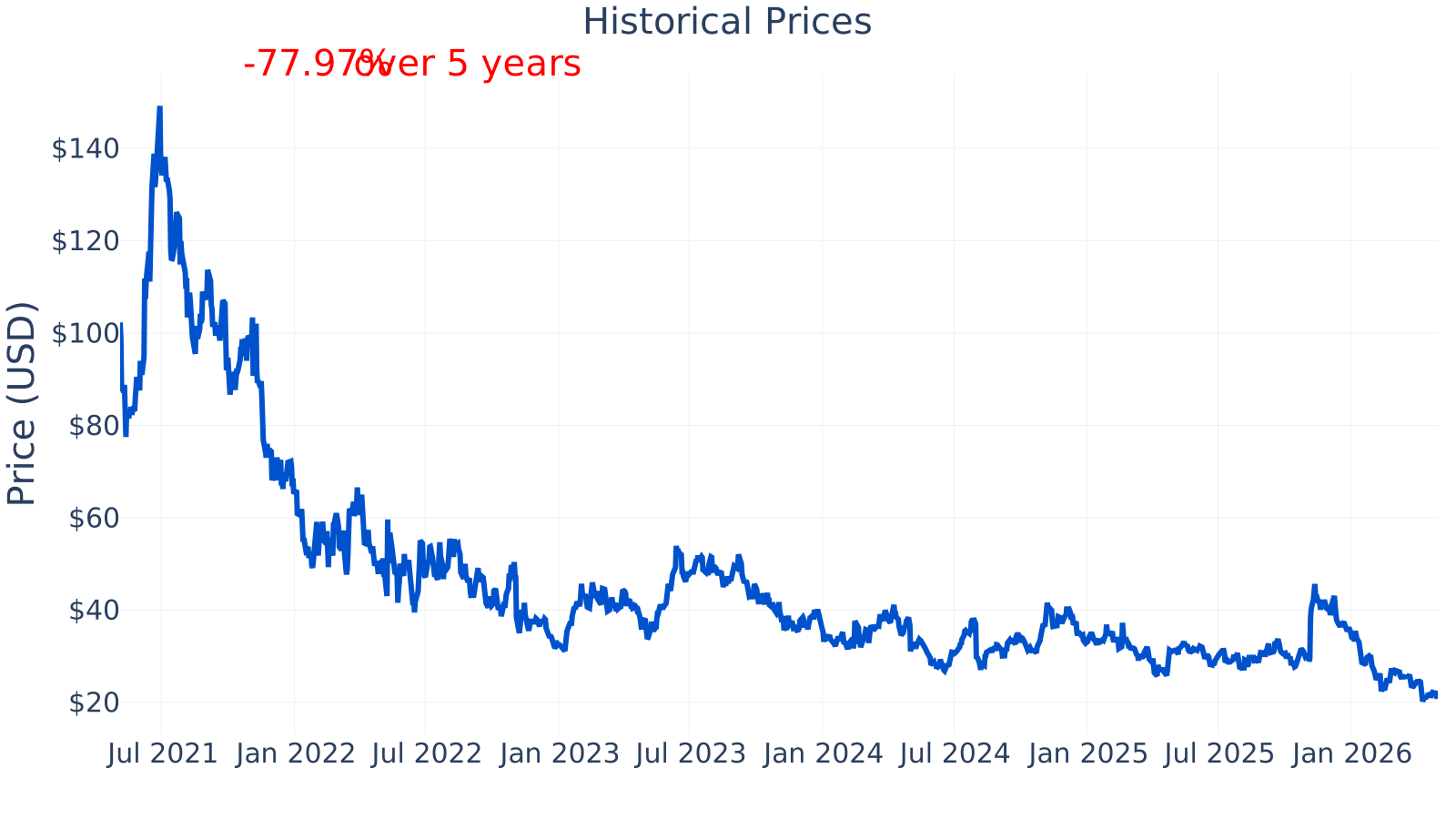
Overview
Appian Corp is a software company that helps organizations build and run business applications more quickly. Its platform is often described as “low-code,” meaning teams can create workflows and apps with less manual programming than traditional approaches. In practice, Appian is used to automate processes like onboarding, case management, compliance checks, customer service workflows, and other step-by-step operational tasks that companies want to run more efficiently and consistently.
The business is primarily oriented around delivering its platform as cloud software, while also supporting customers with professional services related to implementing and expanding the platform in real-world operations. Like many enterprise software companies, Appian’s long-term goal is typically to expand recurring usage-based or subscription-style revenue, while keeping services more focused on enabling adoption rather than being the main profit driver.
Main sources of revenue (typical structure for Appian as described in company filings):
- Cloud subscriptions (recurring platform access and usage; generally the largest component)
- Maintenance and support (support for customers, often associated with longer-term relationships)
- Professional services (implementation, consulting, and training; tends to be less recurring)
Over the last several years, total revenue has risen steadily (from about $369M in 2021 to about $727M in 2025). Over the same period, operating results improved materially: operating income moved from a sizeable loss (about -$87M in 2021) to a profit (about $27M in 2025), which suggests the company has been making progress scaling the business while controlling operating costs relative to revenue.
Key Figures
| Metric | Value | Industry ⓘ |
|---|---|---|
| Date | May 04, 2026 | |
| Context | ||
| Sector | Technology | |
| Industry | Software - Infrastructure | |
| Market Cap ⓘ | $1.68B | |
| Beta ⓘ | 0.88 | |
| Fundamental | ||
| P/E Ratio ⓘ | N/A | 29.58 |
| Profit Margin ⓘ | 0.17% | 6.71% |
| Revenue Growth ⓘ | 21.70% | 18.30% |
| Debt to Equity ⓘ | -734.99% | 24.92% |
| PEG ⓘ | N/A | |
| Free Cash Flow ⓘ | $63.11M | |
Appian’s market capitalization is about $1.68B, and its beta is 0.88, which indicates the stock has historically moved somewhat less than the broader market. Profitability is currently very slim on a net basis, with a profit margin of ~0.17% versus an industry median around 6.71%, showing that while results improved a lot, the company has not yet established strong, consistent net profitability. On growth, the latest year-over-year revenue growth is about 21.7%, above the industry median of about 18.3%. Free cash flow (trailing twelve months) is about $63.1M, a notable change from negative levels in prior periods.
Growth (Medium)
Appian operates in enterprise software focused on process automation and application development—areas supported by long-term trends such as cloud adoption, digitization of internal operations, and demand for faster delivery of business applications. In many organizations, modernizing workflows is not a one-time project; it tends to expand over time as additional departments adopt automation and as compliance requirements and customer expectations evolve.
Appian’s strategy is centered on expanding recurring platform usage (especially cloud-delivered subscriptions) and increasing customer adoption across more use cases within the same organization. If executed well, this approach can support compounding revenue over time because the platform becomes embedded in day-to-day operations.
Revenue growth has remained positive, with a slowdown from the higher growth rates seen in 2021–2022 (often above the mid-20% range) to more recent levels, ending 2025 at about 21.7% year-over-year. This is still a solid pace for enterprise software, and it is slightly above the industry median shown.
Free cash flow has improved significantly over time, moving from negative levels (for example, about -$121M in early 2023) to positive (about $31M in early 2025 and about $63M on a trailing basis in the latest metrics). For long-term business durability, sustained positive free cash flow can matter because it reduces dependence on external financing and gives management more flexibility.
Potential catalysts (in a factual, business-model sense) tend to relate to expanding cloud subscriptions, broadening adoption among large enterprises and government organizations, and continued progress in operating efficiency—especially if revenue continues growing while operating expenses grow more slowly.
Risks (High)
Appian’s main risks largely reflect the realities of enterprise software competition and the company’s history of thin or inconsistent profitability. While net margin recently turned slightly positive, the longer track record includes substantial losses, and maintaining profitability while still investing in product development and sales execution is an ongoing challenge.
The profit margin trend shows a multi-year recovery from large negative levels (roughly -20% to -33% in 2021–2023) toward break-even, reaching about 0.17% most recently. However, the industry median shown is around 6.71%, highlighting that Appian still lags many peers on net profitability even after meaningful improvement.
The debt-to-equity ratio becomes difficult to interpret in the most recent periods because it turns negative (around -735% most recently). This typically happens when accounting equity is negative, which can occur after accumulated losses or other balance sheet effects. In that situation, the ratio no longer provides a clean “leverage” signal, and it raises the importance of reviewing the balance sheet details (cash, total debt, and the drivers of equity) directly in filings rather than relying on this single metric.
Competition is another major risk. Appian operates in markets that overlap with large, well-resourced software vendors and platform providers. Competitors can include:
- Low-code / workflow automation platforms offered by large enterprise vendors
- CRM and enterprise application ecosystems that expand into workflow automation
- Automation and integration tool providers that solve adjacent problems
Appian’s competitive advantages are generally tied to product capability, customer references in complex deployments, and the “stickiness” that can develop when a platform becomes embedded in critical workflows. At the same time, it is not the largest company in this space by scale, and competing against larger platforms can pressure pricing, sales cycles, and long-term market share.
Valuation
A traditional price-to-earnings (P/E) ratio is not currently meaningful here (shown as 0), which commonly occurs when earnings are minimal or inconsistent. That makes valuation comparisons more difficult using simple earnings-based metrics, especially versus an industry median P/E around ~29 in the periods shown.
In cases like this, the market often implicitly values the company based on a mix of factors such as revenue scale and growth, gross margin structure, progress toward sustained profitability, and the durability of recurring subscription revenue. Based on the financial trends shown elsewhere in the article—particularly improving operating results and positive free cash flow—investors typically focus on whether those improvements can persist through different economic environments and competitive conditions.
Conclusion
Appian is an enterprise software company focused on enabling organizations to build and automate business processes through a platform approach. The company has shown steady revenue expansion over multiple years and a notable improvement in operating performance, culminating in positive operating income in 2025 and a move to positive free cash flow on a trailing basis.
At the same time, the risk profile remains elevated. Profitability is only marginally positive at the net level and below typical industry medians, competition is intense, and certain balance sheet ratios (like debt-to-equity) become harder to interpret due to negative equity dynamics. For long-term evaluation, the most important points to track in filings are whether subscription-style revenue continues to grow at a healthy pace, whether margins continue to improve in a sustainable way, and whether free cash flow remains consistently positive.
Sources:
- U.S. SEC EDGAR — Appian Corp filings (Form 10-K, Form 10-Q)
- Appian Investor Relations — Annual reports and shareholder materials (company-hosted)
- Wikipedia — “Appian Corporation” (basic company background)
This article is for informational purposes only and does not constitute financial advice. Some content is AI-generated. See Disclaimer


