Stock Analysis · Amphenol Corporation (APH)
Overview
Amphenol Corporation (APH) designs and manufactures interconnect products—mostly connectors, along with cable assemblies and sensors. These components are used to transmit power and data inside many types of equipment, from smartphones and data-center hardware to cars, factory automation systems, aircraft, and medical devices. In simple terms, Amphenol sells the “plug-in and connect” building blocks that help electronic and electrical systems work reliably, often in demanding environments.
Its revenue base is diversified across many end markets, which can help reduce reliance on any single product cycle. Amphenol also tends to operate as a high-volume manufacturer with a broad catalog, and it frequently expands through acquisitions (a long-running element of its stated strategy in its filings).
Main sources of revenue are typically discussed by end market in Amphenol’s annual report. Based on that structure, the largest revenue drivers generally come from a mix of communications, industrial, automotive, and defense-related demand, alongside other electronics categories. Exact percentages can change year to year and should be taken directly from the latest Form 10-K for the most current breakdown.
The business model can be summarized as: selling highly engineered, repeat-purchase components (connectors/cables/sensors) to large equipment makers, where reliability, qualification processes, and long product lifecycles can matter as much as price.
Across the years shown, revenue and operating income rise meaningfully, suggesting that scale and product mix improved profitability as the company grew. Research and development spending is present but relatively small compared with total revenue, consistent with an engineering/manufacturing company where process capability and customer qualification also play a major role.
Key Figures
| Metric | Value | Industry ⓘ |
|---|---|---|
| Date | Feb 07, 2026 | |
| Context | ||
| Sector | Technology | |
| Industry | Electronic Components | |
| Market Cap ⓘ | $166.75B | |
| Beta ⓘ | 1.21 | |
| Fundamental | ||
| P/E Ratio ⓘ | 40.79 | 41.23 |
| Profit Margin ⓘ | 18.49% | 6.11% |
| Revenue Growth ⓘ | 49.10% | 12.20% |
| Debt to Equity ⓘ | 115.57% | 39.00% |
| PEG ⓘ | 1.43 | |
| Free Cash Flow ⓘ | $4.38B | |
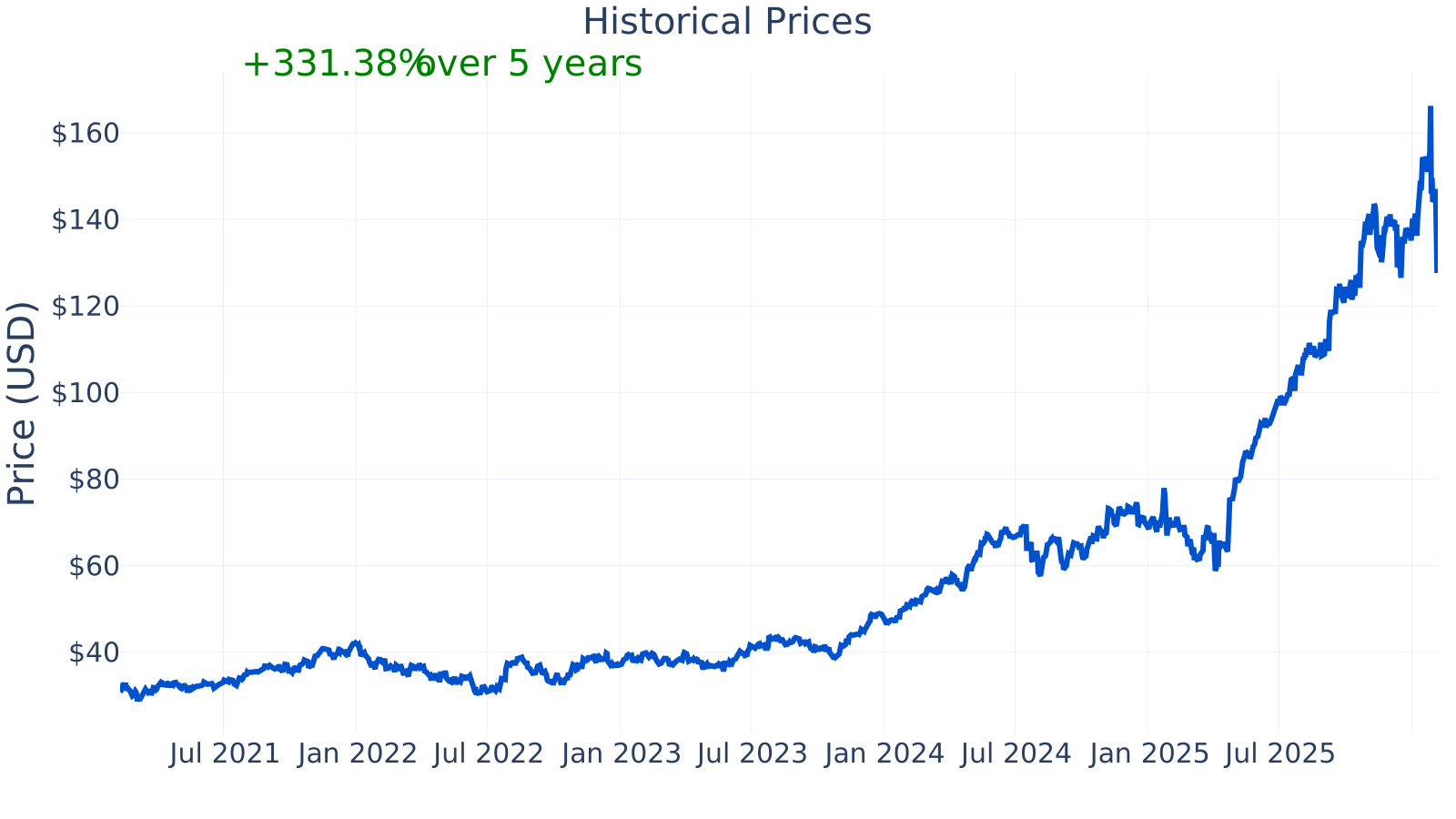
Amphenol’s market capitalization is about $166.8B, placing it among the largest companies in electronic components. The stock’s beta of 1.21 indicates it has historically moved somewhat more than the broader market (higher volatility than a beta of 1.0).
Profitability stands out versus the industry median: the latest profit margin is ~18.5% compared with an industry median near 6.1%. Recent year-over-year revenue growth is ~49.1%, well above the industry median of about 12.2%, though growth rates in this type of business can vary significantly over time depending on end-market cycles and acquisitions.
Leverage is higher than the industry median: debt-to-equity is ~115.6% versus an industry median near 39.0%. Free cash flow (trailing twelve months) is approximately $4.38B, which helps support ongoing investment, acquisitions, and shareholder returns (subject to company decisions and market conditions).
Growth (Medium)
Amphenol operates in the electronic components space, which is closely tied to long-term trends like increased electrification, higher data usage, and more electronics content per device. Many of its end markets—including automotive electronics (including electrified vehicles), factory automation, data communications infrastructure, and defense applications—require more high-performance connectivity over time. That creates a broad set of potential demand “tailwinds,” although the path is not usually smooth because customers can be cyclical.
A key part of Amphenol’s growth strategy, as described in its filings, is to combine organic expansion (new products, deeper customer relationships, and content gains in existing platforms) with acquisitions. This approach can increase scale, broaden the product portfolio, and add exposure to faster-growing niches, but it also increases the importance of successful integration and disciplined capital allocation.
Revenue growth shows clear cycles: strong growth in 2021–2022, a softer period around 2023 (including slightly negative quarters), and then a sharp acceleration into 2024–2025, reaching roughly 49% year-over-year by the latest point shown. A jump of this size often reflects a combination of end-market strength and acquisition effects, so it is useful to separate “organic” growth from acquired revenue in the company’s quarterly and annual filings when evaluating how repeatable the pace may be.
Free cash flow trends upward over the period shown, from roughly $1.23B (2021) to about $2.22B (2024–2025 points shown), with the latest trailing twelve month figure listed in the table at about $4.38B. In practical terms, rising free cash flow can make it easier to fund acquisitions, invest in capacity, and withstand downturns, though cash generation can fluctuate with working capital needs in a manufacturing business.
Risks (Medium)
This article is for informational purposes only and does not constitute financial advice. Some content is AI-generated. See Disclaimer


