Stock Analysis · Amkor Technology Inc (AMKR)
Overview
Amkor Technology Inc is a semiconductor “outsourcing” company. Instead of designing chips, it helps other companies finish making them after the silicon wafer is produced. This part of the chip supply chain is often called packaging and test. In simple terms: Amkor takes finished chip wafers from chip makers, separates them into individual chips, places them into protective packages (so they can be handled and installed into devices), and tests them to confirm they work as intended.
This work matters because modern electronics—smartphones, data centers, cars, and industrial equipment—need chips that are smaller, faster, and more energy-efficient. Packaging has become more complex over time, and it can directly affect performance, power use, and reliability.
In its SEC filings, Amkor generally describes revenue as coming from two broad service lines:
- Packaging and test services (the core business; typically the large majority of revenue)
- Other / related services (smaller portion, depending on the year)
Amkor also tends to discuss end markets such as communications (smartphones and related devices), computing, automotive/industrial, and consumer—mix can change meaningfully from year to year based on customer demand.
Over the last several years, total revenue has been relatively stable in the mid-single-digit billions of dollars (about $6.1B–$7.1B from 2021 to 2025), while profitability has moved up and down with industry demand and pricing. Net income was higher in 2021–2022, then lower in 2023–2025 compared with that earlier peak period.
Key Figures
| Metric | Value | Industry ⓘ |
|---|---|---|
| Date | May 01, 2026 | |
| Context | ||
| Sector | Technology | |
| Industry | Semiconductor Equipment & Materials | |
| Market Cap ⓘ | $17.29B | |
| Beta ⓘ | 1.95 | |
| Fundamental | ||
| P/E Ratio ⓘ | 40.09 | 56.18 |
| Profit Margin ⓘ | 6.17% | 7.37% |
| Revenue Growth ⓘ | 27.50% | 9.20% |
| Debt to Equity ⓘ | 32.69% | 25.99% |
| PEG ⓘ | 0.76 | |
| Free Cash Flow ⓘ | $391.83M | |
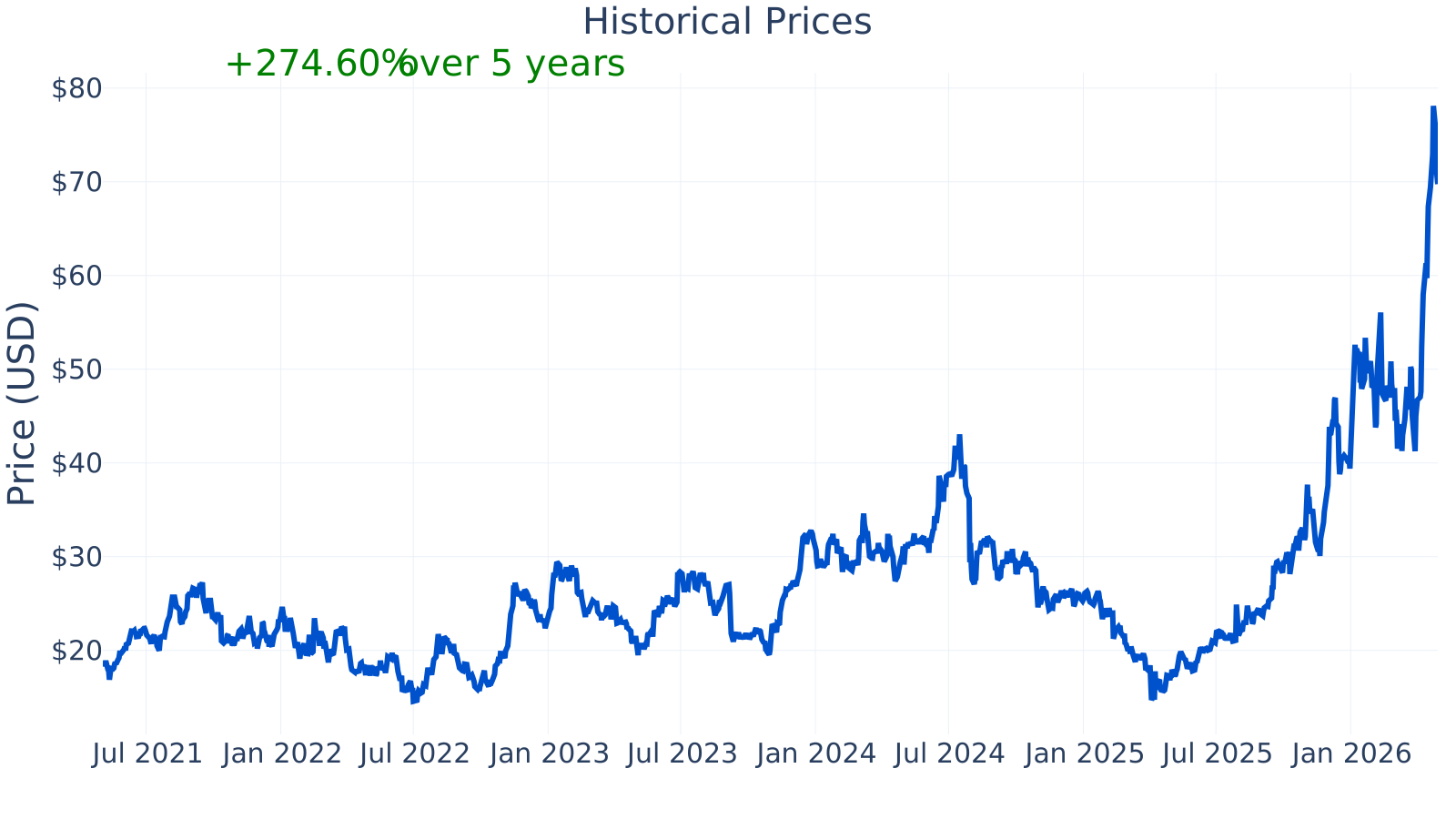
Amkor’s market capitalization is about $17.3B, and the stock has shown relatively high sensitivity to market moves, with a beta of 1.95 (meaning it has often moved more than the broader market). The company’s P/E ratio is ~40.1, below the industry median shown here (~56.2), while its profit margin is ~6.2% versus an industry median of ~7.4%.
On growth, the most recent year-over-year revenue growth is ~27.5%, above the industry median (~9.2%). Leverage is moderate: debt-to-equity is ~32.7% (industry median ~26.0%). Free cash flow over the trailing twelve months is about $392M.
Growth (Medium)
Amkor operates in the semiconductor supply chain, which has long-term growth drivers tied to increased chip content across the economy. Even in years when unit sales of certain devices slow down, the longer-run trend has been toward more semiconductors per product (especially in automotive electronics, data centers, and connected devices). Packaging and testing are required steps for nearly all chips shipped, which links Amkor’s demand to overall semiconductor volumes and the complexity of new chip designs.
Strategy-wise, Amkor’s positioning is closely connected to two ideas that have been emphasized across the packaging industry in recent years: (1) more advanced packaging to support higher performance and (2) scale and operational execution to deliver consistent quality at high volumes for major customers. For a business like Amkor, the biggest practical growth lever is sustained demand from large chip platforms (for example, in mobile and computing) plus incremental expansion in areas like automotive/industrial where qualification cycles can be longer but relationships can be sticky once established.
The revenue growth pattern shows a cyclical dip (several quarters of negative year-over-year growth through parts of 2023–2024) followed by a stronger re-acceleration, reaching roughly 27% most recently. That swing is consistent with a semiconductor cycle: periods of inventory correction and softer end demand can be followed by sharper recoveries when utilization improves.
Free cash flow has also fluctuated, moving from roughly $283M (2022) to $260M (2023), up to about $509M (2024), down to about $223M (2025), and back to about $392M most recently. For long-term business quality, this matters because packaging and test is capital-intensive: the ability to produce cash after funding equipment and facilities can vary substantially depending on utilization, pricing, and investment pace.
Risks (High)
Amkor’s results can be strongly affected by the semiconductor cycle. When customers reduce production or work through inventory, outsourcing providers can see lower factory utilization, which tends to pressure margins. Customer concentration can also be important in this industry: large chip makers and major device ecosystems can represent meaningful portions of demand, and shifts in a few programs can move the overall numbers.
Another structural risk is that packaging and test is a highly competitive global business. Customers often negotiate on price, quality, and delivery reliability. In addition, some large semiconductor companies run parts of packaging and test internally, and may choose to expand in-house capability for strategic products.
Capital intensity is a further consideration. The business requires ongoing spending for advanced equipment, cleanrooms, and process upgrades. If demand weakens after capacity is added, profitability and cash generation can come under pressure.
Debt levels appear moderate, with debt-to-equity trending down from above 50% in 2021 toward roughly 33% most recently. That direction is generally consistent with balance-sheet improvement over time, though leverage remains somewhat higher than the industry median shown on the chart in many quarters.
Profit margin has declined compared with the higher levels seen in 2021–2022 (about 8%–12% in that period), reaching around 6% most recently. The chart also shows that margins have often been below the industry median, though the gap narrowed over time as the industry median came down.
On competitive position, Amkor is one of the largest outsourced semiconductor packaging and test (OSAT) providers globally, but it is not the only scale player. Key competitors typically cited in industry discussions include ASE Technology Holding (including SPIL), JCET Group, and Powertech Technology, among others, plus a long tail of smaller regional firms. Amkor’s competitive advantages are primarily operational (manufacturing execution, quality, scale, and long-standing customer relationships). The main challenge is that scale players can compete aggressively, and differentiation can be difficult outside of specific advanced packaging capabilities and customer co-development relationships.
Valuation
Amkor’s current P/E ratio is about 40, and the historical line shows it has varied widely over time (from single digits in parts of 2022 to above 30 more recently). The chart also indicates the industry median P/E has frequently been higher than Amkor’s over the period shown.
How “expensive” that multiple is depends heavily on expectations for earnings normalization and cycle strength. The company’s recent revenue growth has accelerated, but profit margin remains modest compared with earlier peaks. In other words, valuation here reflects not only near-term growth but also the market’s view on how durable margins and cash generation may be as demand improves.
Conclusion
Amkor is a large, established company in a necessary part of the semiconductor supply chain: packaging and testing. The business benefits from long-term trends toward rising semiconductor content and more complex packaging requirements, but results can swing meaningfully with industry cycles. Recent data shows re-accelerating revenue growth and positive free cash flow, while profitability remains relatively modest and leverage is moderate.
Overall, the long-term picture combines structural demand for packaging/test services with high competitive pressure, customer and cycle sensitivity, and ongoing capital needs. Any long-horizon assessment typically comes down to whether Amkor can sustain utilization, maintain strong customer programs, and translate advanced packaging demand into consistently higher margins and cash generation across cycles.
Sources:
- U.S. SEC EDGAR — Amkor Technology, Inc. filings (Form 10-K, Form 10-Q)
- Amkor Technology — Investor Relations materials (SEC filings and company presentations, where available)
- Wikipedia — “Amkor Technology” (basic company background)
This article is for informational purposes only and does not constitute financial advice. Some content is AI-generated. See Disclaimer