Stock Analysis · Amkor Technology Inc (AMKR)
Overview
Amkor Technology, Inc. is a semiconductor packaging and testing company. In simple terms, it helps turn finished silicon “chips” into usable components by enclosing them in protective packages, connecting them to electrical contacts, and testing them to make sure they work as expected. This step is essential before chips can be installed in phones, computers, cars, data centers, and many other electronic products.
Amkor’s business sits in the “back-end” of the semiconductor supply chain and is often described as outsourced semiconductor assembly and test (OSAT). Chip designers and manufacturers use companies like Amkor to add packaging technology, handle large-scale manufacturing, and provide testing capacity without building all of that internally.
From a revenue standpoint, Amkor primarily earns money by delivering packaging and test services to semiconductor companies and electronics manufacturers. In its reporting, the company generally groups revenue by service families (rather than consumer-style products). The largest categories typically include:
- Packaging / assembly services (the largest revenue contributor)
- Test services
Amkor also reports revenue exposure by end markets (such as communications, computing, automotive/industrial). The exact mix can shift year to year as customer demand changes.
Across 2021–2024, total revenue increased from about $6.14B (2021) to $7.09B (2022), then declined to about $6.50B (2023) and $6.32B (2024). Over the same period, profitability compressed: net income fell from about $643M (2021) and $766M (2022) to about $360M (2023) and $354M (2024). This pattern is consistent with a cyclical industry environment where volumes and pricing can fluctuate while the company continues to carry a meaningful fixed cost base.
Key Figures
| Metric | Value | Industry ⓘ |
|---|---|---|
| Date | Feb 07, 2026 | |
| Context | ||
| Sector | Technology | |
| Industry | Semiconductor Equipment & Materials | |
| Market Cap ⓘ | $12.20B | |
| Beta ⓘ | 1.95 | |
| Fundamental | ||
| P/E Ratio ⓘ | 35.77 | 47.44 |
| Profit Margin ⓘ | 4.77% | 9.40% |
| Revenue Growth ⓘ | 6.70% | 9.90% |
| Debt to Equity ⓘ | 45.63% | 20.73% |
| PEG ⓘ | 1.87 | |
| Free Cash Flow ⓘ | $230.47M | |
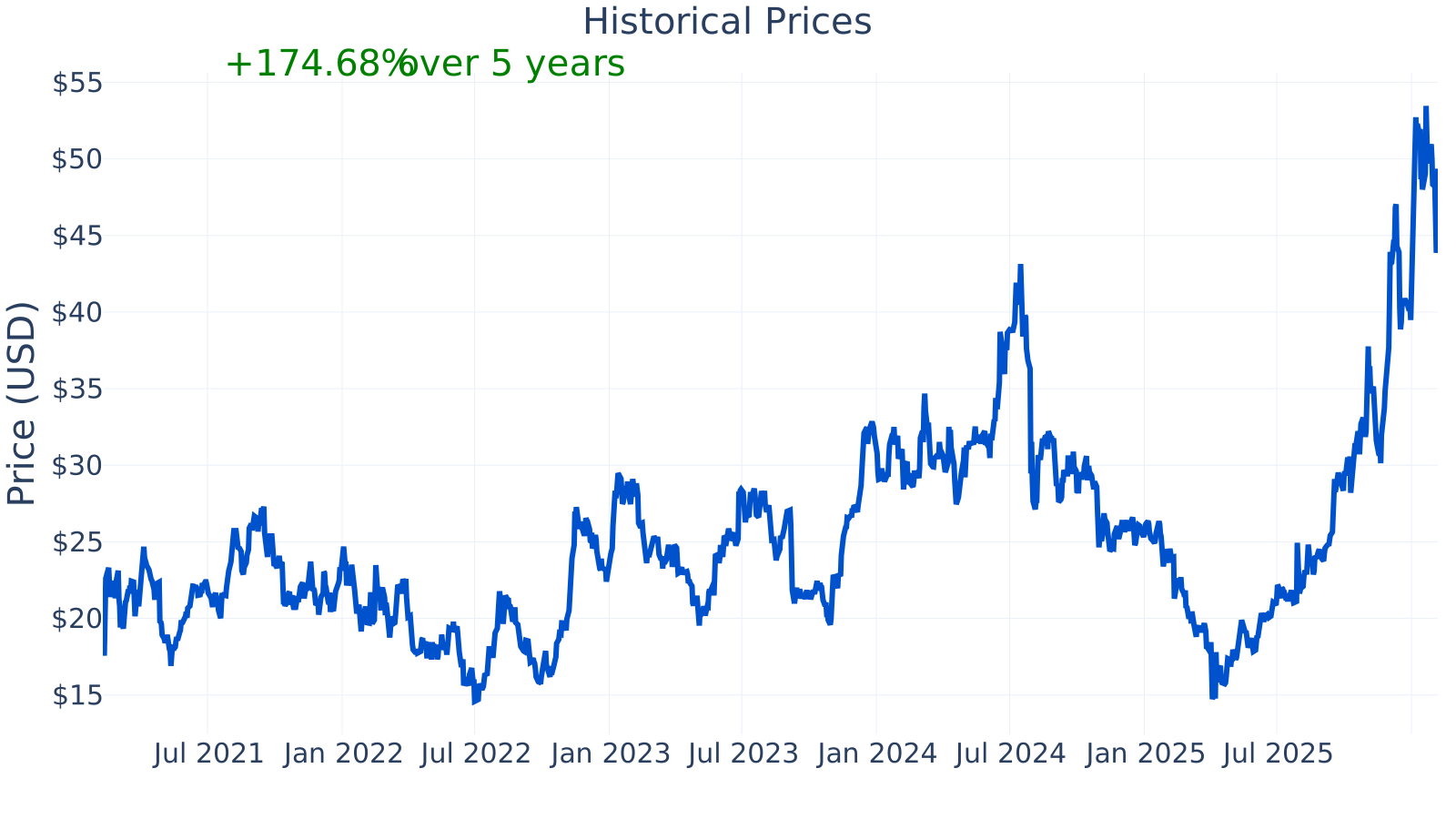
Amkor’s market capitalization is about $12.2B. The stock has shown higher-than-market sensitivity with a beta of ~1.95, meaning its share price has tended to move more than the overall market. On profitability, the company’s profit margin is ~4.77%, below the industry median shown here (~9.41%). Recent year-over-year revenue growth is ~6.7%, also below the industry median shown here (~9.9%). Leverage is higher than the industry median: debt-to-equity ~45.6% versus an industry median of about 20.7%. Trailing twelve-month free cash flow is ~$230.5M. The current P/E ratio is ~35.8, below the industry median shown here (~47.4), and the listed PEG ratio is ~1.87.
Growth (Medium)
Amkor operates in the semiconductor ecosystem, an industry shaped by long-term growth in electronic content across many products. Even when chip demand is cyclical (periods of tight supply and then slower demand), the long-term direction has been toward more chips per device and more advanced packaging requirements, especially as performance, power efficiency, and size constraints get stricter.
From a strategy perspective, packaging is not just a commodity step: as chips become more complex, packaging can be a differentiator for performance and reliability. Companies like Amkor can benefit when customers choose to outsource advanced packaging and testing rather than building all capacity in-house. Demand can be influenced by technology transitions (new device generations), and by growth in end markets like automotive electronics and data-center computing, where reliability and performance matter.
Revenue growth has been volatile over the past several years. Growth was strong through 2021 and parts of 2022 (often above 15%–25% year-over-year in multiple quarters), then turned negative for an extended stretch across 2023 and parts of 2024, before returning to modestly positive territory most recently (around +6.7% in the latest period shown). This highlights the cyclical nature of the company’s demand environment.
Free cash flow (cash generated after operating needs and capital spending) has also fluctuated. It rose to roughly $509M in the period shown around 2024-03-31 and then moved down to about $223M around 2025-03-31, with the latest trailing twelve-month value near $230M. For long-term analysis, variability in free cash flow matters because packaging/test is capital-intensive, and cash generation can swing with utilization (how fully factories are loaded) and investment cycles.
Risks (High)
This article is for informational purposes only and does not constitute financial advice. Some content is AI-generated. See Disclaimer