Stock Analysis · American Axle & Manufacturing (AXL)
Overview
American Axle & Manufacturing (AAM) is an auto parts supplier that designs, engineers, and manufactures drivetrain and metal-forming products used in passenger vehicles, pickup trucks, and SUVs. In simple terms, it makes key “motion and power-transfer” components that help a vehicle move—such as axles, driveshafts, and related systems—along with other engineered components made through forging and casting.
The company’s revenue mainly comes from supplying parts directly to automakers (original equipment manufacturers). Because AAM operates in the automotive supply chain, its sales tend to move with global vehicle production volumes, model launches, and how much content AAM has “per vehicle” on platforms it supplies.
Public filings describe revenue concentration primarily by customer and by geography; detailed product-by-product revenue splits are typically not provided as a clean percentage breakdown in a single standardized table. At a high level, the company’s main revenue sources can be grouped as:
- Driveline and drivetrain systems/components (axles, driveshafts, and related technologies supplied to automakers)
- Metal forming and casting/forging-related products (engineered components produced through manufacturing processes such as forging and casting)
- Manufacturing and engineering services tied to vehicle programs (program launches, integration, and ongoing production support)
AAM’s recent income statement pattern shows a large share of revenue consumed by production costs, with profitability heavily influenced by volume, pricing, and manufacturing efficiency—typical characteristics for a high-scale automotive supplier.
Across 2021–2025, total revenue increased from about $5.16B (2021) to about $5.84B (2025), while net income swung between small profits and losses (for example, +$35M in 2024 and -$19.7M in 2025). Interest expense remained sizable (roughly $175M–$202M per year in the periods shown), which can meaningfully affect bottom-line results when operating profit is modest.
Key Figures
| Metric | Value | Industry ⓘ |
|---|---|---|
| Date | May 05, 2026 | |
| Context | ||
| Sector | Consumer Cyclical | |
| Industry | Auto Parts | |
| Market Cap ⓘ | $2.12B | |
| Beta ⓘ | 1.59 | |
| Fundamental | ||
| P/E Ratio ⓘ | 24.32 | 24.76 |
| Profit Margin ⓘ | 0.72% | 3.56% |
| Revenue Growth ⓘ | N/A | 5.40% |
| Debt to Equity ⓘ | 21.12% | 69.29% |
| PEG ⓘ | 0.43 | |
| Free Cash Flow ⓘ | $155.10M | |
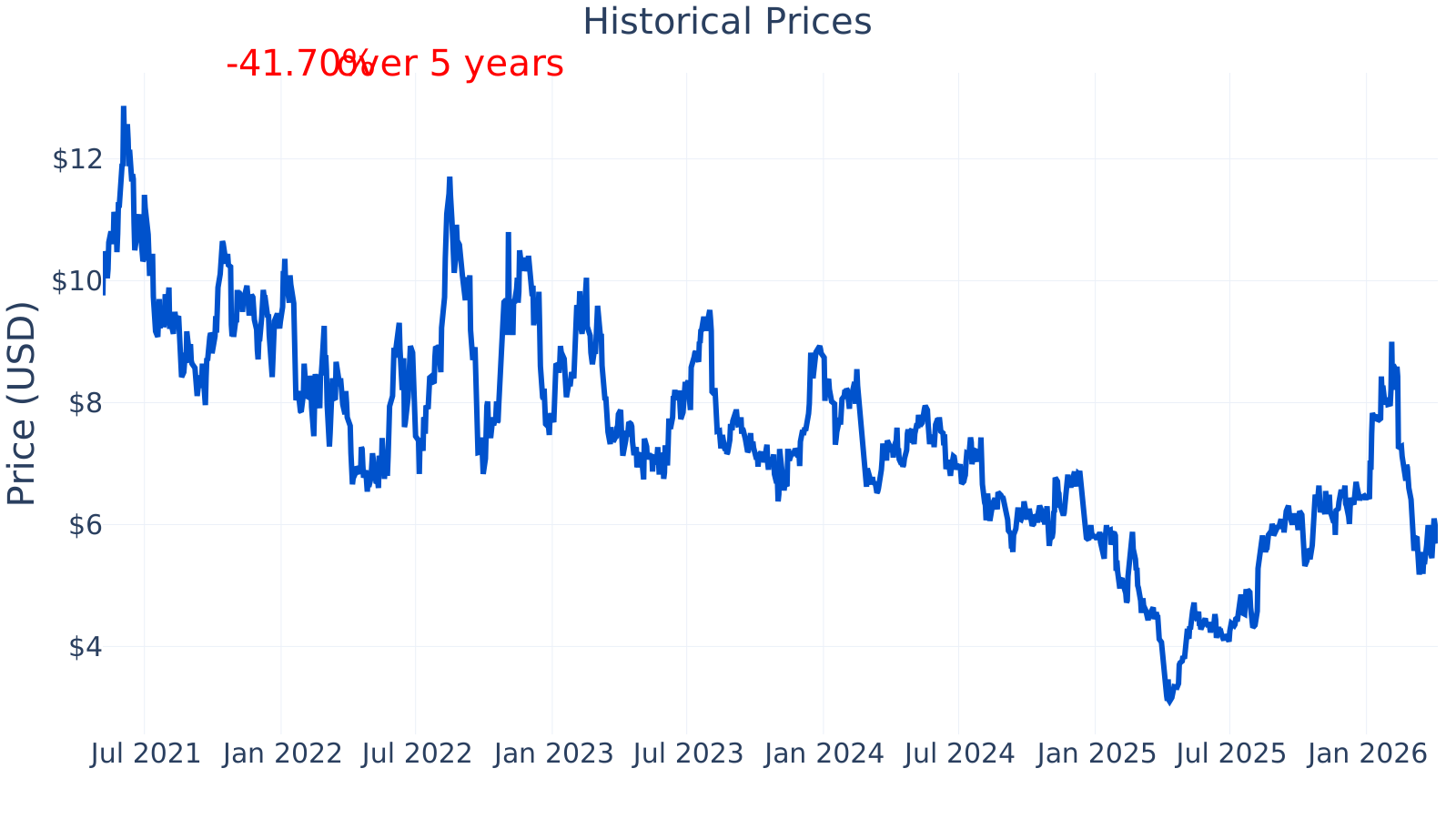
AAM’s market capitalization is about $2.12B, placing it among smaller publicly traded auto suppliers. The stock’s beta of 1.59 suggests it has historically moved more than the broader market (higher price volatility). The latest P/E ratio is ~24.3, close to the industry median (~24.8), while the profit margin is ~0.72%, well below the industry median (~3.57%). Revenue growth year over year is shown as ~0% versus an industry median of ~5.4%. Leverage looks lower on the latest snapshot with debt-to-equity ~21% compared with an industry median near 69%, though the longer history below shows that this ratio has moved dramatically over time. Trailing twelve-month free cash flow is about $155.1M.
Growth (Medium)
AAM operates in the auto parts industry, which is mature overall and closely tied to global vehicle demand. That said, the industry is also being reshaped by long-term trends such as electrification, hybrid platforms, and ongoing efficiency requirements. For suppliers, growth often comes less from the market expanding rapidly and more from (1) winning new vehicle programs, (2) increasing content per vehicle, and (3) improving manufacturing performance and pricing discipline.
Revenue growth has been uneven. After very strong year-over-year growth in mid-2021 (an unusual period for comparisons), the pattern from 2022 through 2024 was mostly low-to-mid single-digit growth with some stronger quarters, followed by negative comparisons in late 2024 and parts of 2025, ending 2025 close to flat year over year. This shape is consistent with a business influenced by production schedules, customer mix, and broader auto build rates.
Free cash flow (cash left after operating needs and capital spending) has remained positive in the periods shown, moving from about $257.6M (TTM, 2022-03-31) to $219.1M (2023-03-31), $183.7M (2024-03-31), and $221.1M (2025-03-31). Positive free cash flow can help fund investment, reduce debt, and provide resilience during weaker industry stretches, even when accounting earnings are pressured.
Potential catalysts in this type of business generally include new program launches, platform awards, richer product mix (more value-added systems per vehicle), and operational improvements (scrap reduction, better utilization, and lower warranty costs). Because the company’s revenue base is large and production-driven, even small changes in operating performance can have an outsized effect on earnings.
Risks (High)
AAM’s biggest risks are typical of automotive suppliers but can be significant in magnitude. Demand depends on automakers’ production levels, and those can change quickly due to macroeconomic conditions, inventory adjustments, labor disruptions, or shifts in consumer demand. Customer concentration is also a common issue in this industry: losing share on a major vehicle platform (or having a platform end) can reduce volumes for years.
The debt-to-equity history shows an important point: leverage has been very high for much of 2021–2025 (often several hundred percent), then drops sharply to about 21% at the end of 2025. A sudden change like this can happen due to shifts in reported equity (for example, earnings, accounting items, or balance-sheet actions) as well as changes in debt levels. Regardless of the cause, the broader takeaway is that leverage metrics have been volatile, and interest expense has been a recurring, material cost in the income statement.
Profit margins have generally been thin and sometimes negative. From 2021 through 2025, the net margin frequently stayed below the industry median and dipped below zero in multiple quarters, finishing 2025 at roughly -0.34% versus an industry median around 3.4%. This suggests the company has had less pricing power and/or higher costs than many peers, and it leaves less room for error if volumes soften or costs rise.
In terms of competitive positioning, AAM participates in a crowded global supply chain where scale, manufacturing quality, reliability, cost, and long-standing customer relationships matter. Competitive advantages in this industry often come from engineering integration, footprint near customers, execution on launches, and the ability to manufacture at high quality and low cost. Without relying on any single “winner-take-all” dynamic, AAM competes against other large drivetrain and powertrain component suppliers and diversified auto parts manufacturers. Examples of well-known competitors in adjacent areas of the auto parts market include Magna International, Linamar, and ZF (private), among others. Compared to very large diversified suppliers, AAM is smaller and more focused, which can be beneficial for specialization but can also increase exposure to a narrower set of platforms and end-markets.
Valuation
Using the price-to-earnings (P/E) ratio as a simple valuation lens, AAM’s latest P/E of about 24.3 is close to the industry median shown (about 24.8). The historical P/E series is choppy, with several periods not plotted (set to zero on the chart) and occasional spikes—patterns that often appear when earnings are very low, negative, or unusually volatile.
Because profit margins have been thin and earnings have fluctuated, a single P/E snapshot may not fully capture the business’s earnings power across a cycle. In that context, it can be helpful to view valuation alongside (1) margin stability, (2) the ability to generate free cash flow, and (3) balance-sheet resilience. The data shown points to a company that has generated positive free cash flow at times, but with profitability that has lagged the industry median and a history of leverage volatility—factors that can influence how the market values the shares over time.
Conclusion
American Axle & Manufacturing is a long-established automotive supplier focused on drivetrain-related systems and engineered metal components. Its business profile is closely linked to automaker production cycles, and its results show the typical sensitivity of auto suppliers to volume, costs, and platform/customer dynamics.
The recent picture is mixed: revenue has been relatively steady in the mid-single-digit billions, free cash flow has been positive in the periods shown, but profit margins have remained low versus the industry median and have periodically turned negative. The company’s valuation (based on the latest P/E) sits near the industry median, while the stock’s historical volatility and the company’s margin profile highlight that outcomes can vary meaningfully over time.
Sources:
- U.S. SEC EDGAR — American Axle & Manufacturing Holdings, Inc. filings (Form 10-K, Form 10-Q)
- American Axle & Manufacturing — Investor Relations materials (company-hosted)
- Wikipedia — “American Axle” (basic company background)
This article is for informational purposes only and does not constitute financial advice. Some content is AI-generated. See Disclaimer


