Stock Analysis · Alphabet Inc (GOOG)
Overview
Alphabet Inc. is a technology company best known for Google. Its products help people find information (Google Search), watch videos (YouTube), use maps and email (Google Maps and Gmail), and run apps on phones (Android). It also provides tools for businesses to advertise online and offers cloud computing services (Google Cloud). In addition, Alphabet invests in “Other Bets,” which are earlier-stage businesses such as Waymo (autonomous driving) and Verily (life sciences).
Alphabet reports its business primarily through Google Services (most consumer products and ads), Google Cloud, and Other Bets. In practice, the company’s revenue is dominated by advertising tied to Search, YouTube, and partner sites.
Main sources of revenue (largest to smallest, based on company reporting categories):
- Advertising (Google Search & other, YouTube ads, Google Network): the largest share of revenue.
- Google Cloud: cloud infrastructure and productivity tools sold to businesses.
- Google Services non-advertising: includes items such as Google Play, subscriptions, devices, and other consumer-related revenue streams.
- Other Bets: smaller businesses outside the core Google segments (typically a small share of revenue).
Across recent years, Alphabet’s total revenue increased meaningfully (from about $257.6B in 2021 to about $403.0B in 2025), while the company continued spending heavily on research and development, reflecting a strategy of ongoing product and platform innovation.
From 2021 to 2025, total revenue rose from $257.6B to $403.0B. Over the same period, operating income increased from $91.1B to $158.8B and net income increased from $76.0B to $132.2B. Research and development spending also grew (from $31.6B to $61.1B), highlighting sustained investment while profitability expanded.
Key Figures
| Metric | Value | Industry ⓘ |
|---|---|---|
| Date | Feb 07, 2026 | |
| Context | ||
| Sector | Communication Services | |
| Industry | Internet Content & Information | |
| Market Cap ⓘ | $3.91T | |
| Beta ⓘ | 1.09 | |
| Fundamental | ||
| P/E Ratio ⓘ | 29.86 | 14.12 |
| Profit Margin ⓘ | 32.81% | 10.23% |
| Revenue Growth ⓘ | 18.00% | 7.10% |
| Debt to Equity ⓘ | 17.35% | 10.16% |
| PEG ⓘ | 2.47 | |
| Free Cash Flow ⓘ | $73.27B | |
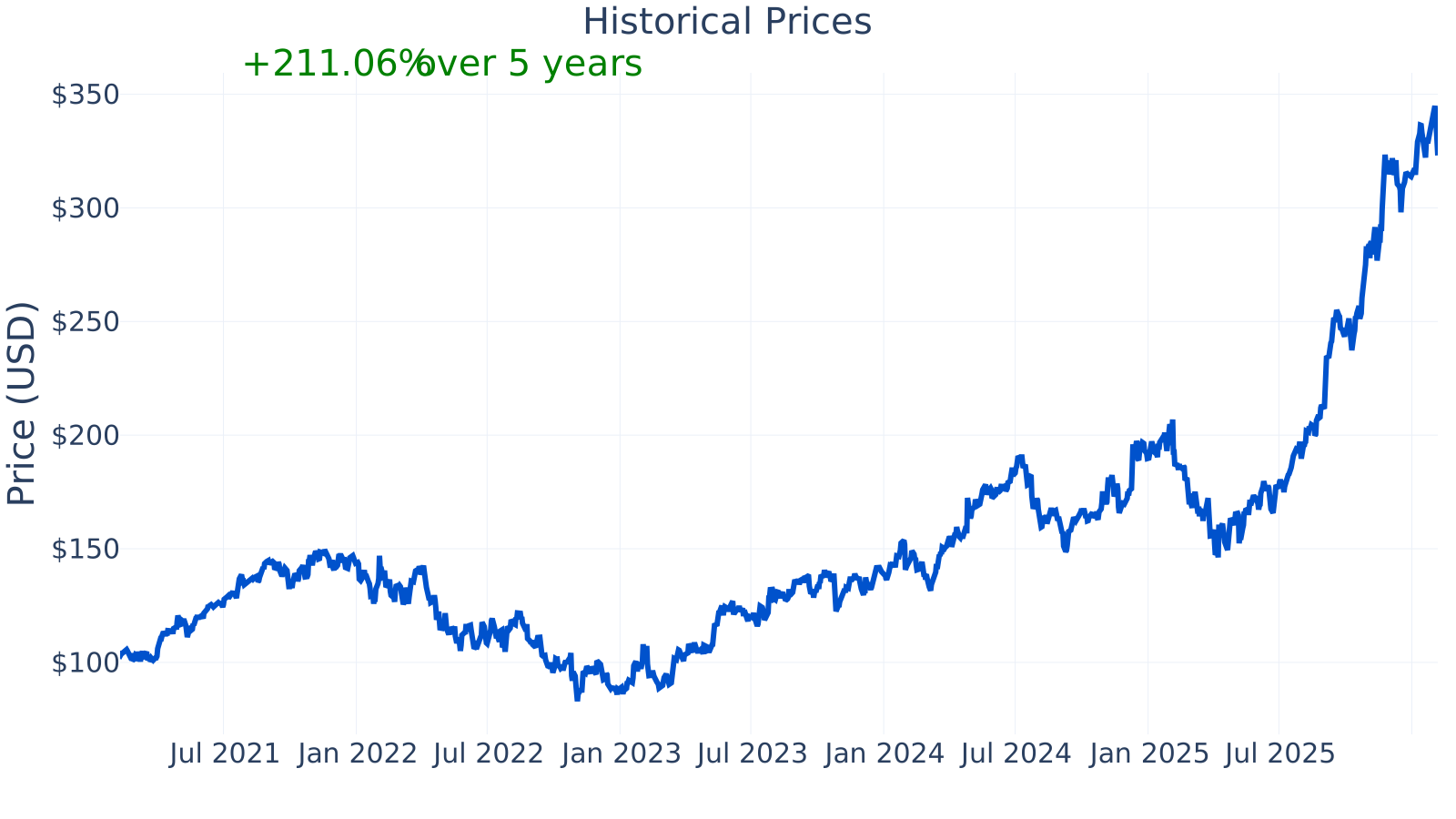
Alphabet’s equity value is about $3.91T, placing it among the largest public companies. The stock’s beta (1.086) suggests price movements that have been slightly more volatile than the overall market historically. Profitability stands out: Alphabet’s profit margin is 32.81% versus an industry median of 10.23%. Recent year-over-year revenue growth is 18.0% versus an industry median of 7.1%. Leverage is relatively modest, with debt-to-equity at 17.35% (industry median 10.16%). The P/E ratio is 29.86 compared with an industry median of 14.12, and trailing twelve-month free cash flow is about $73.27B.
Growth (Medium)
Alphabet operates in large, long-running markets: digital advertising, online video, mobile operating systems, and cloud computing. These areas are shaped by ongoing shifts toward online commerce, digital media consumption, and companies moving their software and infrastructure to the cloud. Because Alphabet’s products sit close to daily consumer activity (searching, watching, navigating, emailing), it has multiple “surfaces” where new features can be introduced and monetized.
Revenue growth slowed significantly in 2022–2023 compared with the very high growth rates seen in 2021, then re-accelerated through 2024 and into 2025. By the end of 2025, year-over-year growth is shown at roughly 18%, indicating renewed momentum compared with the low single-digit growth period in early 2023.
Free cash flow has remained large in absolute terms and has generally trended upward from 2021 to 2025 (roughly $50.7B in 2021 to about $74.9B by 2025). For long-term business durability, this matters because free cash flow can fund data centers, research, and acquisitions, while also supporting shareholder return programs when management chooses to do so.
A major strategic theme is artificial intelligence. Alphabet integrates AI across Search, advertising tools, YouTube recommendations, Android, and cloud offerings, and it develops its own AI models and infrastructure. In principle, AI can be a catalyst by improving product quality (which can support usage), enhancing advertising performance (which can support pricing), and differentiating cloud services (which can support enterprise adoption). At the same time, AI also tends to raise costs due to computing requirements, making execution and efficiency important for sustaining margins.
Risks (Medium)
This article is for informational purposes only and does not constitute financial advice. Some content is AI-generated. See Disclaimer


