Stock Analysis · Allison Transmission Holdings Inc (ALSN)
Overview
Allison Transmission Holdings Inc. designs and manufactures fully automatic transmissions and electric-hybrid propulsion systems, mainly for medium- and heavy-duty vehicles. In practice, its products are used in applications where durability, uptime, and predictable performance matter: city buses, refuse trucks, delivery vehicles, construction and mining equipment, defense vehicles, and other commercial/industrial use cases. The company also sells related parts and provides service support, which matters because many of these vehicles stay in operation for long periods and require maintenance over time.
In broad terms, the business is supported by two recurring demand drivers: (1) new vehicle production (the “original equipment” market), and (2) the installed base of vehicles already operating in the field (service, parts, and repairs). For long-term watchers, the second driver can help smooth results because maintenance demand is tied to vehicles already on the road, not only new builds.
Allison reports its revenue by end market in its annual filings. The largest buckets are typically commercial on-highway (trucks and buses) and off-highway (construction, energy, mining, etc.), with defense as a smaller but notable category. Exact percentages can shift year to year based on vehicle production cycles and specific program timing.
From 2021 to 2025, total revenue increased from about $2.4B (2021) to about $3.0B (2025), with a high point around $3.2B (2024). Over the same period, operating income rose from about $688M (2021) to about $902M (2025), showing that profitability remained strong even as revenue moved up and down. Interest expense declined notably from roughly $116M (2021) to about $98M (2025), which can help reduce pressure on net income when the business is carrying meaningful debt.
Key Figures
| Metric | Value | Industry ⓘ |
|---|---|---|
| Date | May 04, 2026 | |
| Context | ||
| Sector | Consumer Cyclical | |
| Industry | Auto Parts | |
| Market Cap ⓘ | $10.91B | |
| Beta ⓘ | 0.96 | |
| Fundamental | ||
| P/E Ratio ⓘ | 17.88 | 24.76 |
| Profit Margin ⓘ | 20.70% | 3.56% |
| Revenue Growth ⓘ | -7.40% | 5.40% |
| Debt to Equity ⓘ | 156.45% | 76.35% |
| PEG ⓘ | 0.79 | |
| Free Cash Flow ⓘ | $712.00M | |
Allison Transmission’s market capitalization is about $10.9B and the stock’s beta is about 0.97, which is close to the broader market in terms of typical day-to-day volatility. The company’s P/E ratio is about 17.9 versus an industry median near 24.8, while its profit margin is about 20.7% versus an industry median near 3.6%, highlighting a much higher level of profitability than the typical peer in this industry grouping. The latest year-over-year revenue growth shown is about -7.4% (industry median about +5.4%), suggesting a more recent slowdown. Debt-to-equity is about 156% versus an industry median near 76%, indicating heavier leverage than many peers. Free cash flow over the trailing twelve months is about $712M, which is a key figure for a manufacturer because it reflects cash left after operating needs and capital spending.
Growth (medium)
Allison operates in markets that tend to grow with freight activity, construction and infrastructure spending, municipal budgets (buses and refuse), and long-run vehicle replacement cycles. These are not typically “hypergrowth” markets, but they can be durable over time. The revenue growth pattern shown here reflects that cyclicality: strong positive growth in multiple periods from 2021 through 2024, followed by negative year-over-year comparisons during 2025 (ending at roughly -7.4%). That kind of swing is common in vehicle-linked industries, where customer orders can be delayed by inventories, production schedules, or macroeconomic conditions.
Strategically, a key question for future growth is how Allison positions itself as vehicle powertrains evolve. In addition to conventional automatic transmissions, the company has been developing electrified propulsion solutions (including hybrid and fully electric systems, depending on application). Electrification is not happening at the same pace across all heavy-duty segments, but it can be a multi-year catalyst in areas such as transit buses and certain vocational fleets where duty cycles are predictable and policy incentives can matter.
The free cash flow trend shown (about $496M in 2022 rising to roughly $652M in 2024, and around $651M in 2025, with $712M shown as the latest trailing twelve months figure) indicates the business has continued to generate substantial cash through the cycle. For long-term analysis, sustained cash generation can support reinvestment in product development and manufacturing capabilities, and it also provides flexibility for debt management and shareholder-return policies (as described in company filings).
Risks (medium-high)
The biggest risk category is demand cyclicality. Allison sells into end markets where purchases are often tied to fleet replacement timing and broader economic activity. When customers delay ordering new vehicles, original equipment demand can drop quickly, and it may take time to rebound. The recent negative year-over-year revenue growth shown in 2025 illustrates how results can soften after stronger periods.
Financial leverage is another important risk factor to monitor. Debt-to-equity has improved substantially over time (from levels above 300% in 2021 to around 156% most recently), but it remains higher than the industry median (about 76%). Higher leverage can amplify outcomes: it can support shareholder returns and capital allocation when conditions are favorable, but it can also reduce flexibility during downturns or when interest rates rise. Interest expense declined from 2021 to 2025 in the income breakdown above, but leverage still matters because refinancing conditions and credit markets can change.
On the other hand, Allison appears to have a meaningful profitability advantage versus the typical peer in its industry group. Profit margin has generally been in the high teens to mid-20% range across the periods shown, ending near 20.7%, while the industry median is much lower. Higher margins can be a sign of brand strength, product differentiation, pricing power, scale, and an installed base that supports service-related economics. Still, margins can come under pressure from warranty costs, input cost inflation, manufacturing disruptions, and competitive pricing—especially if OEM customers push for lower prices in weaker demand environments.
Competition comes from a mix of transmission and powertrain manufacturers across on-highway and off-highway markets. Competitive dynamics can vary by vehicle category and geography. For Allison, a potential advantage is its long operating history and large installed base in fully automatic transmissions for certain medium- and heavy-duty applications, where performance, reliability, and service support are critical decision points. A key risk is technology transition: if some end markets move faster toward alternative drivetrains (including different electrification architectures that reduce the role of a conventional transmission), the company may need continued product investment and partnerships to protect its position.
Valuation
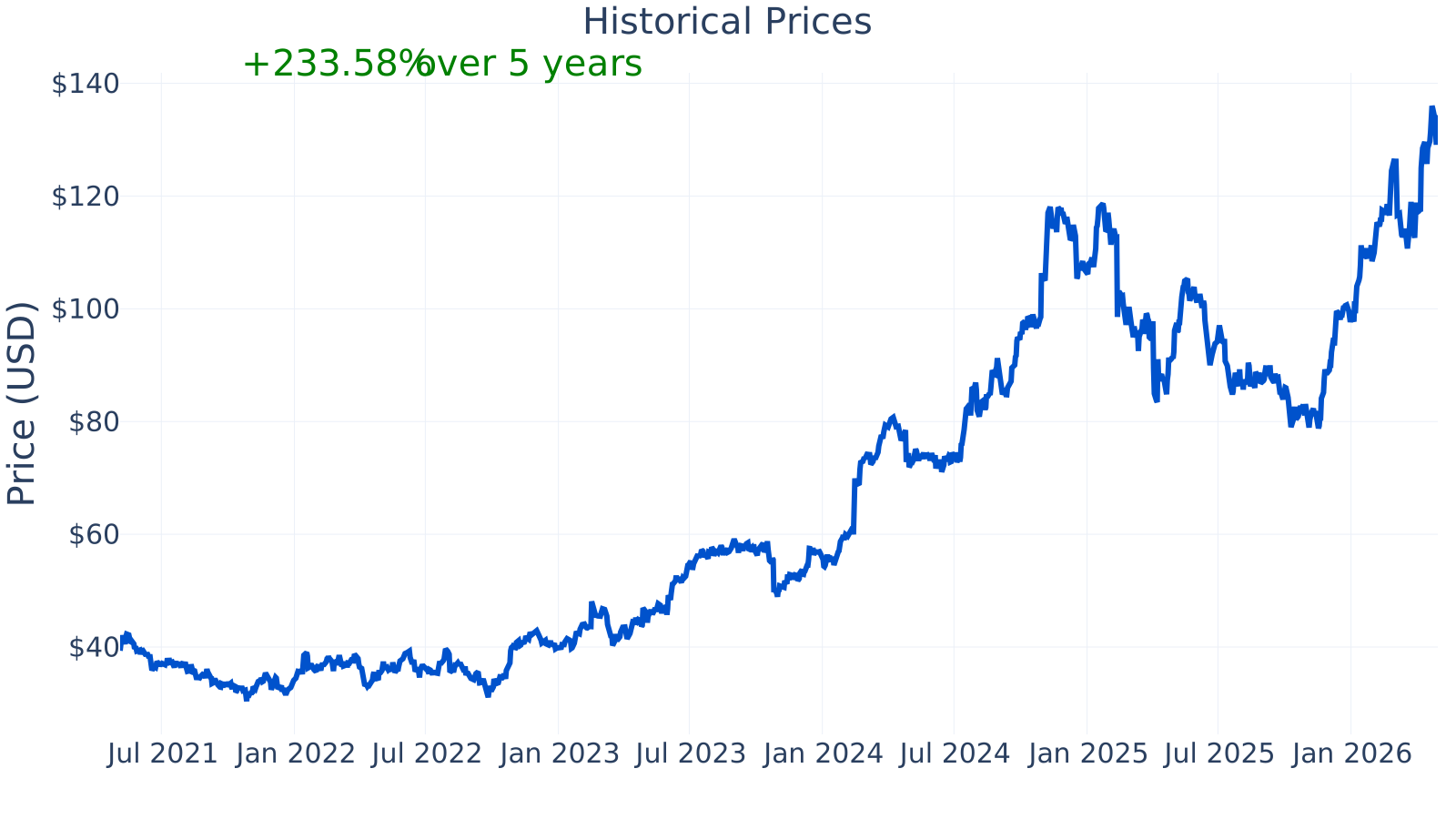
Based on the latest metrics shown, Allison’s P/E ratio is about 17.9, compared with an industry median around 24.8. Historically in the period shown, the company’s P/E often sat below the industry median, though it has moved up and down with the stock price and earnings cycle (for example, increasing notably into 2024–2026 as the share price rose). A lower-than-industry P/E can reflect different growth expectations, business mix, or risk perceptions (including cyclicality and leverage), rather than being “good” or “bad” by itself.
Valuation context also depends on durability of profitability and cash generation. Allison’s profit margin is substantially above the industry median and free cash flow has been significant in recent years, which are supportive fundamental signals. Offsetting that, the revenue growth rate shown most recently is negative and the company carries higher leverage than the industry median, both of which can lead markets to apply more conservative valuation multiples—especially late in an economic cycle.
Conclusion
Allison Transmission is a specialized manufacturer focused on medium- and heavy-duty applications where performance and reliability are important, with revenue supported by both new vehicle production and an installed base that can generate ongoing service and parts demand. Over the 2021–2025 period, the company showed strong profitability and meaningful cash generation, even as revenue fluctuated and more recent year-over-year growth turned negative.
The main long-term topics to track are (1) cycle sensitivity in commercial and industrial vehicle markets, (2) leverage levels relative to peers and how the company manages refinancing and debt reduction through the cycle, and (3) how effectively Allison adapts its product portfolio to electrification and evolving customer requirements. The current valuation signals (including a P/E below the industry median) appear consistent with a company that combines above-average margins with cyclical exposure and higher-than-typical leverage.
Sources:
- SEC EDGAR — Allison Transmission Holdings Inc. Form 10-K (Annual Report)
- SEC EDGAR — Allison Transmission Holdings Inc. Form 10-Q (Quarterly Report)
- Allison Transmission Investor Relations — SEC Filings
- Allison Transmission Investor Relations — Press Releases
- Wikipedia — “Allison Transmission” (company background and history)
This article is for informational purposes only and does not constitute financial advice. Some content is AI-generated. See Disclaimer