Stock Analysis · Allegro Microsystems Inc (ALGM)
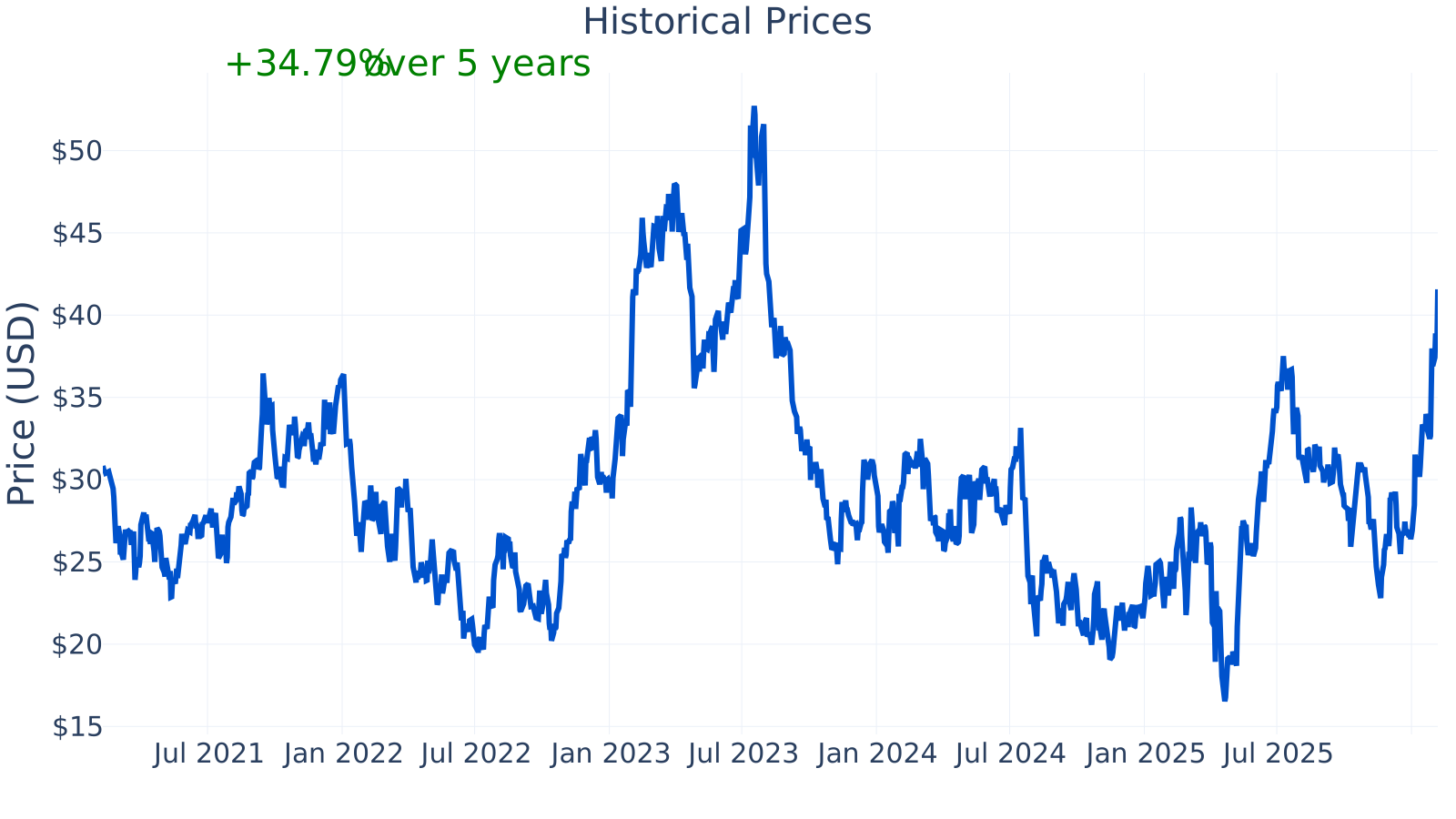
Overview
Allegro Microsystems, Inc. is a semiconductor company that designs and sells sensor and power integrated circuits. In simple terms, it makes chips that help electronic systems sense motion/position/current and control electric power efficiently. These components are commonly used in automobiles (for example, to improve efficiency and safety features) and in industrial equipment (to monitor and control motors and power systems).
Allegro’s business is typically described by end markets (where its chips are used) and by product families (types of chips). Based on how the company describes its operations in filings, the two most important end markets are usually:
- Automotive (the largest contributor in most periods)
- Industrial and other
Within those markets, revenue is primarily generated from selling semiconductor products such as magnetic sensors and power ICs (including motor-control and current-sensing solutions). Exact percentage splits can vary by fiscal year and are best read directly from the company’s latest annual report segment disclosures.
One useful way to understand the business is to look at how revenue has recently translated into gross profit and expenses. Over the last several fiscal years, revenue rose from about $591M (FY2021) to about $1.05B (FY2024), followed by a decline to about $725M (FY2025). Over the same period, research and development spending stayed substantial (roughly $109M–$180M annually in the figures shown), reflecting an ongoing focus on new products.
The recent picture shows a sharp change from strong profitability in FY2022–FY2024 to a loss in FY2025: revenue and gross profit contracted meaningfully, while operating expenses stayed large. That combination pushed operating income and net income negative in FY2025, highlighting how sensitive results can be to demand cycles in semiconductors.
Key Figures
| Metric | Value | Industry ⓘ |
|---|---|---|
| Date | Feb 07, 2026 | |
| Context | ||
| Sector | Technology | |
| Industry | Semiconductors | |
| Market Cap ⓘ | $7.70B | |
| Beta ⓘ | 1.64 | |
| Fundamental | ||
| P/E Ratio ⓘ | N/A | 45.89 |
| Profit Margin ⓘ | -1.57% | 9.42% |
| Revenue Growth ⓘ | 28.90% | 13.10% |
| Debt to Equity ⓘ | 33.47% | 25.62% |
| PEG ⓘ | N/A | |
| Free Cash Flow ⓘ | $121.16M | |
Allegro’s market capitalization is about $7.7B, placing it in the mid-cap range. The stock’s beta of 1.64 indicates it has tended to move more than the overall market (higher volatility). The latest profit margin is about -1.6% versus an industry median near 9.4%, reflecting a period of weaker profitability. At the same time, the latest year-over-year revenue growth is about 28.9% (industry median ~13.1%), suggesting a rebound from a softer period. Leverage, measured by debt-to-equity of ~33%, is somewhat above the industry median (~25.6%). Trailing twelve-month free cash flow is about $121M, which indicates the core business has recently generated cash even amid profit pressure.
Growth (Medium)
Allegro operates in semiconductors, an industry known for long-term demand growth but also pronounced cycles. The company is positioned in areas that are often associated with structural trends, especially vehicle electrification and the broader move toward more sensors and power management in cars and industrial systems. In practice, that can mean more content per vehicle (more chips used in each car) and more sophisticated control in industrial equipment.
A practical way to view the growth story is to separate long-term drivers from near-term volatility. The long-term drivers come from increased electronics intensity (especially in automotive) and continued demand for efficient power control. The near-term variability comes from inventory corrections and changes in production volumes at customers.
The revenue growth pattern reflects this cyclicality: earlier periods show strong growth, then a notable downturn in 2024, followed by a return to positive growth in 2025, ending at roughly +28.9% year-over-year in the most recent point shown. This “down-then-up” shape is consistent with a semiconductor cycle rather than a straight-line trend.
Free cash flow has also fluctuated: it increased through 2023, then dropped sharply in 2024 and into 2025 before the latest trailing figure shows about $121M. For long-term evaluation, this matters because consistent cash generation can support investment in research and development and provide flexibility during down cycles.
Potential catalysts (in a factual, non-predictive sense) typically come from (1) normalization after an industry downturn, (2) new product ramps, and (3) customer production trends in automotive and industrial markets. Whether those translate into sustained growth depends on execution, competitive positioning, and overall end-market demand.
Risks (High)
Allegro’s biggest risks are closely tied to how semiconductor businesses work. Results can swing due to changes in customer demand, production schedules, and inventory levels. The recent shift from healthy profit margins in 2022–2023 to negative margins in late 2024–2025 illustrates how quickly profitability can change when revenue declines or costs rise.
Debt-to-equity has moved up over time, from very low levels earlier in the period shown to roughly 33% most recently, above the industry median near 26%. While this is not extreme by general corporate standards, the upward trend can matter in cyclical industries because debt can reduce flexibility during weak demand periods.
Profitability has deteriorated significantly from peaks above 20% in 2023 to negative territory in late 2024 and 2025, ending around -1.6% most recently, while the industry median remained positive. This gap can reflect multiple factors (mix, pricing, utilization, operating expense levels, and cycle timing). For long-term assessment, the key question is whether margins normalize as volumes recover and whether the company can defend pricing and product differentiation.
Competitive pressure is another central risk. Allegro competes with other analog and mixed-signal semiconductor suppliers, including large diversified players and specialized sensor/power chip companies. In many chip categories, competitors can offer alternative solutions, and customers may dual-source for supply chain resilience and pricing leverage. In addition, automotive qualification cycles are long and switching costs can be meaningful, but once designed in, suppliers must maintain high quality and reliable delivery.
Competitive advantages for Allegro are generally associated with specialized know-how in sensing and power ICs, long customer relationships (especially in automotive), and the difficulty of meeting reliability requirements. However, leadership depends on the specific product category (for example, certain sensor types versus power IC niches), and the company’s position can vary by application and customer program.
Valuation
Valuation for a semiconductor company is often discussed using multiples like the price-to-earnings (P/E) ratio, but P/E can become less informative when earnings are temporarily depressed or negative. That issue appears relevant here, given the recent negative profit margin.
Historically, Allegro’s P/E ratio has moved widely, ranging from very high levels earlier in the timeline to levels closer to the industry at points in 2023–early 2024, and then becoming unavailable/meaningfully not shown later (consistent with earnings that are not suitable for a standard P/E comparison). The current industry median P/E shown in the latest table is about 45.9, which provides context for how the sector is valued, but it does not by itself determine whether a specific company’s price level is “high” or “low” when profitability is in flux.
In this context, valuation discussions typically lean more on: (1) whether revenue growth is returning, (2) whether margins can recover toward prior levels, (3) cash generation, and (4) balance-sheet flexibility. Allegro shows a recent rebound in year-over-year revenue growth and positive trailing free cash flow, while profitability remains weaker than the industry median and leverage has risen compared with earlier years.
Conclusion
Allegro Microsystems is a semiconductor designer focused on sensing and power management chips, with heavy exposure to automotive and meaningful participation in industrial applications. The company’s long-term narrative is connected to ongoing increases in electronics content and power efficiency needs, but the financial record shown also highlights the industry’s cyclicality: revenue expanded strongly into FY2024, then contracted sharply in FY2025 alongside a material drop in profitability.
The most important long-term considerations from the facts discussed are: the sensitivity of margins to revenue swings, the recent rebound in year-over-year revenue growth, the return to positive trailing free cash flow, and a debt-to-equity ratio that has increased over time. Together, these point to a business with credible structural demand drivers but elevated uncertainty around near-term earnings normalization and competitive dynamics.
Sources:
- SEC EDGAR — Allegro Microsystems, Inc. Form 10-K (Annual Report) (business description, risk factors, financial statements, segment/end-market discussion)
- SEC EDGAR — Allegro Microsystems, Inc. Form 10-Q (Quarterly Reports) (updates on operations, market conditions, financial statements)
- Allegro Microsystems Investor Relations — SEC filings and investor materials (company-hosted copies and presentations, when provided)
- Wikipedia — “Allegro MicroSystems” (basic company background; non-financial overview)
This article is for informational purposes only and does not constitute financial advice. Some content is AI-generated. See Disclaimer


