Stock Analysis · Alkami Technology Inc (ALKT)
Overview
Alkami Technology, Inc. is a software company focused on digital banking. Its platform is used by financial institutions (such as banks and credit unions) to provide online and mobile banking experiences to their customers. In simple terms, Alkami helps these institutions run the “everyday app and website” where end users check balances, move money, pay bills, and interact with their accounts.
The company’s business model is typical of enterprise software: it sells access to its platform and related services to financial institutions, generally through recurring arrangements (software subscriptions) plus implementation and support-type services. Over time, this structure often aims to increase the share of recurring revenue as customers expand usage and add capabilities.
From its filings, Alkami reports revenue in two broad categories, with the larger share generally coming from recurring platform access (subscription-style revenue) and the remainder from services tied to onboarding, configuration, and other professional work. Percentages can vary by period and contract mix.
One visible trend over the last several years is that revenue has grown materially (from about $152 million in 2021 to about $444 million in 2025), while operating expenses have also increased, keeping operating income negative. Gross profit has expanded as well, which indicates the core product is scaling, but the company has continued to invest heavily in R&D and in sales and administration.
Key Figures
| Metric | Value | Industry ⓘ |
|---|---|---|
| Date | Mar 02, 2026 | |
| Context | ||
| Sector | Technology | |
| Industry | Software - Application | |
| Market Cap ⓘ | $1.74B | |
| Beta ⓘ | 0.53 | |
| Fundamental | ||
| P/E Ratio ⓘ | N/A | 25.64 |
| Profit Margin ⓘ | -10.74% | 7.25% |
| Revenue Growth ⓘ | 34.70% | 16.65% |
| Debt to Equity ⓘ | 97.65% | 24.64% |
| PEG ⓘ | N/A | |
| Free Cash Flow ⓘ | $66.51M | |
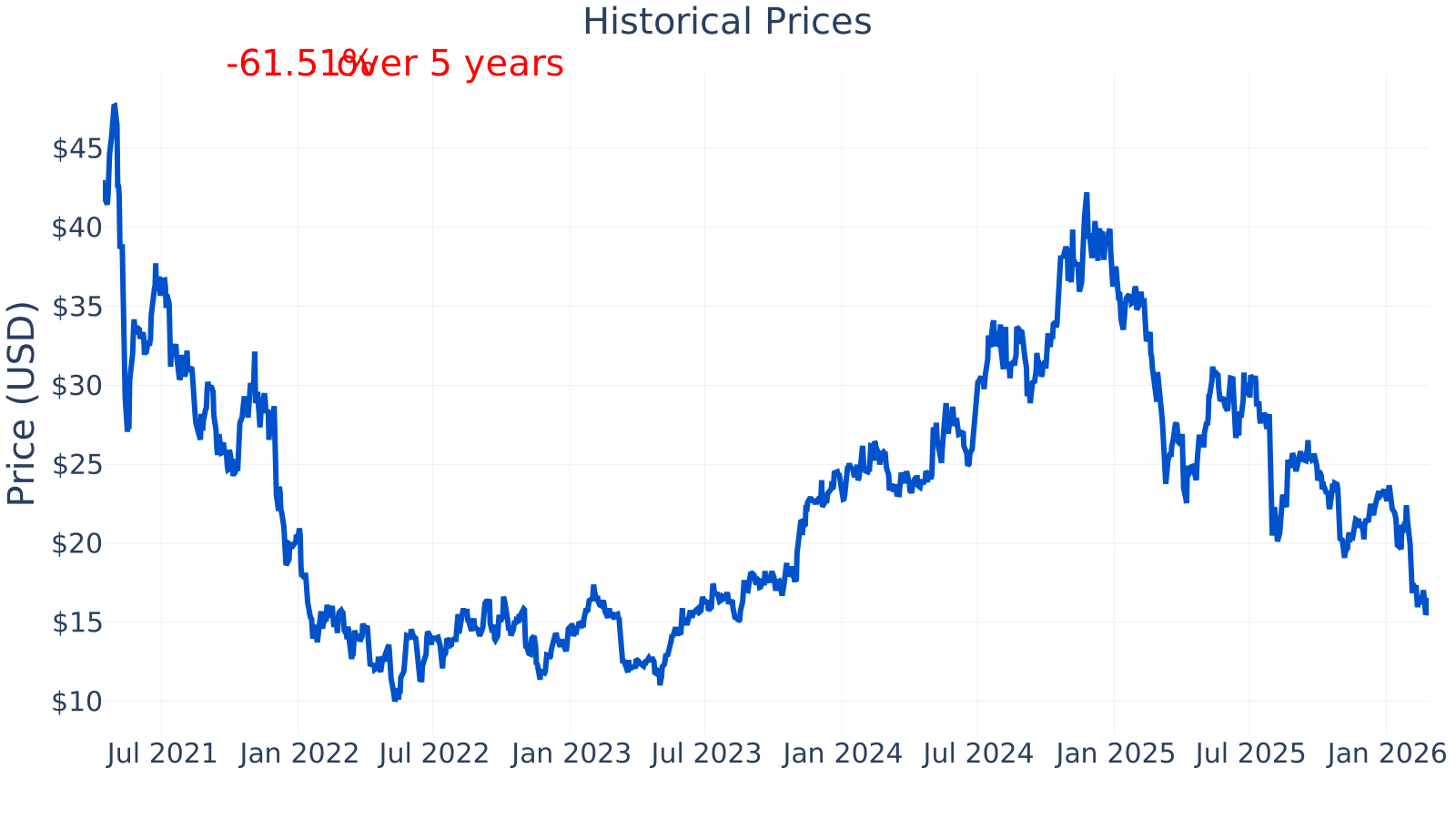
At the latest point shown, Alkami’s market capitalization is about $1.74 billion and its beta is about 0.53 (a measure that has historically implied less day-to-day volatility than the broader market, though it can change). Profitability is still negative, with profit margin around -10.74% versus an industry median near +7.25%. On the other hand, year-over-year revenue growth is shown at about 34.7%, which is higher than the industry median of about 16.65%. Debt-to-equity is shown at about 97.65% versus an industry median near 24.64%, indicating a more leveraged balance sheet than many peers. Free cash flow over the trailing twelve months is positive at about $66.5 million.
Growth (medium)
Digital banking software sits in a long-running modernization cycle: many financial institutions continue to replace older systems and improve digital experiences as more customer activity moves to mobile and online channels. In that context, a vendor that provides a full digital banking platform can benefit if institutions keep prioritizing user experience, security, and new features.
Alkami’s strategy is consistent with a “land and expand” enterprise software approach: win financial institutions as customers, implement the platform, and then grow over time through additional features, higher user adoption, and broader product usage. This can be a logical growth path in software, but it also depends on retaining customers and keeping the platform competitive.
The year-over-year growth trend shown remains strong across the period presented (generally in the mid‑20% to mid‑30% range), ending around 34.7%. Sustained growth at that level suggests continued customer additions and/or expanding usage within existing clients, although it does not by itself indicate profitability.
Free cash flow has improved significantly over time in the period shown, moving from meaningfully negative levels (for example, around -$40 million in 2023) to slightly positive in 2025, and the latest metric table indicates a positive trailing twelve months free cash flow figure. For a software company that is not yet consistently profitable on a net income basis, improving cash generation can be an important operational milestone, because it can reduce reliance on external financing.
Risks (high)
A central risk is that Alkami is still reporting negative profit margins (about -10.74% at the latest point shown). While losses have narrowed compared with earlier periods, the company remains in a phase where operating costs (especially R&D and selling/general/administrative spending) are high relative to current revenue. If growth slows or customer acquisition becomes more expensive, reaching sustained profitability could take longer.
The margin trend shown improves materially from roughly -32% in 2021 to roughly -11% more recently, indicating progress toward breakeven. However, the company remains below the industry median, which is shown as positive in recent periods, highlighting that many peers are already profitable while Alkami is still transitioning.
Competition is another major factor. Digital banking and fintech software is a crowded market with both large, established vendors and specialized platform providers. Competitors can include core banking software providers that bundle digital capabilities, digital-only platform vendors, and in-house development efforts at financial institutions. In competitive environments, pricing pressure, feature parity, and switching decisions can affect renewals and expansion.
Alkami’s competitive advantages are typically framed around being purpose-built for digital banking, offering a modern user experience, and delivering frequent product updates as a software platform. Still, leadership in this area is not absolute; market share and “best platform” status can vary by segment (credit unions vs. banks, institution size, and geography), and larger vendors may compete using broad suites and existing relationships.
Balance sheet leverage is also a consideration. The latest debt-to-equity shown is about 97.65%, well above the industry median near 24.64%, and the chart indicates a sharp increase beginning in 2025. Higher leverage can raise financial risk, particularly if operating results weaken or if refinancing becomes more costly, although the practical impact depends on the company’s cash position, debt terms, and maturity schedule (details that are typically discussed in quarterly and annual filings).
Valuation
For many companies, a common valuation reference is the price-to-earnings (P/E) ratio. In Alkami’s case, the P/E values shown are not meaningful (displayed as 0 across the timeline presented), which commonly happens when earnings are negative. That means valuation discussions often rely more on revenue growth, gross margin profile, cash flow trajectory, and the expected path toward profitability, rather than traditional earnings-based multiples.
In this context, whether the stock price is “expensive” or “cheap” cannot be inferred from a P/E comparison to the industry median because the company’s earnings are not positive. Instead, the key question becomes whether growth (about 34.7% year-over-year in the latest period shown) and improving cash generation are sufficient to offset the risks from ongoing losses, competitive pressure, and higher leverage (about 97.65% debt-to-equity in the latest point shown). The market capitalization of roughly $1.74 billion provides a sense of scale, but on its own it does not indicate valuation attractiveness without profitability-based benchmarks.
Conclusion
Alkami Technology is a digital banking software provider operating in an area that benefits from long-term demand for better online and mobile experiences at financial institutions. The company has demonstrated strong revenue growth over multiple years and improving cash flow, while also showing a multi-year improvement in profit margin (though still negative).
The main trade-offs visible from the financial profile are (1) sustained growth and improving cash generation versus (2) continued net losses, competitive intensity in financial software, and a higher debt-to-equity level than the industry median, with a notable increase in leverage during 2025. For long-term analysis, the most informative checkpoints typically include whether revenue growth remains durable, whether margins continue to improve toward profitability, and how the balance sheet evolves relative to cash flow generation.
Sources:
- SEC EDGAR — Alkami Technology, Inc. filings (Form 10-K, Form 10-Q)
- Alkami Technology, Inc. — Investor Relations materials and press releases
- Wikipedia — “Alkami Technology” (basic company background)
This article is for informational purposes only and does not constitute financial advice. Some content is AI-generated. See Disclaimer


